


COMECAUSE IN-HT500 Research-Grade Soil and Fertilizer Nutrient Analyzer
| Brand | COMECAUSE |
|---|---|
| Model | IN-HT500 |
| Origin | Shandong, China |
| Manufacturer Type | OEM Manufacturer |
| Instrument Class | Portable Field Analyzer |
| Detection Channels | 4 fixed optical channels |
| Test Parameters | N, P, K, organic matter, pH, EC, moisture, temperature, and 30+ macro/micronutrients & heavy metals in soil, fertilizer, plant tissue, and aqueous extracts |
| Measurement Range | 0.001–9999 (unitless absorbance-based quantification scale) |
| Repeatability | ≤0.03% (as CV, measured with potassium dichromate standard) |
Overview
The COMECAUSE IN-HT500 is a field-deployable, research-grade spectrophotometric analyzer engineered for quantitative assessment of agronomic and environmental parameters across soil, fertilizer, plant tissue, and water matrices. It operates on the principle of dual-beam visible-light absorption spectroscopy, utilizing four precisely calibrated narrow-band LED light sources (680 nm red, 420 nm blue, 510 nm green, 590 nm orange) to measure analyte-specific colorimetric reactions. Each channel integrates a solid-state, fixed-position cuvette chamber with full optical shielding (15.7 cm diameter light-tight cover), eliminating mechanical drift and ensuring long-term photometric stability. Designed for GLP-aligned field laboratories and extension services, the IN-HT500 delivers traceable, repeatable results without requiring lab-grade infrastructure—enabling real-time decision support for precision agriculture, soil health monitoring, and regulatory compliance screening.
Key Features
- Android 5.1 operating system with quad-core ≥1.8 GHz CPU, 16 GB internal storage, and responsive 7.0-inch TFT-LCD (1024×600 resolution) optimized for outdoor visibility under ambient light.
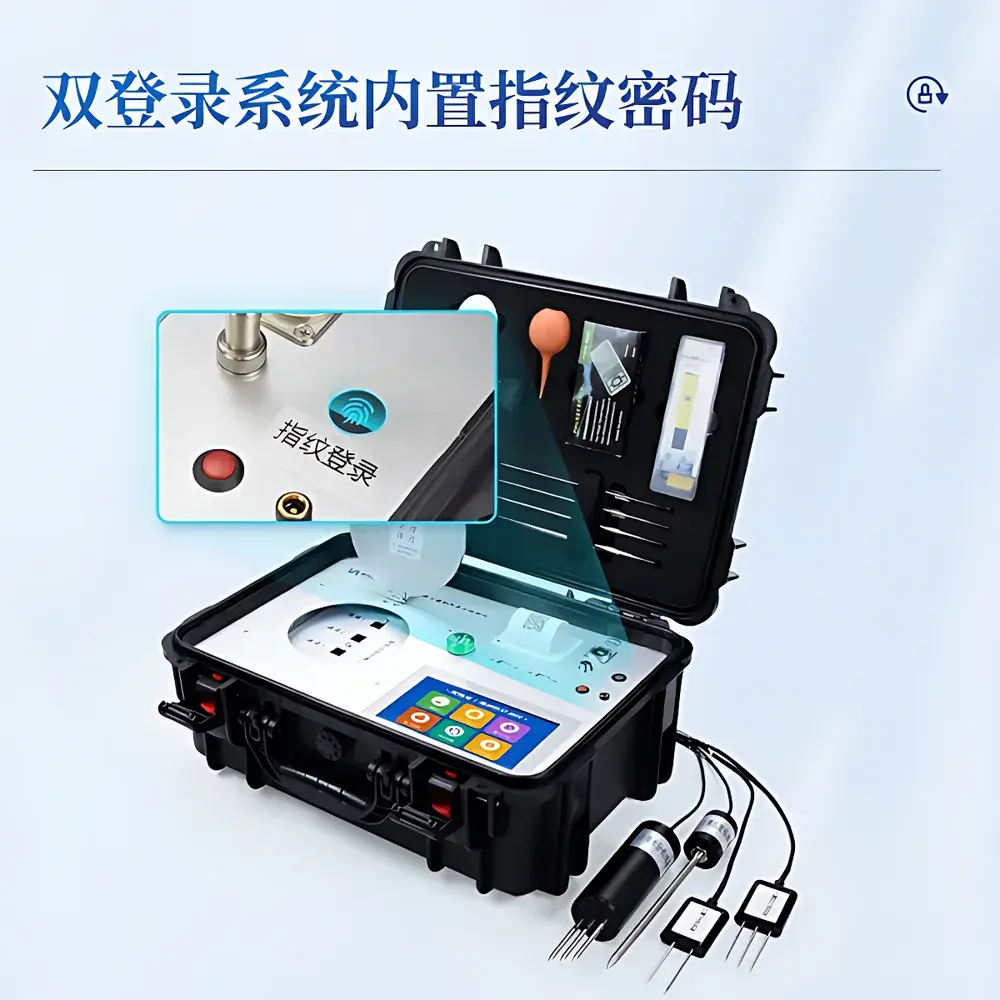
- Dual authentication: password + fingerprint login; multi-user account management with role-based data access control and audit-ready session logs.
- Integrated GPS module providing real-time georeferenced metadata (latitude/longitude/timestamp) for spatially explicit reporting and GIS integration.
- Onboard thermal printer supporting direct output of test ID, channel number, absorbance values, concentration (mg/kg or mg/L), operator ID, date/time, and QR-coded data linkage.
- Four dedicated optical channels with wavelength-stabilized LEDs (±2 nm tolerance); >100,000-hour rated lifetime; photometric repeatability ≤0.03% CV (K₂Cr₂O₇ standard).
- IP65-rated rugged housing with shock-absorbing PVC engineering plastic carry case; operational in -20°C to 50°C ambient range.
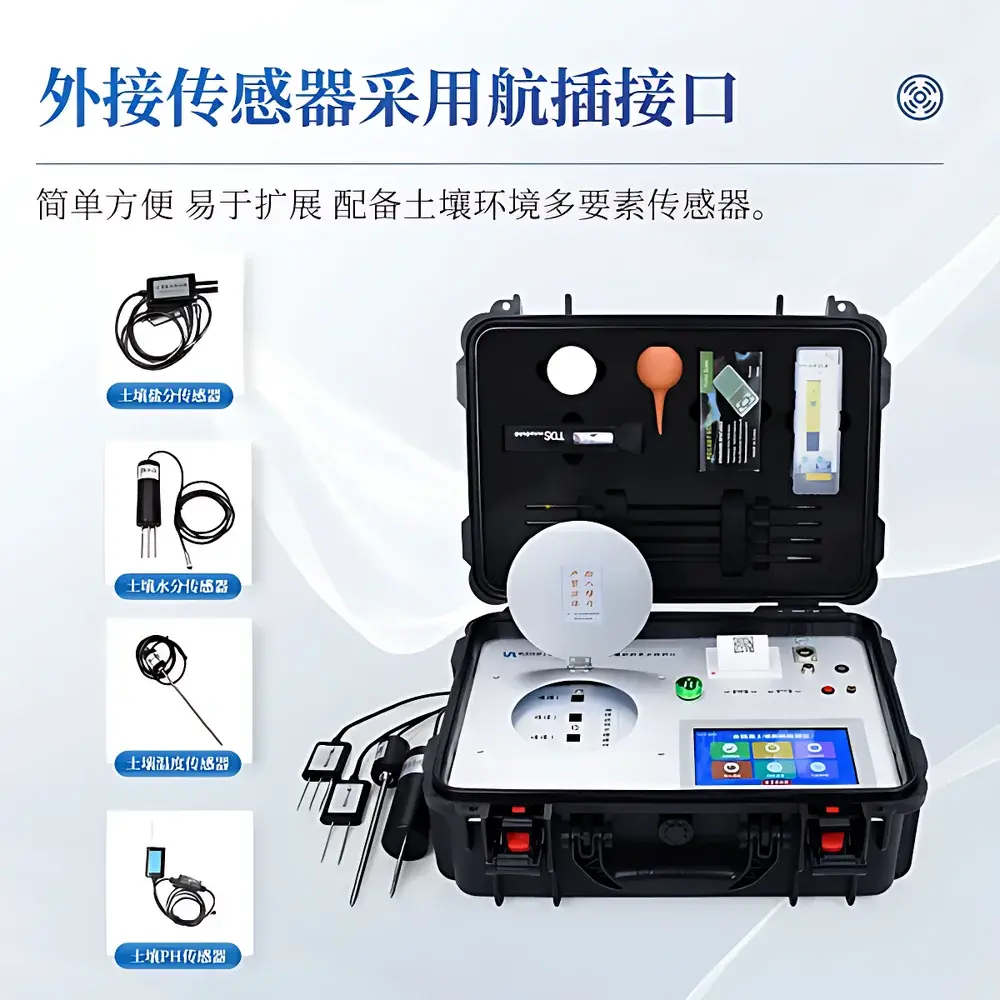
- Integrated environmental sensors: direct-insertion volumetric soil moisture probe (0–100% m³/m³, ±2% accuracy), stainless-steel temperature probe (-40–120°C, ±0.2°C), graphite-based EC sensor (0–20 mS/cm, ±1%), and solid-state soil pH electrode (0–14, ±0.2 units).
- AC/DC power flexibility: 220 V AC input or internal 4800 mAh Li-ion battery enabling >10 hours continuous operation; auto-save during unexpected power loss.
Sample Compatibility & Compliance
The IN-HT500 supports standardized extraction protocols for over 80 analytes across three primary sample categories: (1) soil (e.g., ammonium-N, Olsen-P, exchangeable-K, organic matter via Tyurin or extraction methods, Ca, Mg, S, B, Fe, Cu, Mn, Zn, Cl, Mo, Pb, As, Cr, Cd, Hg, Ni, Al, F, Se, pH, EC, moisture); (2) fertilizers (single-nutrient and compound formulations including urea-N, biuret, water-soluble P, K, humic substances from leonardite/brown coal/peat, foliar and water-soluble fertilizers); and (3) plant tissues (total N/P/K, nitrate/ammonium, micronutrients). All onboard workflows align with internationally referenced procedures—including ISO 11260 (soil N), ISO 13878 (total C/N), AOAC 971.22 (fertilizer P), and EPA Method 9060A (soil organic matter)—and support traceability per FDA 21 CFR Part 11 requirements when deployed with cloud audit logs and electronic signatures.
Software & Data Management
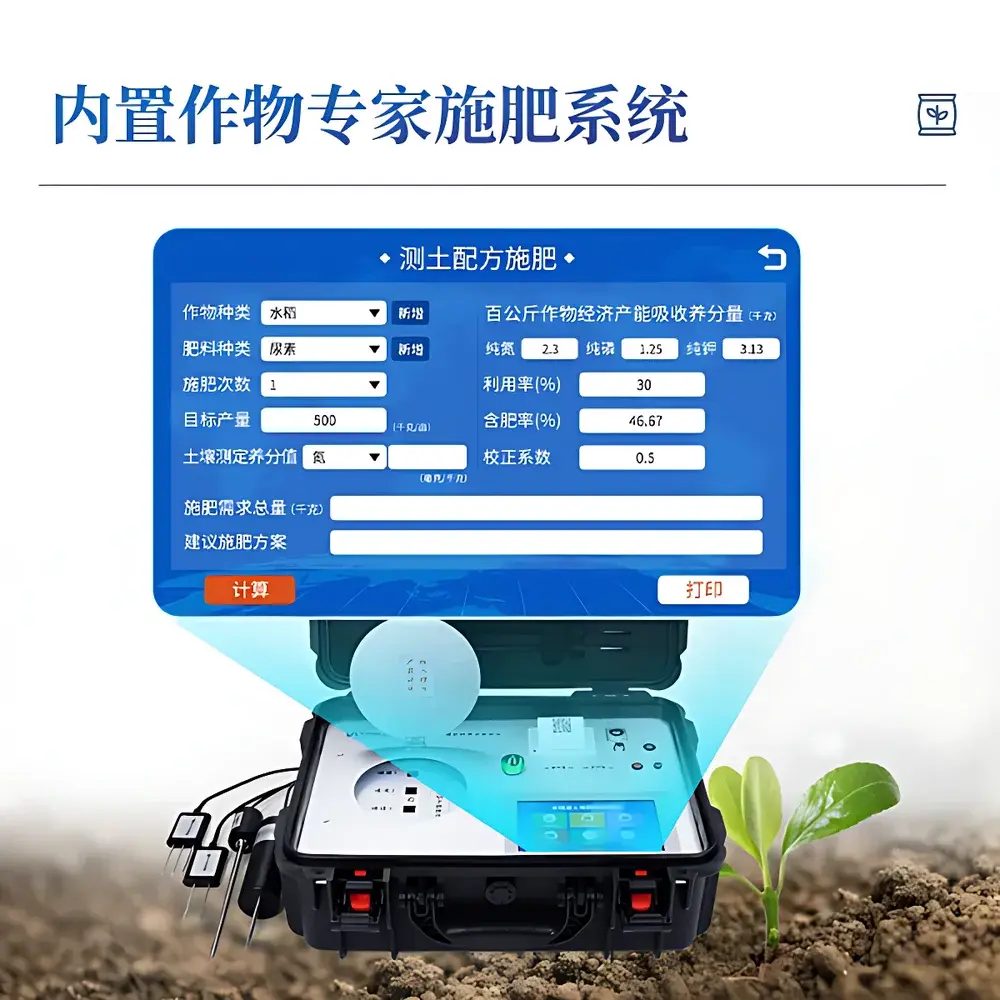
Data acquisition, processing, and reporting are managed through an embedded Android application with native cloud synchronization. Upon Wi-Fi or Ethernet connection, results are transmitted to a secure, tenant-isolated agricultural cloud platform featuring role-based dashboards, time-series analytics, and automated report generation. The system supports CSV/XLSX export, API access for LIMS integration, and offline-first operation with automatic sync upon reconnection. Built-in calibration validation tools eliminate manual zeroing; all optical and sensor calibrations are performed internally using factory-traceable reference standards. Firmware updates and method library revisions are delivered over-the-air. The platform also hosts a web-accessible soil fertility database containing >120 crop-specific nutrient sufficiency ranges, yield-targeted fertilizer recommendation algorithms, and regional correction coefficients compliant with national soil testing guidelines.
Applications
The IN-HT500 serves as a validated tool for soil health assessment programs (e.g., USDA NRCS Soil Health Institute protocols), fertilizer quality assurance in manufacturing and distribution, on-farm nutrient budgeting, environmental site assessments (e.g., heavy metal screening per ASTM D3987), and academic field research in agronomy, pedology, and environmental science. Its portability and rapid turnaround (<20 min for soil NPK, <50 min for full fertilizer panel) make it suitable for mobile soil testing labs, extension agent deployments, and regulatory inspection teams conducting unannounced field audits. The instrument’s adherence to documented SOPs and built-in digital chain-of-custody functionality facilitates use in ISO/IEC 17025-accredited testing environments where method validation and uncertainty estimation are required.
FAQ
What sample preparation is required prior to analysis?
Standardized extraction protocols—including filtration, centrifugation, and reagent addition—are fully guided by step-by-step on-screen instructions with integrated video tutorials. No external lab manuals are needed.
Does the instrument require daily calibration?
No. Internal optical and sensor self-checks occur at startup and between samples; full calibration is performed only during annual service using certified reference materials.
Can raw spectral data be exported for third-party analysis?
Yes. Absorbance values per channel, wavelength, and timestamp are exportable in plain-text format compatible with MATLAB, R, or Python-based chemometric modeling.
Is remote firmware update supported?
Yes. Over-the-air (OTA) updates are delivered automatically or manually via Wi-Fi; version history and changelogs are maintained in the system log.
How is data security ensured during cloud transmission?
All communications use TLS 1.2+ encryption; user accounts enforce MFA; cloud storage complies with GDPR and CCPA data residency policies; audit trails record every data modification event.







