
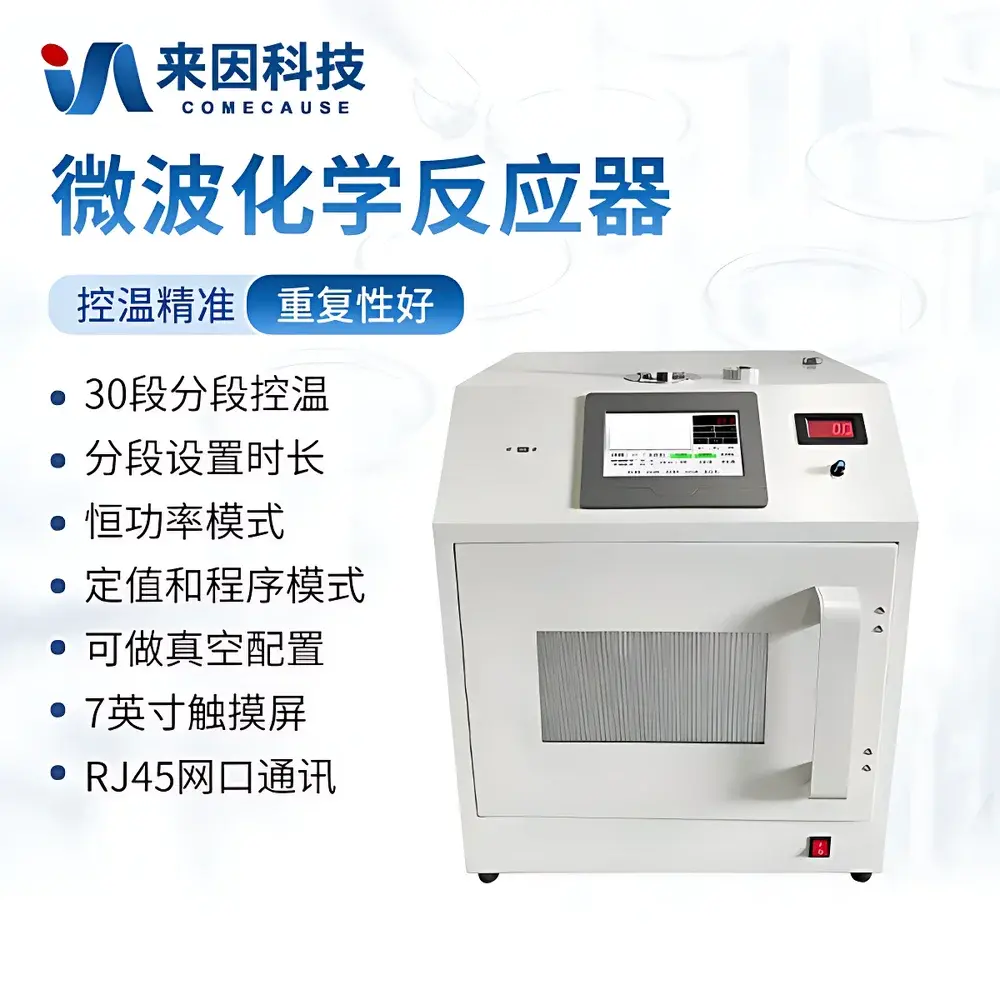
COMECAUSE IN-WH8 Automated Microwave Synthesis Reactor
| Brand | COMECAUSE |
|---|---|
| Origin | Shandong, China |
| Manufacturer Type | Direct Manufacturer |
| Instrument Category | Microwave Synthesizer |
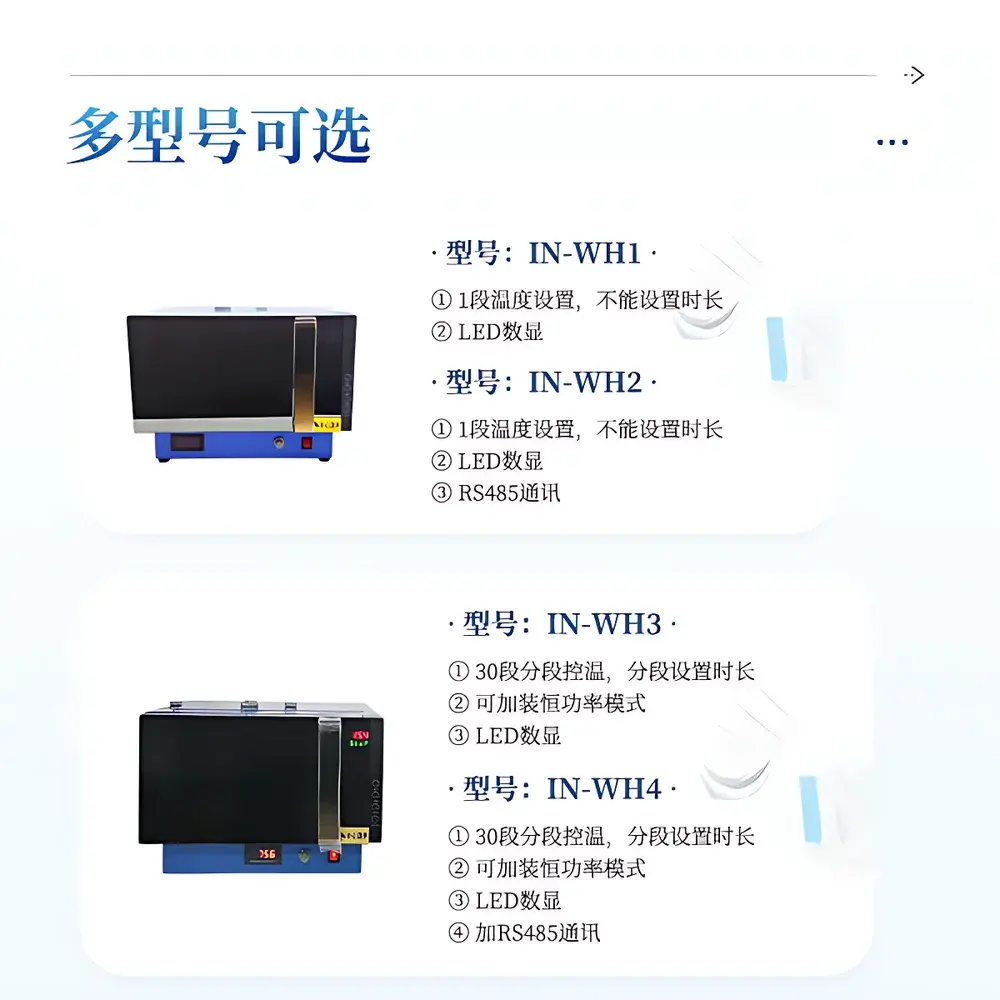
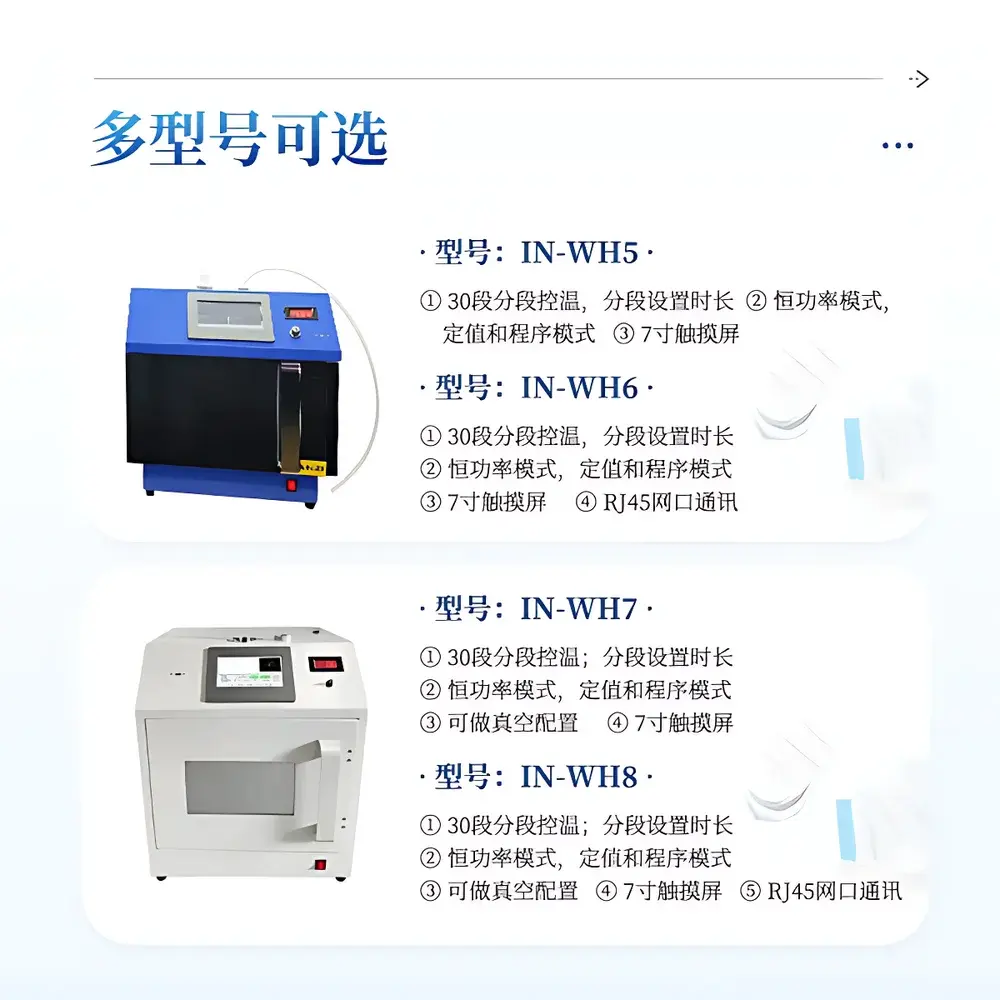
| Model | IN-WH8 |
| Temperature Range | Ambient to 250 °C (high-temperature customization available) |
| Pressure Range | Not specified in source data |
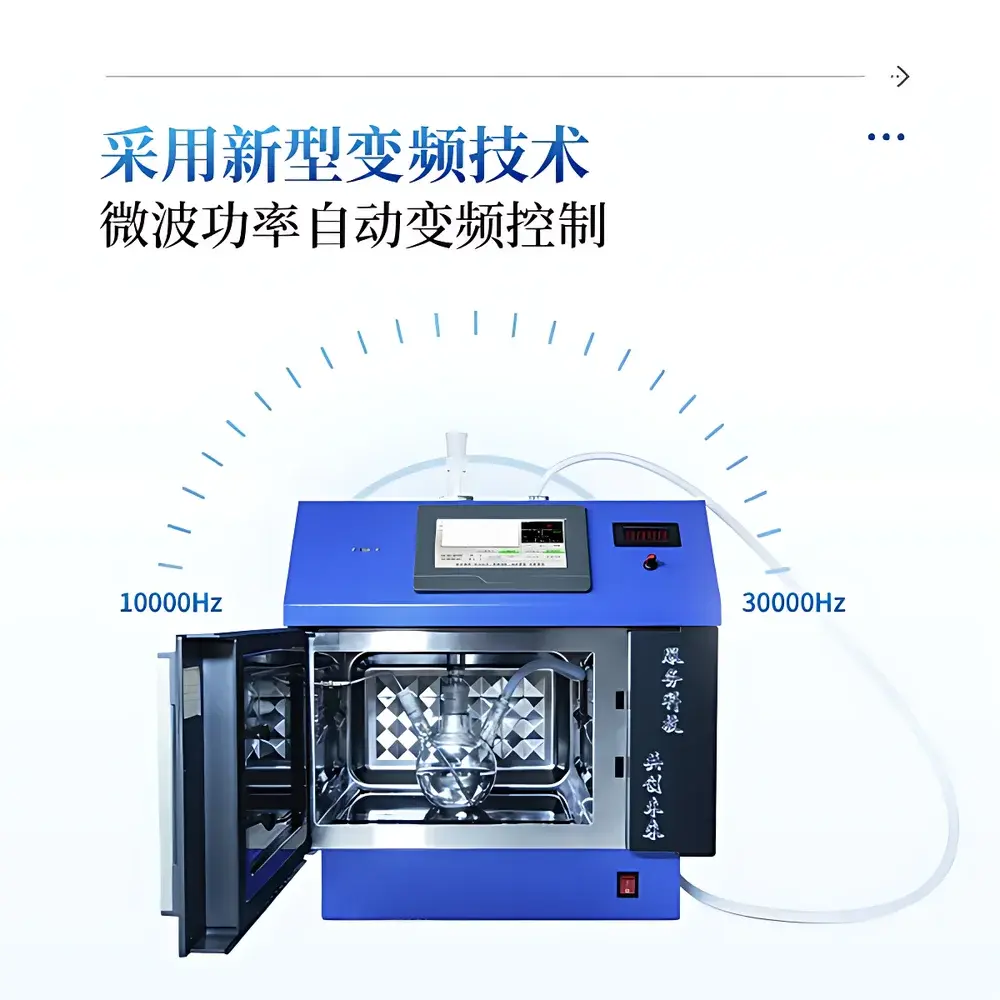
| Microwave Output Power | ≤2000 W (0–1800 W continuous automatic frequency-variable control) |
| Magnetron Frequency | 2450 MHz ±50 Hz |
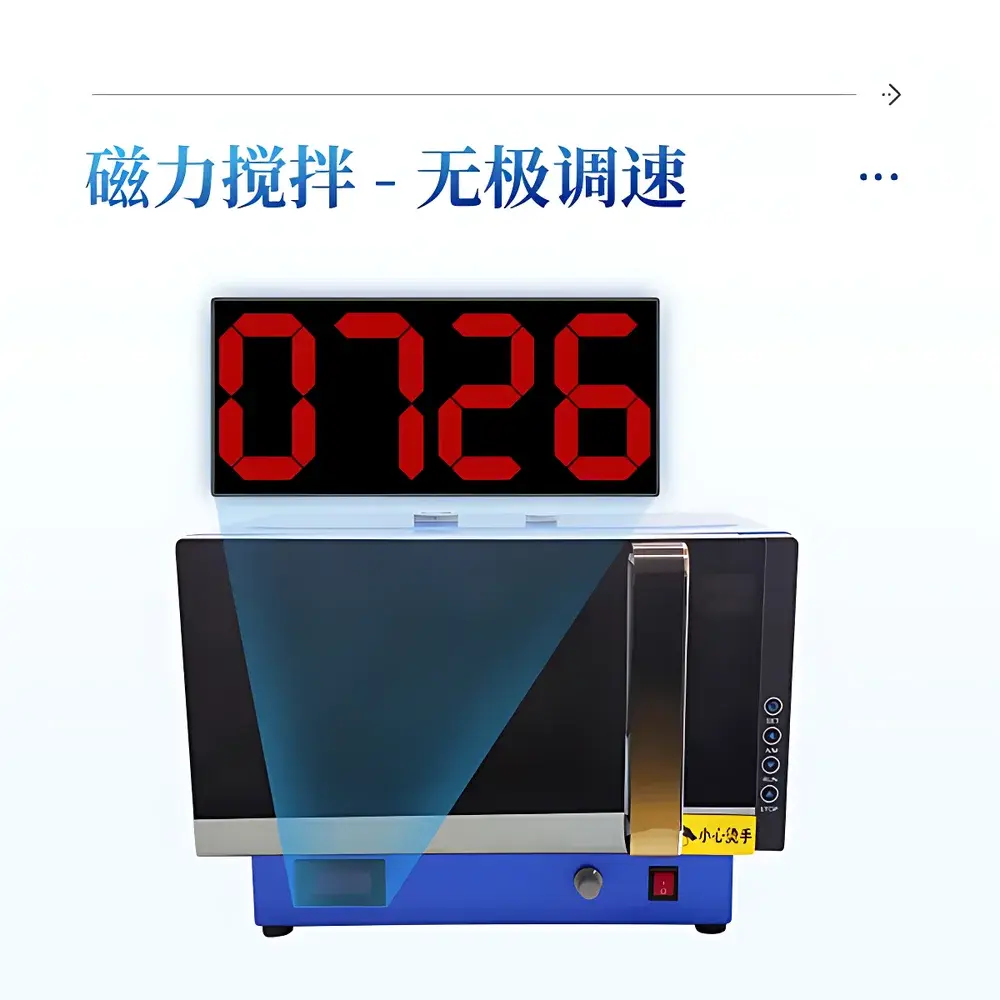
| Stirring Method | Magnetic stirring |
| Reaction Vessel Capacity | 50–500 mL |
| Power Supply | AC 220 V ±10%, 50 Hz |
| Temperature Resolution | 0.1 °C |
| Temperature Control Accuracy | ±1 °C |
| Programmable Segments | 30 |
| Stirring Speed Range | 0–2000 rpm (digital display) |
| Maximum Runtime per Segment | 3200 min |
| Cavity Dimensions | 325 × 325 × 202 mm (L×W×H) |
| External Dimensions | 500 × 420 × 555 mm (L×W×H) |
| Display | 7-inch capacitive touchscreen LCD |
| Safety Features | Empty-cavity detection, low-dielectric material auto-shutdown, real-time fault alarm |
| Data Interface | USB port for mouse/U-disk connection, temperature curve logging, and parameter export |
Overview
The COMECAUSE IN-WH8 Automated Microwave Synthesis Reactor is an engineered platform for controlled, rapid, and reproducible microwave-assisted chemical synthesis under atmospheric pressure. It operates on the principle of dielectric heating: microwave energy at 2450 MHz induces molecular rotation and friction within polar solvents and reagents, enabling volumetric, non-contact heating with significantly reduced thermal inertia compared to conventional conductive or convective methods. This results in accelerated reaction kinetics—often 5–100× faster than oil-bath or heating mantle systems—while improving selectivity, yield, and reproducibility. The reactor supports open-vessel chemistry including condensation, esterification, Suzuki coupling, oxidation, hydrolysis, and extraction protocols. Its architecture integrates a solid-state frequency-variable magnetron, precision PID temperature feedback loop, and sealed stainless-steel cavity rated for continuous operation up to 250 °C. Designed for compliance with laboratory safety standards, it incorporates hardware-level interlocks, real-time dielectric monitoring, and fail-safe shutdown protocols for unattended operation.
Key Features
- Frequency-variable microwave control: Automatic 0–1800 W power modulation across the 2450 MHz band (±50 Hz tolerance), enabling dynamic impedance matching for consistent energy coupling across diverse solvent/reagent systems.
- 30-segment programmable temperature profile: Supports ramp-hold-cool sequences with 0.1 °C resolution and ±1 °C accuracy; dual operating modes—constant temperature and constant power—allow method optimization for exothermic or endothermic transformations.
- Integrated magnetic stirring: Variable-speed (0–2000 rpm) digital stirrer ensures homogeneous mixing and heat distribution without mechanical feedthroughs or seal degradation.
- Full stainless-steel reaction cavity: Corrosion-resistant 304-grade construction with optimized waveguide geometry minimizes standing-wave hotspots and enables uniform field distribution (validated via IR thermography mapping).
- Real-time process monitoring: On-screen temperature/time curves, actual microwave frequency readout, and live power output display; optional external camera integration for visual reaction tracking via HDMI output.
- Data integrity & traceability: USB interface supports direct export of time-stamped temperature logs, power profiles, and program settings to U-disk; no proprietary software required for raw data retrieval.
Sample Compatibility & Compliance
The IN-WH8 accommodates standard ground-glass jointed vessels (NS29/32, NS45/50) ranging from 50 mL to 500 mL, permitting modular integration of reflux condensers, addition funnels, Dean-Stark traps, and gas inlet/outlet adapters. All vessel interfaces maintain atmospheric pressure during operation, eliminating high-pressure certification requirements while retaining compatibility with volatile or air-sensitive reagents via inert gas purging. The system meets IEC 61000-6-3 (EMC emission limits) and IEC 61000-6-2 (immunity to industrial electrical noise). While not certified to UL/CSA or CE for medical or explosive environments, its safety architecture—including cavity leakage detection (<5 mW/cm² at 5 cm), door interlock verification, and dielectric load sensing—aligns with ISO/IEC 17025 laboratory risk assessment guidelines for non-pressurized microwave equipment.
Software & Data Management
No proprietary software installation is required. All operational parameters—including 30-step temperature programs, stirring speed setpoints, and power limits—are configured directly via the 7-inch capacitive touchscreen interface. Temperature and power data are logged internally at user-selectable intervals (default: 1 Hz) and exported as CSV files via USB. Timestamped logs include system ID, operator input, and event flags (e.g., “power reduction due to temp overshoot”, “stirring motor stall detected”). For GLP/GMP-aligned workflows, users may implement external audit trails using third-party LIMS-compatible timestamping tools; the device provides no built-in 21 CFR Part 11 electronic signature functionality but supports manual record linkage via exported file metadata (creation/modification timestamps, SHA-256 checksums).
Applications
- Organic synthesis: Accelerated cross-coupling (Heck, Suzuki, Stille), heterocycle formation, Friedel-Crafts acylation, and peptide coupling under ambient pressure.
- Nanomaterial preparation: Controlled nucleation and growth of metal oxides (TiO₂, ZnO), quantum dots, and MOFs with narrow size distribution.
- Natural product extraction: Microwave-assisted solvent extraction (MASE) of polyphenols, alkaloids, and terpenes from botanical matrices with >90% recovery vs. Soxhlet.
- Materials science: Polymer grafting, sol-gel processing, and ceramic precursor decomposition with minimized thermal gradients.
- Method development & screening: Rapid optimization of solvent, catalyst loading, and stoichiometry across 6–12 parallel reactions using interchangeable vessel kits.
FAQ
What safety certifications does the IN-WH8 hold?
The unit complies with IEC 61000-6-2 and IEC 61000-6-3 for electromagnetic compatibility. It is not CE-marked or UL-listed, and is intended for research use only—not for clinical, pharmaceutical production, or hazardous area deployment.
Can the reactor be integrated into a fume hood?
Yes. Its atmospheric-pressure design, rear-mounted ventilation grille, and absence of internal vacuum or gas compression components allow safe installation in standard laboratory fume hoods with ≥150 cfm face velocity.
Is remote operation supported?
No native Wi-Fi or Ethernet interface is provided. Remote monitoring requires external USB-to-Ethernet video capture and manual file polling via networked storage; no API or SDK is supplied.
What maintenance is required for long-term reliability?
Monthly cavity cleaning with isopropanol-dampened lint-free cloth; annual inspection of magnetron cooling fan airflow and stirrer motor brush wear; biannual calibration verification using NIST-traceable PT100 probe (user-performed, no service contract required).
Does the system support custom vessel geometries?
Yes—any borosilicate glass or quartz vessel with standard taper joints (NS29/32, NS45/50) and maximum outer diameter ≤80 mm may be mounted using the adjustable clamping ring and PTFE-insulated support base.



