
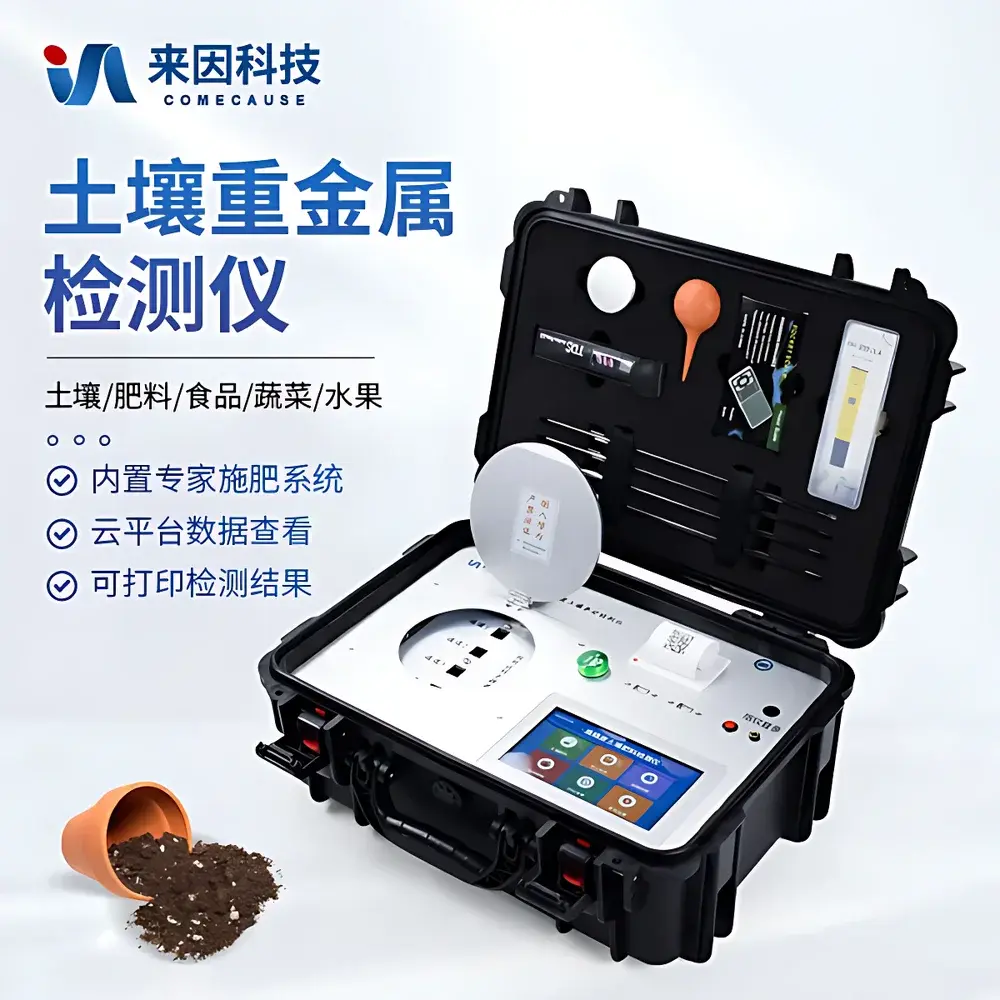
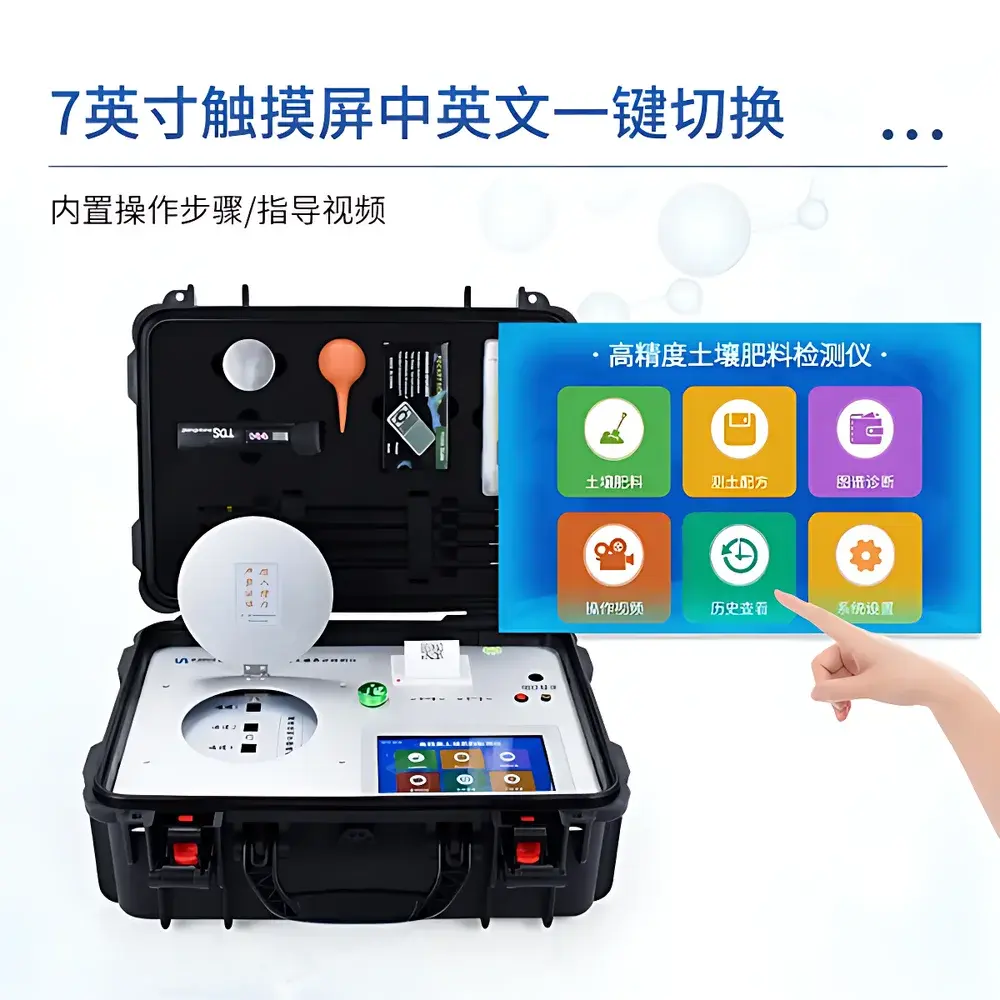
COMECAUSE IN-ZS300 Multi-Sample Soil Heavy Metal Analyzer
| Brand | COMECAUSE |
|---|---|
| Model | IN-ZS300 |
| Origin | Shandong, China |
| Manufacturer Type | OEM Manufacturer |
| Category | Domestic (PRC) |
| Power Supply | AC 220 ± 22 V / DC 12 V + 5 V (built-in 4800 mAh Li-ion battery) |
| Power Consumption | ≤ 5 W |
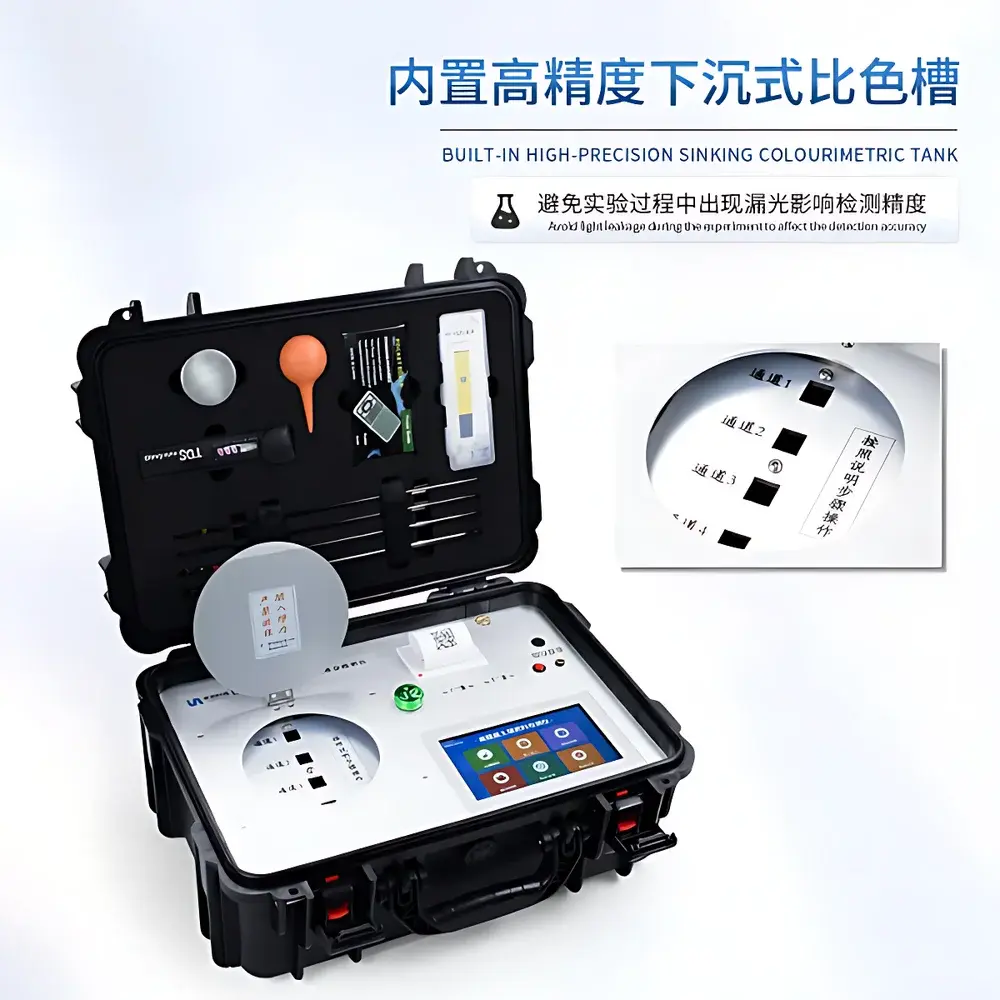
| Optical Channels | 4 fixed solid-state cuvette modules |
| Wavelengths | Red 680 ± 2 nm, Blue 420 ± 2 nm, Green 510 ± 2 nm, Orange 590 ± 4 nm |
| Display | 7.0″ color LCD, 1024 × 600 resolution |
| Operating System | Android 5.1, quad-core CPU ≥ 1.8 GHz, 16 GB internal storage |
| GPS Module | Integrated real-time geotagging |
| Data Connectivity | Wi-Fi, dual USB ports, thermal printer (no ribbon required) |
| IP Rating | IP65 |
| Battery Life | Up to 10 hours continuous operation |
| Repeatability Error | ≤ 0.03% (K₂Cr₂O₇ solution) |
| Stability | Drift < 0.3% in 1 h (transmittance), < 0.001 absorbance units in 2 h |
| Linearity Error | ≤ 0.1% (CuSO₄ solution) |
| Sensitivity | Red ≥ 4.5 × 10⁻⁵, Blue ≥ 3.17 × 10⁻³, Green ≥ 2.35 × 10⁻³, Orange ≥ 2.13 × 10⁻³ |
| Sample Throughput | Pb, As, Cr, Cd, Hg: ~60 min total (incl. extraction & reagent prep) |
| Fe, Zn, Cu | ~30 min |
| Mn | ~40 min |
| Detection Targets | Pb, As, Cr, Cd, Hg, Ni, Al, F, Ti, Se, Fe, Zn, Mn, Cu in soil, fertilizer, food, vegetables, and fruit |
| Compliance | Meets functional requirements for field-deployable spectrophotometric heavy metal screening per ASTM D7574-22 (Standard Guide for Field Screening of Metals in Soils Using Portable XRF and Colorimetric Methods), supports GLP-aligned data traceability (time-stamped, GPS-tagged, user-authenticated records) |
Overview
The COMECAUSE IN-ZS300 Multi-Sample Soil Heavy Metal Analyzer is a field-deployable, microprocessor-controlled colorimetric analyzer engineered for rapid, on-site quantification of priority heavy metals—including lead (Pb), arsenic (As), cadmium (Cd), chromium (Cr), mercury (Hg), zinc (Zn), copper (Cu), iron (Fe), and manganese (Mn)—in soil, agricultural substrates, and related environmental matrices. Unlike X-ray fluorescence (XRF) or ICP-based systems, the IN-ZS300 employs validated wet-chemical colorimetric reaction protocols coupled with high-stability LED optical sources and precision four-channel photometric detection. Its measurement principle relies on controlled acid digestion or chelation-based derivatization, followed by spectrophotometric analysis at pre-calibrated wavelengths optimized for each target analyte’s absorption maxima. Designed explicitly for regulatory screening and trend monitoring—not definitive regulatory compliance certification—the instrument delivers reproducible semi-quantitative results aligned with EPA Method 3050B extraction principles and ASTM D7574-22 field-screening guidelines. The system operates without external gas supply, high-voltage components, or consumable optics, making it suitable for extended deployment in remote agricultural zones, brownfield sites, and ecological restoration projects where laboratory access is limited.
Key Features
- Four independent, fixed-position optical channels with thermally stabilized LEDs (680 nm red, 420 nm blue, 510 nm green, 590 nm orange) ensuring long-term wavelength fidelity (>100,000 hr lifetime) and minimal inter-channel crosstalk.
- Integrated sample processing guidance: step-by-step on-device video tutorials and interactive procedural prompts eliminate reliance on paper manuals—critical for field technicians with variable training backgrounds.
- Secure multi-user environment with dual authentication (PIN + fingerprint), role-based account management, and time-stamped audit trails compliant with basic GLP documentation expectations.
- Real-time georeferencing via embedded GPS module; all measurement records automatically tagged with latitude, longitude, date, and local timestamp—enabling spatial mapping of contamination gradients.
- Onboard thermal printer outputs full metadata: analyte name, concentration (mg/kg), operator ID, GPS coordinates, channel-specific absorbance values, QR-coded result linkage, and calibration status flags.
- Robust mechanical architecture: IP65-rated enclosure, shock-absorbing PVC polymer housing, and recessed, light-tight cuvette chamber (15.7 cm diameter遮光 cover) to suppress ambient interference during photometric reading.
- Energy-resilient operation: dual-power mode (AC adapter or internal 4800 mAh Li-ion battery), voltage-monitoring display, and auto-save functionality during unexpected power loss preserves raw data integrity.
Sample Compatibility & Compliance
The IN-ZS300 accepts homogenized, air-dried soil samples (≤2 mm particle size) prepared using standardized acid-leaching or chelating extraction methods compatible with ISO 11466:2023 (soil extractable metals) and China’s HJ 491-2019 standard for soil heavy metal determination. It also supports analysis of fertilizers, compost amendments, vegetable tissue digests, and fruit homogenates when adapted to matrix-specific digestion protocols. While not intended as a primary reference method per ISO/IEC 17025, the instrument satisfies functional validation criteria for field screening under ASTM D7574-22 and supports data traceability requirements for preliminary site assessments governed by national soil environmental quality standards (e.g., GB 15618-2018). All measurement logs include immutable digital signatures, user credentials, and device serial number—facilitating internal QA/QC review and third-party verification workflows.
Software & Data Management
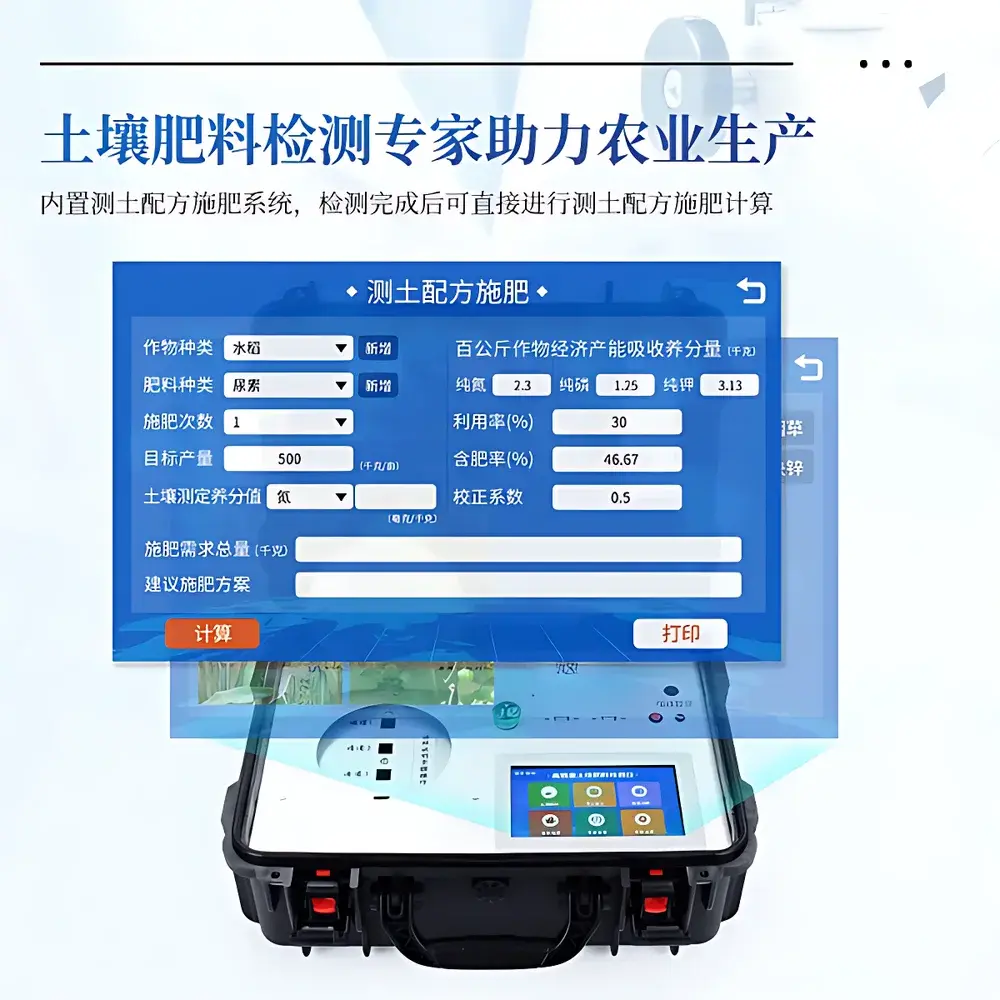
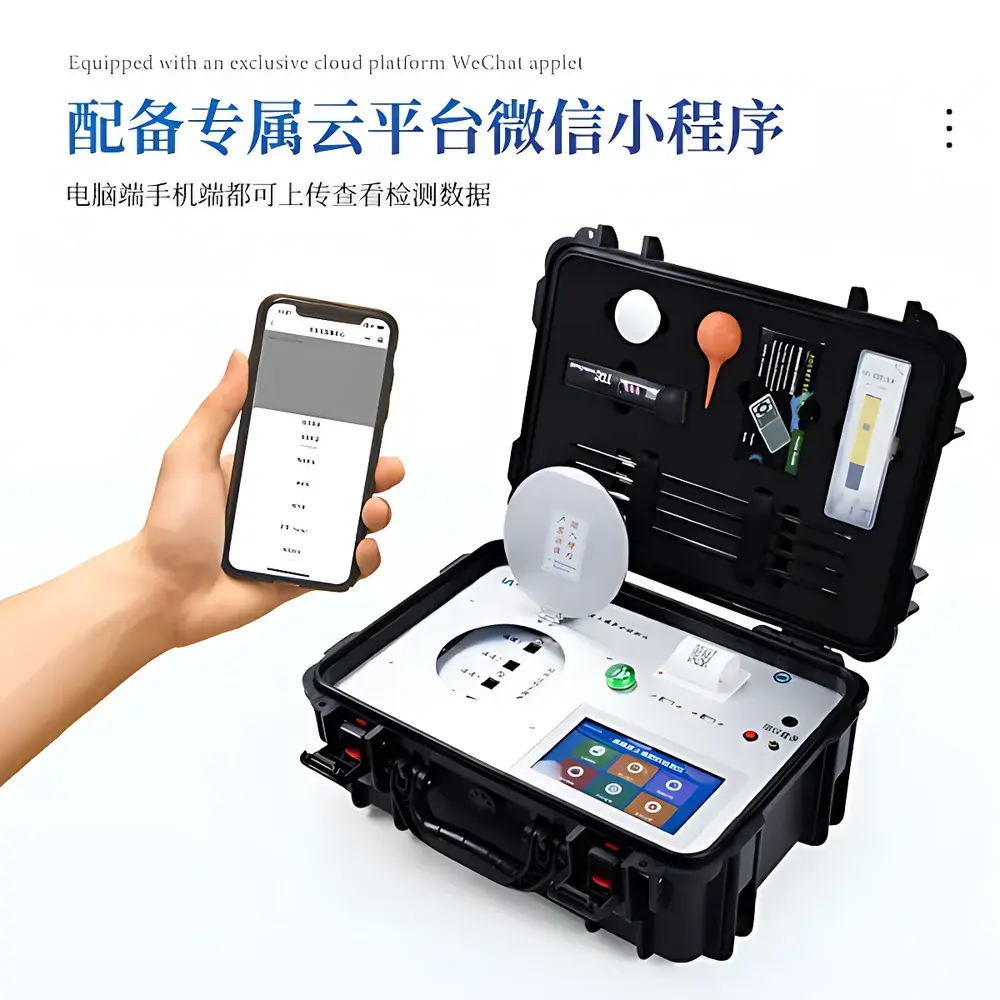
Running Android 5.1 on a dedicated quad-core platform, the IN-ZS300 executes proprietary firmware certified under PRC Software Copyright Registration No. 2023SRXXXXXX. Data are stored locally in encrypted SQLite format and synchronized via Wi-Fi to a cloud-hosted Agricultural Environmental Data Center. Each client receives a logically isolated tenant account supporting RBAC (role-based access control), CSV/XLSX export, and cross-operator comparative analytics. The companion WeChat Mini Program enables remote access to historical datasets, trend charts, and geo-referenced heatmaps without requiring desktop software. Raw absorbance values, calibration curves, and procedural timestamps are retained for ≥18 months—meeting minimum retention periods for environmental field surveys under GB/T 32725-2016. Optional integration with legacy LIMS platforms is supported via RESTful API endpoints.
Applications
- Agricultural land assessment: Routine monitoring of orchard, paddy, and greenhouse soils to verify compliance with GB 15618-2018 risk screening values prior to organic certification or crop rotation planning.
- Brownfield reconnaissance: Rapid triage of former industrial parcels (e.g., smelters, electroplating facilities) to delineate hotspots for subsequent confirmatory ICP-MS analysis.
- Ecological remediation tracking: Time-series quantification of metal immobilization efficacy following phosphate or biochar amendment application.
- Food safety pre-screening: In-field verification of root-zone metal levels in high-risk crops (e.g., leafy greens, tubers) to inform harvest decisions and supply chain traceability.
- Educational & extension use: Hands-on training for agronomy students and cooperative extension agents on standardized soil testing protocols and data interpretation fundamentals.
FAQ
Does the IN-ZS300 require daily calibration?
No. The instrument performs automatic internal calibration before each test sequence using factory-characterized reference standards. Manual recalibration is only recommended after firmware updates or physical impact events.
Can it quantify total vs. bioavailable metal fractions?
It measures extractable (operationally defined) concentrations based on user-selected digestion protocols (e.g., HNO₃/HF for pseudo-total, EDTA for bioavailable fraction). Results must be interpreted relative to the chosen extraction method.
Is the device suitable for regulatory reporting?
It serves as a Tier 1 screening tool per ASTM D7574-22. Confirmatory analysis using accredited lab methods (e.g., ICP-OES per ISO 11885) is required for legally defensible reporting.
What maintenance is required beyond routine cleaning?
Annual verification of LED intensity stability and cuvette optical path integrity is advised. No optical alignment or lamp replacement is needed within the first five years of service.
How does it handle high-organic-matter soils?
Samples must undergo standardized ashing or stronger acid digestion (per HJ 491-2019 Annex B) to minimize turbidity and color interference. Built-in correction algorithms mitigate residual matrix effects for common humic-rich profiles.







