

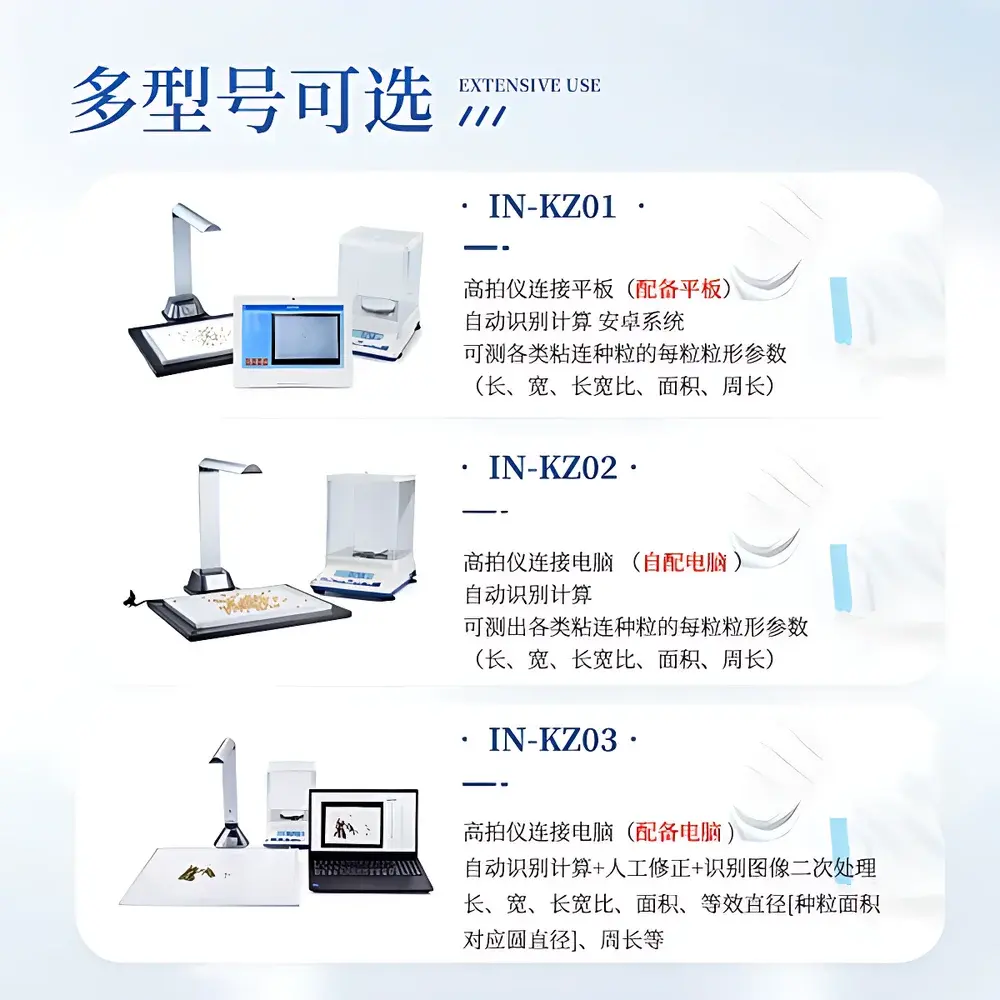


COMECAUSE IN~KZ02 Intelligent Seed Counting and Morphometric Analysis System
| Brand | COMECAUSE |
|---|---|
| Origin | Shandong, China |
| Manufacturer Type | Direct Manufacturer |
| Country of Origin | China |
| Model | IN~KZ02 |
| Price | USD 2,200 (approx.) |
Overview
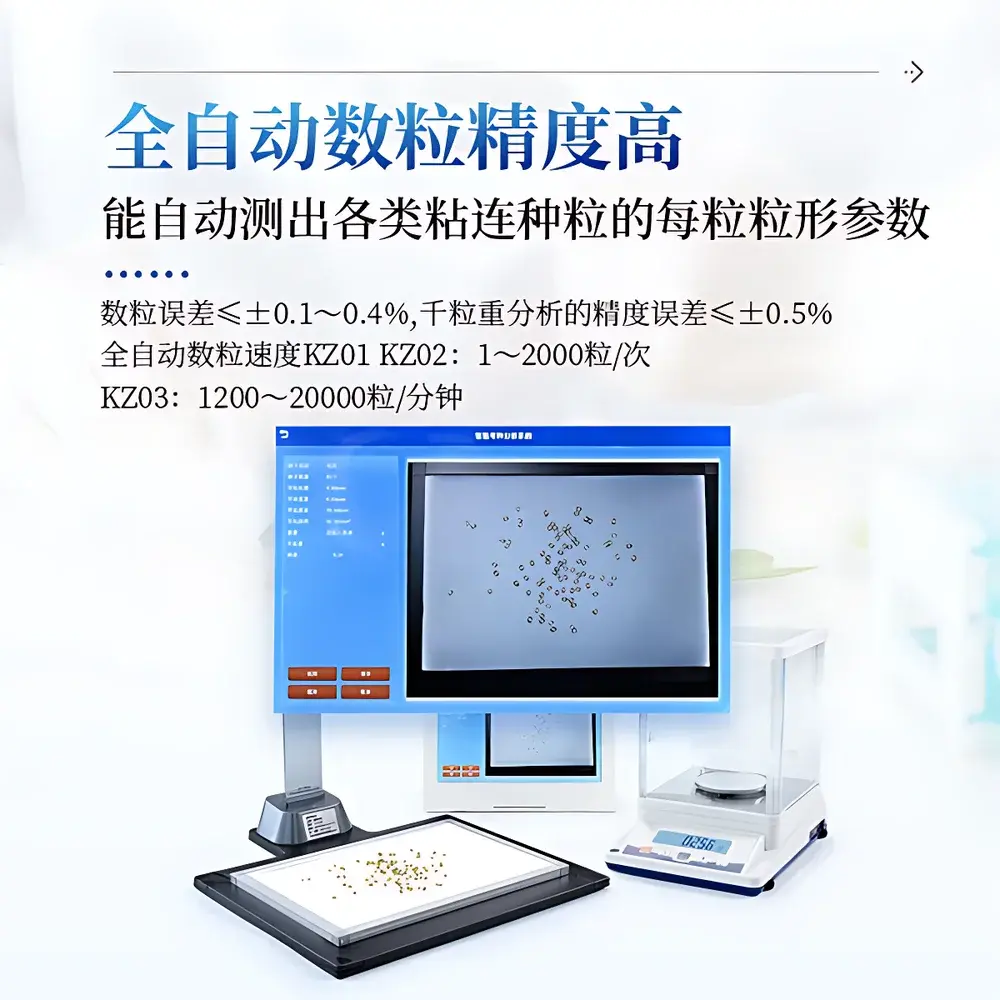
The COMECAUSE IN~KZ02 Intelligent Seed Counting and Morphometric Analysis System is a dedicated optical metrology instrument engineered for high-throughput, non-destructive seed phenotyping in agricultural research, breeding programs, and seed quality control laboratories. It operates on the principle of transmitted-light digital image acquisition combined with advanced computational morphology analysis. A 16-megapixel auto-focus color imaging module captures high-resolution top-down images of seed samples placed on a uniform LED-backlit nano-optical light guide plate. The system applies calibrated spatial transformation algorithms, morphological filtering, convex hull detection, and edge-based segmentation to extract geometric features—including particle count, length, width, perimeter, area, and aspect ratio—with sub-pixel precision. By integrating user-input sample mass data (via external analytical balance), the system computes 1,000-seed weight (TSW) in accordance with ISO 5652:2014 and ISTA Rules for Seed Testing. Designed for field-deployable use and lab-grade repeatability, it supports rapid batch processing of seeds ranging from 0.5 mm (e.g., lettuce, carrot) to 20 mm (e.g., maize, sunflower), with particular optimization for paddy rice—where pre-sieving or air separation is recommended to distinguish filled vs. unfilled grains prior to analysis.
Key Features
- 16 MP auto-focus color imaging sensor with real-time distortion correction and adaptive white-balance calibration
- Uniform LED backlighting system incorporating nano-structured light guide plate and reflective backing—ensuring shadow-free illumination and <±2% intensity variation across active imaging area
- Aluminum alloy frame construction for mechanical stability, thermal dimensional stability, and long-term rigidity under repeated handling
- Embedded morphometric software engine supporting automatic seed detection, classification, and measurement without manual ROI definition
- Counting accuracy: ≤±0.1–0.4% error rate per batch (1–2000 seeds), validated against reference manual counts per ISTA Guideline No. 5.3
- Thousand-seed weight (TSW) calculation accuracy: ≤±0.5% relative error, traceable to NIST-traceable mass standards
- Bilingual UI (English/Chinese) with one-click language toggle; no reinstallation required
- Batch-level metadata logging including timestamp, operator ID, sample ID, ambient temperature/humidity (if connected to optional environmental sensor)
Sample Compatibility & Compliance
The IN~KZ02 accommodates dry, surface-dry, non-adhesive seeds with smooth or moderately textured surfaces. It is validated for cereals (rice, wheat, barley), legumes (soybean, pea), oilseeds (rapeseed, sesame), and horticultural species (tomato, pepper). For rice, users must perform prior pneumatic separation to isolate plump vs. shriveled kernels—enabling accurate fertility rate estimation per ISO 6671:2021. The system complies with core requirements of ISO/IEC 17025:2017 for testing laboratories, supports audit-ready data retention (minimum 7-year storage), and generates immutable analysis logs compatible with GLP-compliant workflows. While not FDA 21 CFR Part 11-certified out-of-the-box, its export functionality enables integration into validated LIMS environments where electronic signatures and change control are managed externally.
Software & Data Management
The proprietary Windows 10+ application provides full local control via intuitive GUI. All image files (TIFF/PNG), raw measurement matrices, and summary reports are stored in structured SQLite databases with SHA-256 hash integrity verification. Users may annotate batches, apply post-hoc corrections to individual seed counts, and regenerate statistics without re-imaging. Export options include Excel (.xlsx) with embedded formulas, CSV for statistical software ingestion (R, Python pandas), and PDF reports containing thumbnails, histograms of size distribution, and tabular summaries. Audit trail logs record all parameter changes, export events, and user logins—supporting internal QA reviews and regulatory readiness assessments.
Applications
- Field trial yield estimation through representative panicle/ear sampling
- Seed lot certification per national seed law requirements (e.g., China GB/T 3543.3–1995, EU Directive 2002/55/EC)
- Quantitative trait locus (QTL) mapping studies requiring high-fidelity grain morphology descriptors
- Post-harvest quality assessment in seed processing facilities
- Teaching laboratories for plant science curricula emphasizing digital phenotyping fundamentals
- Regulatory submission support for variety registration dossiers (e.g., UPOV TG/12/8)
FAQ
What operating systems does the IN~KZ02 software support?
Windows 10 (64-bit) or later; Windows 7 and earlier versions are unsupported due to driver architecture limitations.
Can the system analyze wet or oily seeds?
No—samples must be air-dried to constant weight and free of surface moisture or lipid residue to ensure optical contrast and segmentation reliability.
Is calibration required before each use?
A single pixel-to-mm spatial calibration is performed during initial setup using supplied calibration target; no recalibration is needed unless hardware components are replaced.
How is measurement traceability maintained?
Each analysis includes embedded EXIF metadata referencing calibration date, software version, and hardware serial numbers; raw images and processed data are archived with cryptographic checksums.
Does the system support network deployment or remote access?
Standalone operation only; network sharing of results is enabled via standard file-sharing protocols, but concurrent multi-user control is not implemented.





