
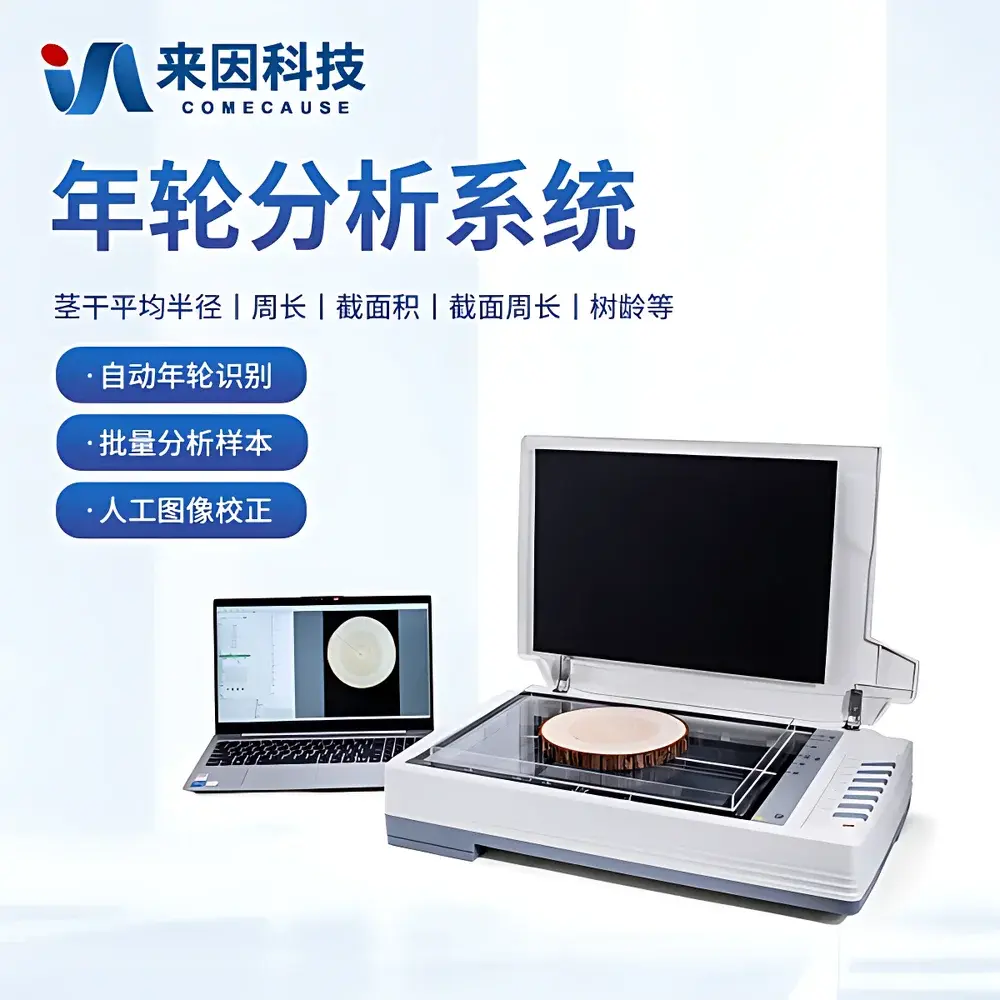
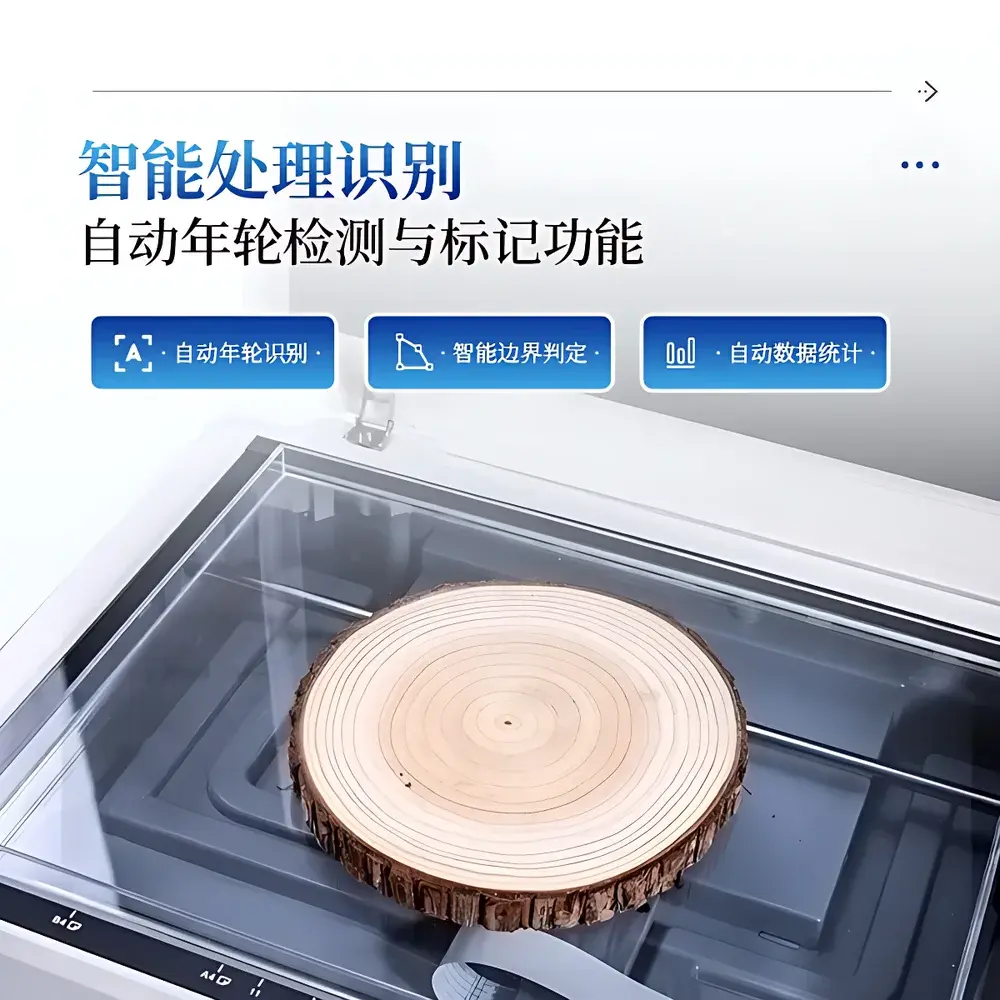
COMECAUSE IN*NL Tree-Ring Analysis System
| Brand | COMECAUSE |
|---|---|
| Origin | Shandong, China |
| Manufacturer | COMECAUSE (Producer) |
| Model | IN*NL |
| Scanning Area | 31 × 44 cm (A3) |
| Optical Resolution | 1600 × 1600 dpi (standard), up to 1800 × 3600 dpi (optional) |
| Minimum Detectable Ring Width | 0.011 mm (optional), 0.016 mm (standard) |
| Image Format Support | TIFF, BMP, PNG, JPEG |
| Software Platform | Windows 10 or later |
| Measurement Precision | Sub-pixel interpolation with XY bidirectional calibration |
| Data Export Formats | Excel (.xlsx), CSV, JSON |
| Language Interface | English / Chinese toggle |
Overview
The COMECAUSE IN*NL Tree-Ring Analysis System is a dedicated dendrochronological imaging and measurement platform engineered for high-fidelity analysis of woody tissue cross-sections—whether from disk samples or increment cores extracted via growth borers. Based on high-resolution optical scanning combined with calibrated digital image metrology, the system quantifies annual ring geometry—including ring width, earlywood/latewood boundaries, radial growth trends, and cross-sectional morphometrics—without destructive sectioning or chemical treatment. Its core measurement principle relies on pixel-accurate edge detection within grayscale or channel-separated reflectance images, followed by geometric calibration against physical scale references. Designed for rigorous field and laboratory applications, the IN*NL supports reproducible, traceable, and auditable tree-ring measurements compliant with internationally recognized dendroecological protocols (e.g., ITRDB standards, TRiDaS metadata schema, and ISO 13041:2021 for wood anatomy imaging).
Key Features
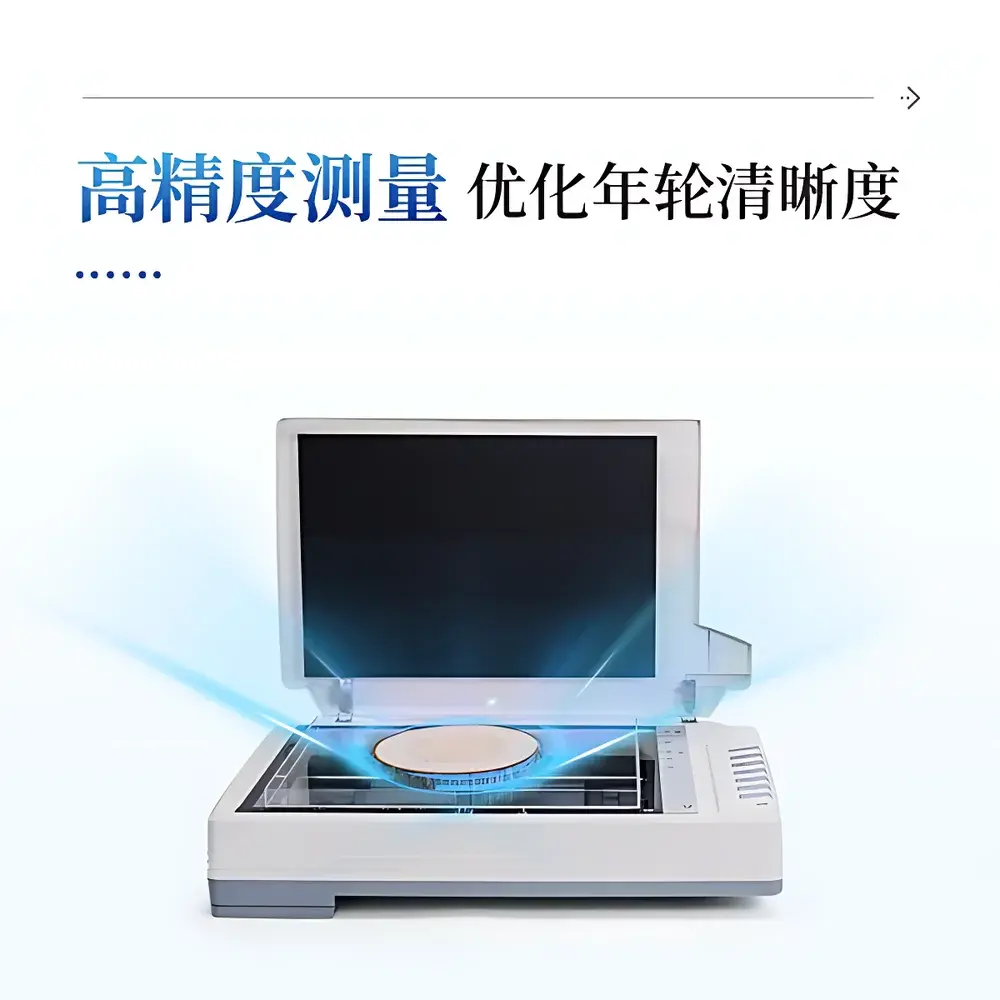
- High-Resolution A3-Scale Imaging: Standard 1600 × 1600 dpi optical resolution (up to 1800 × 3600 dpi optional), enabling sub-0.012 mm spatial discrimination—critical for detecting micro-rings in slow-growing or climate-stressed species.
- Calibrated Bidirectional Metrology: Independent X- and Y-axis scaling correction ensures geometric fidelity across large-area scans; integrated reference bar calibration eliminates lens distortion and stage drift artifacts.
- Adaptive Ring Detection Engine: Combines gradient-based edge enhancement with machine-assisted threshold segmentation, allowing robust identification of indistinct or fused rings (e.g., in coniferous species or drought-affected hardwoods).
- Manual Refinement Workflow: Interactive pixel-level editing tools permit insertion of missing ring markers, boundary realignment, and local contrast adjustment—ensuring analyst control without compromising audit trail integrity.
- Multi-Path Radial Measurement: Supports user-defined linear transects at arbitrary angles; path curvature following enables accurate tracking along natural cambial arcs in eccentric or reaction wood samples.
- Integrated Morphometric Quantification: Automatically computes stem cross-sectional area, circumference, mean radius, basal area increment (BAI), and ring-area ratios—outputting standardized metrics aligned with FAO Forestry Statistics reporting conventions.
Sample Compatibility & Compliance
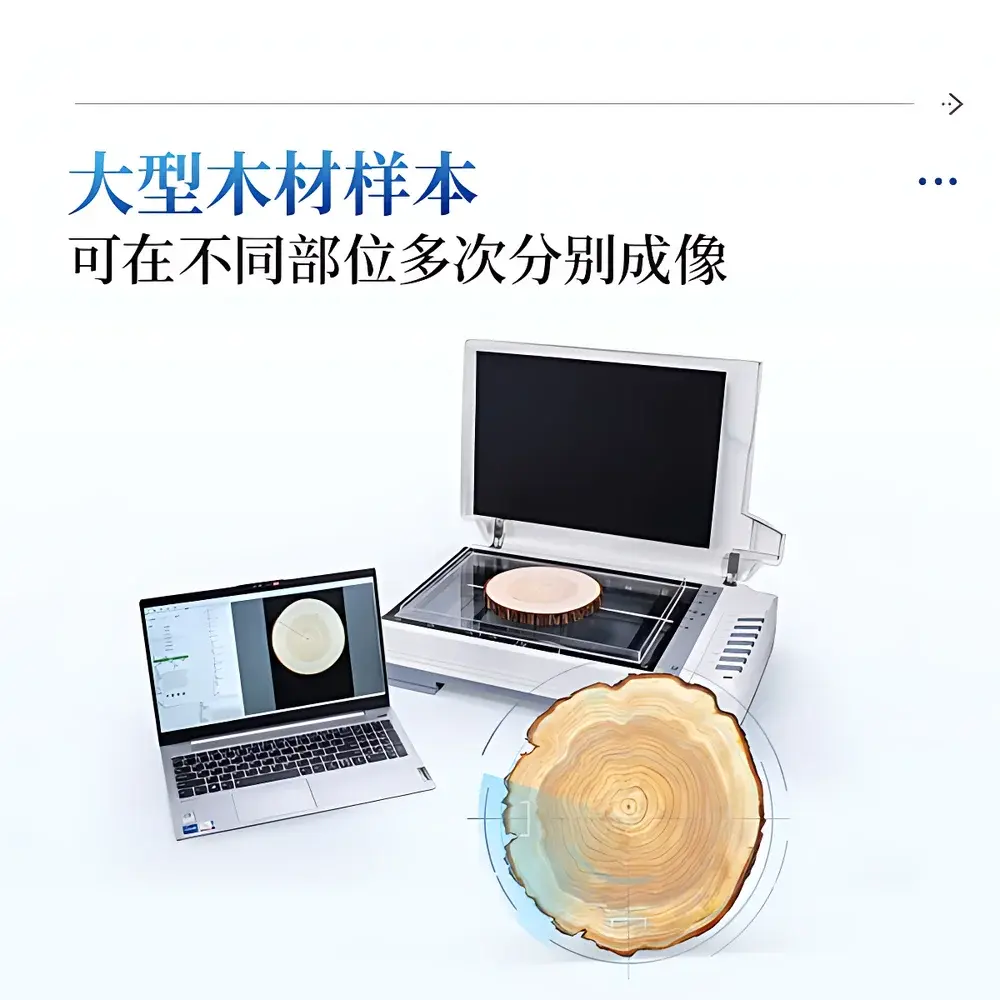
The IN*NL accommodates both solid wood disks (up to 44 cm diameter) and cylindrical increment cores (1–12 mm diameter) mounted on a precision-aligned borer holder. Sample preparation requires only surface sanding or fine polishing—no staining or resin embedding. The system complies with GLP-aligned data handling requirements: all measurement sessions log timestamped operator ID, instrument configuration, calibration status, and version-controlled analysis parameters. Raw image files (TIFF) and processed ring-width series are stored with embedded EXIF and TRiDaS-compliant metadata. Output reports meet minimum formatting criteria for submission to the International Tree-Ring Data Bank (ITRDB) and peer-reviewed dendroclimatology journals.
Software & Data Management
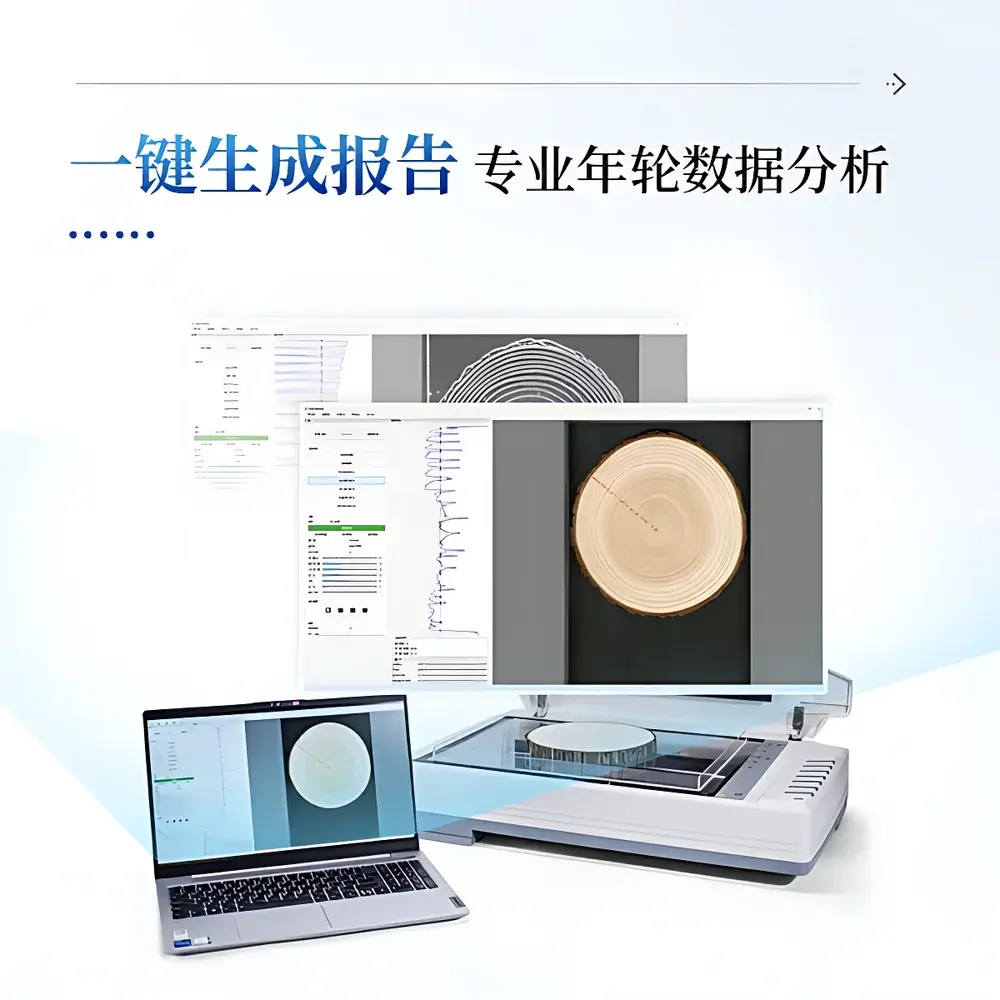
Running exclusively on Windows 10/11, the IN*NL software implements role-based access control, full audit logging (per FDA 21 CFR Part 11 principles), and encrypted project file storage. Batch processing queues support parallel analysis of heterogeneous sample sets with consistent parameter inheritance. All measurements generate timestamped .csv exports containing ring index, year assignment, earlywood/latewood width, and confidence flags. Advanced users may export raw intensity profiles for third-party spectral or wavelet analysis (e.g., using R packages dplR or Python treeclim). The software includes built-in validation checks for common anomalies—such as double-counting, missing rings, or inter-annual synchronization errors—and generates diagnostic heatmaps highlighting low-contrast regions requiring manual review.
Applications
- Paleoclimatology: Reconstructing multi-centennial temperature/precipitation records through standardized ring-width chronologies (e.g., regional curve standardization, RCS).
- Forest Health Monitoring: Detecting growth suppression events linked to pest outbreaks, air pollution exposure, or soil nutrient depletion.
- Ecological Restoration Assessment: Quantifying post-disturbance recovery rates in burned or logged stands using pre- and post-event ring series.
- Timber Provenance & Authentication: Supporting forensic wood identification via intra-annual density patterns and anatomical marker alignment.
- Long-Term Ecophysiological Studies: Correlating radial growth dynamics with eddy-covariance flux data, dendrometer records, or stable isotope ratios (δ13C, δ18O).
FAQ
What image formats does the IN*NL software accept?
TIFF (recommended for archival fidelity), BMP, PNG, and JPEG. Lossless formats preserve bit-depth required for reliable edge detection.
Can the system analyze cores from tropical species with absent or faint annual boundaries?
Yes—through customizable channel separation (e.g., red-channel enhancement for lignin-rich latewood) and manual anchor-point seeding, enabling semi-automated tracing even in diffuse-porous or non-seasonal species.
Is calibration traceable to national standards?
The XY calibration routine uses NIST-traceable line-pair targets; certificate documentation is provided with optional metrology validation kits.
Does the software support multi-user collaborative projects?
Yes—project files include embedded user metadata and change logs; shared network drives enable synchronized annotation workflows across research teams.
How is measurement uncertainty reported?
Each ring-width value includes a confidence score (0–100%) derived from local edge sharpness, contrast-to-noise ratio, and inter-observer agreement statistics from internal validation datasets.





