
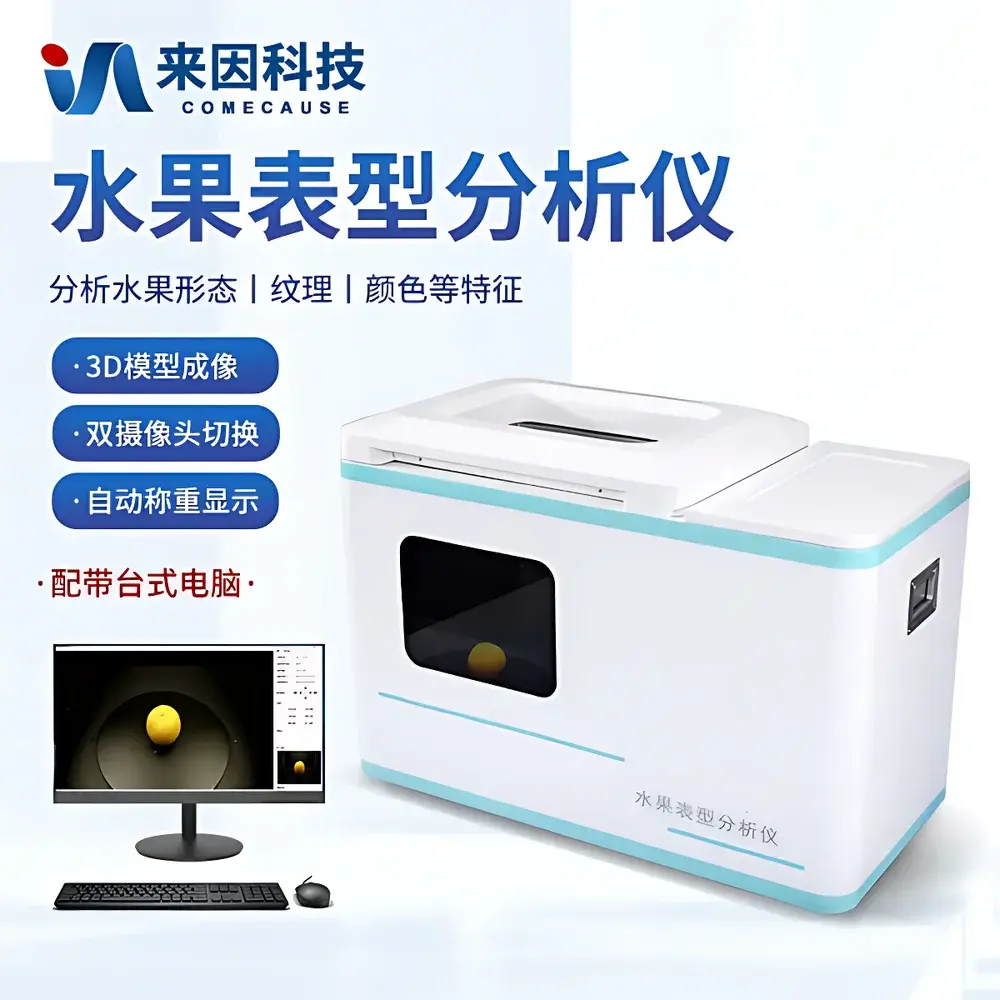

COMECAUSE IN~VistaFruit Apple 3D Phenotyping & External Quality Analysis System
| Brand | COMECAUSE |
|---|---|
| Origin | Shandong, China |
| Manufacturer Type | Direct Manufacturer |
| Country of Origin | China |
| Model | IN~VistaFruit |
| Price | USD 12,000 (FOB Qingdao) |
| Dimensions | 1006 × 506 × 718 mm (W×D×H) |
| Weight | 62 kg |
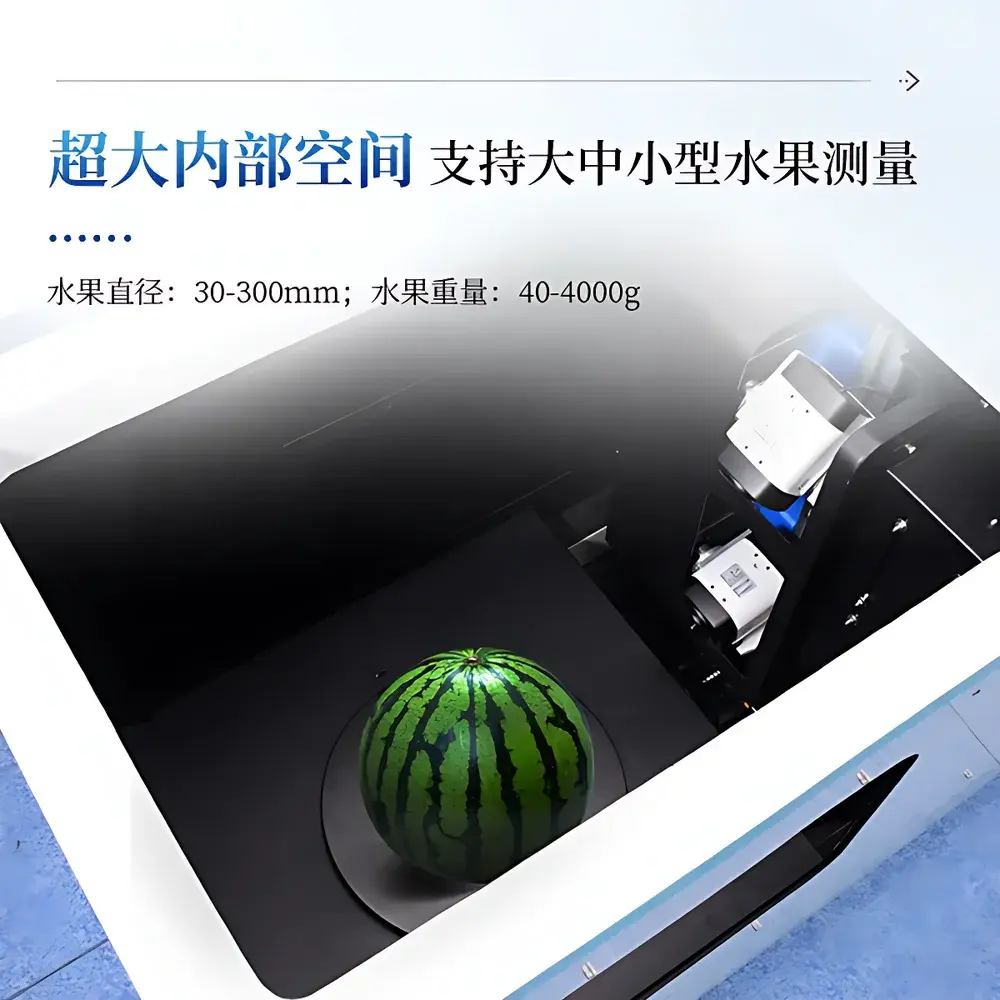
| Fruit Diameter Range | 30–300 mm |
| Mass Range | 40–4000 g |
| Imaging | Multi-view synchronized high-resolution RGB capture |
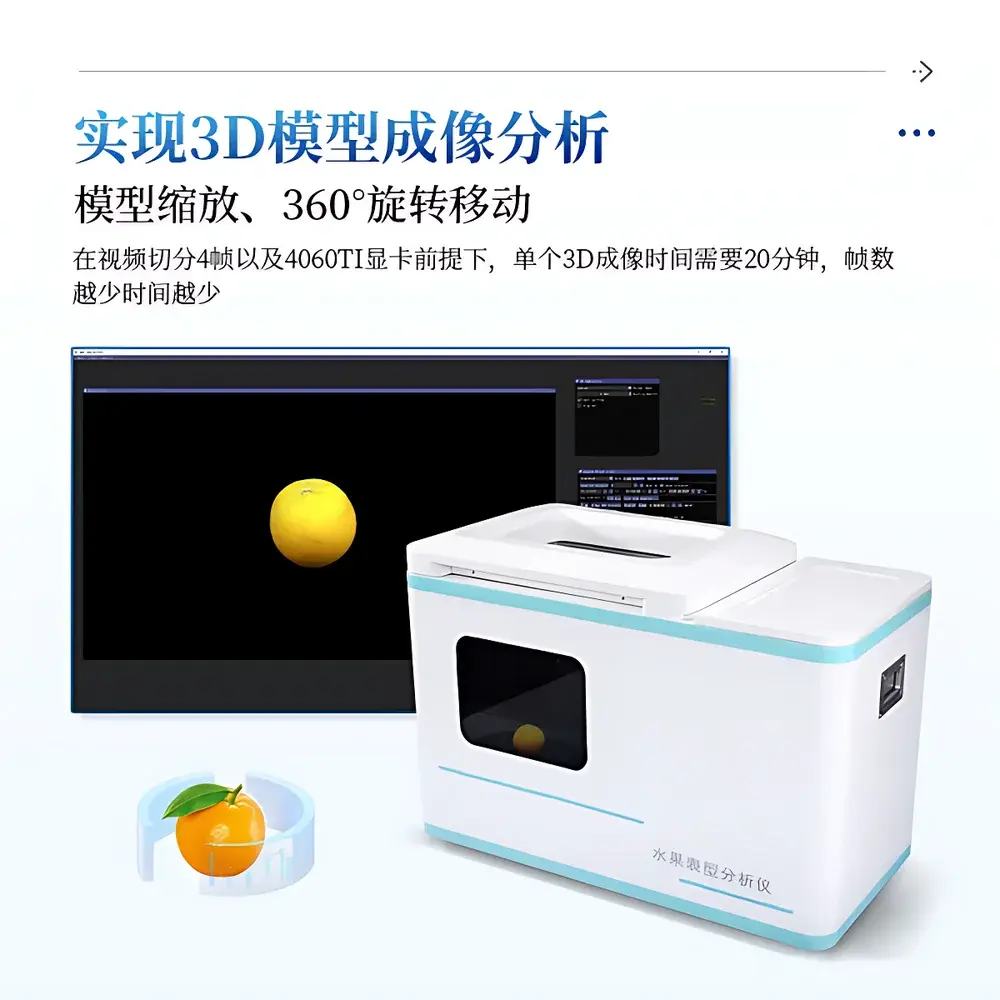
| 3D Reconstruction | Point cloud generation via structure-from-motion + Gaussian Splatting |
| Software | Embedded Windows-based analysis suite with real-time 2D/3D workflow orchestration |
| Compute Platform | Pre-integrated GeekPro-17 workstation (Intel Core i5-14400F, 16 GB RAM, 1 TB SSD, NVIDIA RTX 4060 Ti 8 GB) |
| Interface | Dual-language (English/Chinese) GUI with auto-resizing support |
| Data Export | CSV, JSON, PNG, OBJ, PLY |
| Cloud Sync | Device-ID-bound encrypted cloud storage with audit-trail metadata |
| Compliance | Designed for GLP-aligned data integrity |
Overview
The COMECAUSE IN~VistaFruit Apple 3D Phenotyping & External Quality Analysis System is a turnkey optical metrology platform engineered for non-destructive, quantitative assessment of fruit external phenotype. It operates on the principle of multi-view photogrammetric reconstruction combined with AI-augmented surface feature extraction—leveraging synchronized RGB imaging from calibrated camera arrays to generate dense point clouds, followed by Gaussian Splatting-based surface rendering and geometric parameterization. Unlike conventional contact-based or single-angle vision systems, IN~VistaFruit captures full 360° morphological topology without occlusion, enabling traceable, operator-independent quantification of shape, color distribution, and micro-texture—all critical determinants of commercial grade classification, postharvest quality monitoring, and breeding selection. The system is purpose-built for pome fruits (primarily apple, pear, quince), but validated across a broad spectrum including citrus, stone fruits, melons, and cucurbits (diameter range: 30–300 mm; mass: 40–4000 g). Its architecture integrates embedded weighing, real-time image acquisition control, and parallelized 2D/3D processing pipelines—ensuring throughput scalability without sacrificing metrological rigor.
Key Features
- Integrated precision load cell (±0.1 g resolution) synchronized with image capture—eliminating external scale dependency and temporal misalignment between mass and morphology data.
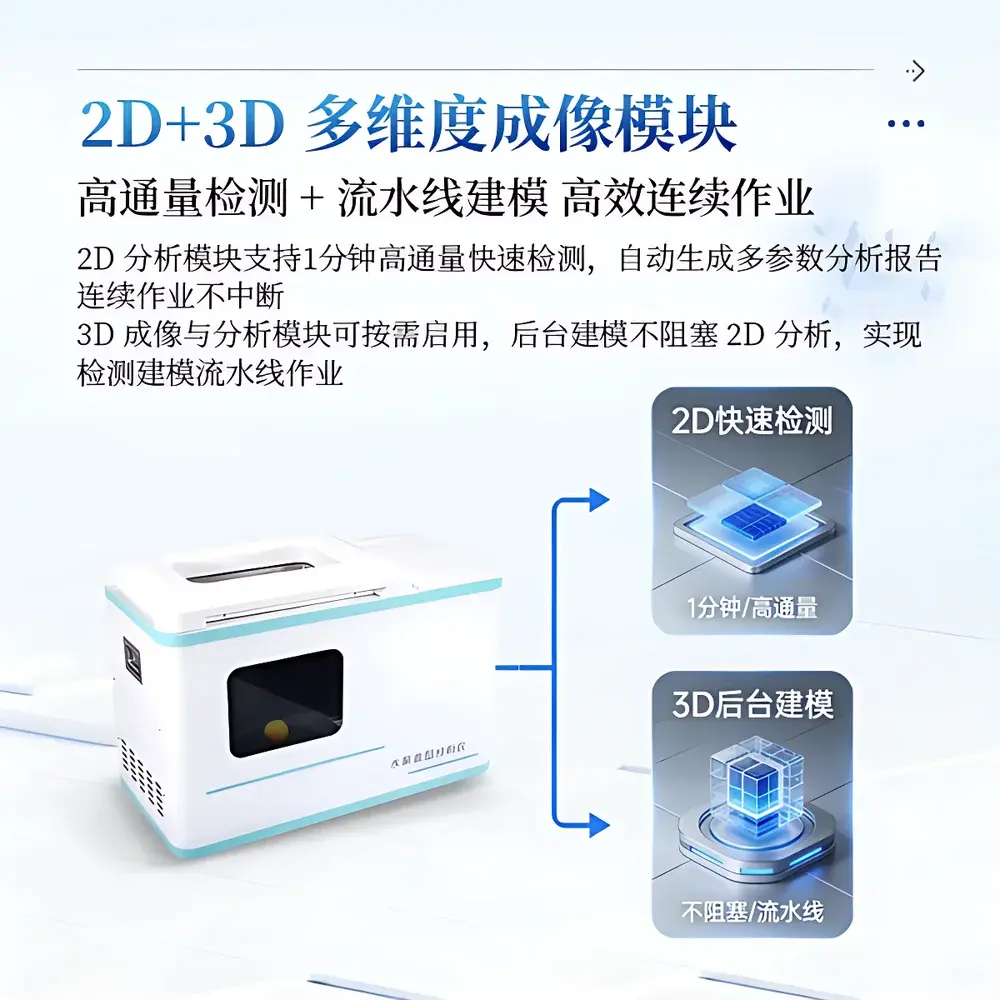
- Dual-mode analysis workflow: High-throughput 2D module (≤60 s/sample) delivers rapid morphometric, chromatic, and textural screening; optional on-demand 3D reconstruction module generates topologically accurate models with sub-millimeter geometric fidelity.
- Gaussian Splatting–enhanced 3D modeling engine optimized for organic surface continuity—preserves natural curvature discontinuities (e.g., calyx, stem cavity, lenticel patterns) without meshing artifacts or smoothing bias.
- Comprehensive parameter taxonomy: 22 morphometric indices (including volume, surface area, sphericity, form factor, aspect ratio), 11 color descriptors across RGB, CIELAB, HSV, and grayscale spaces, and 11 texture metrics derived from Gray-Level Co-occurrence Matrix (GLCM) and Structural Similarity Index (SSIM) analysis.
- Real-time interactive 3D viewer with GPU-accelerated rotation, zoom, pan, and cross-sectional slicing—enabling visual validation of segmentation boundaries and surface anomaly localization.
- Cloud-native data management: Device-bound encryption, versioned dataset storage, time-stamped audit logs, and role-based access controls—fully compatible with institutional data governance frameworks.
Sample Compatibility & Compliance
IN~VistaFruit accommodates intact, unmodified fruit specimens—no pre-treatment, coating, or mounting required. Validation datasets confirm robust performance across cultivars exhibiting wide variation in skin reflectance (matte to glossy), surface relief (smooth epidermis to russeting), and structural heterogeneity (e.g., blush mottling, sunburn scarring, insect damage). The system meets foundational requirements for analytical instrument qualification under ISO/IEC 17025:2017 (clause 5.5.2 on measurement traceability) and aligns with FAO/WHO Codex Alimentarius standards for fruit grading criteria. While not certified for regulated GMP environments out-of-the-box, its software architecture supports optional 21 CFR Part 11 compliance packages—including electronic signature workflows, immutable audit trails, and user-access privilege hierarchies—enabling deployment in contract research organizations (CROs) and regulatory submission–supporting labs.
Software & Data Management
The IN~VistaFruit Analysis Suite runs natively on the bundled Windows 11 Pro workstation and features a modular, event-driven architecture. All raw images, point clouds, reconstructed meshes (OBJ/PLY), and computed parameters are stored in a local SQLite database with automatic backup to encrypted cloud endpoints. Each measurement record includes provenance metadata: timestamp, operator ID, device serial number, environmental ambient light reading (via integrated sensor), and calibration certificate ID. Batch reporting tools generate ISO-compliant PDF summaries with statistical summaries (mean ± SD, CV%), outlier flagging, and scatterplot matrices for multivariate correlation exploration (e.g., hue vs. firmness proxy, entropy vs. storage duration). Data export conforms to MIAPPE (Minimum Information About a Plant Phenotyping Experiment) v1.1 schema—facilitating interoperability with BreedBase, BrAPI, and ELIXIR plant phenomics infrastructures.
Applications
- Pre-breeding & Cultivar Evaluation: Quantitative comparison of appearance traits across progeny populations—accelerating selection for uniformity, blush coverage, or resistance to surface blemishes under controlled-environment trials.
- Postharvest Quality Assurance: Objective enforcement of commercial grade specifications (e.g., USDA Grade A apple size thresholds, EU Regulation (EC) No 1129/2009 color requirements) with zero inter-rater variability.
- Storage & Shelf-Life Studies: Longitudinal tracking of surface degradation markers—loss of chroma, increase in texture entropy, or volume shrinkage—as non-invasive proxies for physiological aging.
- Processing Line Integration: API-accessible control interface (RESTful JSON over Ethernet) enables synchronization with conveyor speed, reject gate triggers, and ERP/MES system handshaking for closed-loop sorting.
- Academic Phenomics Research: Generation of training datasets for deep learning models targeting defect detection, ripeness staging, or origin authentication—leveraging ground-truth 3D morphology and spectral texture maps.
FAQ
What is the minimum recommended hardware configuration for standalone operation?
The system ships with a validated GeekPro-17 workstation (i5-14400F, 16 GB RAM, RTX 4060 Ti). For optimal 3D reconstruction latency (<15 min/model at 12-frame input), an RTX 4070 or higher GPU is recommended.
Can the system operate without cloud connectivity?
Yes—local storage and analysis are fully functional offline. Cloud sync is optional and requires manual opt-in per session.
Is calibration required before each use?
A one-time geometric calibration (using supplied checkerboard target) is performed during installation. Routine verification uses NIST-traceable spherical reference objects (included); no daily recalibration needed.
How does the system handle specular highlights or highly reflective skins?
Multi-angle illumination sequencing and polarized filter options (accessory kit) suppress glare; algorithmic highlight masking is applied during color space transformation to preserve chromatic accuracy.
Are raw image files accessible for third-party analysis?
Yes—full-resolution TIFF sequences (per camera view), unprocessed point clouds (.ply), and metadata JSON are exported on request, supporting reproducible computational phenotyping workflows.





