


COMECAUSE IN~XM01 Wheat Panicle Density Analyzer
| Brand | COMECAUSE |
|---|---|
| Origin | Shandong, China |
| Manufacturer Type | Direct Manufacturer |
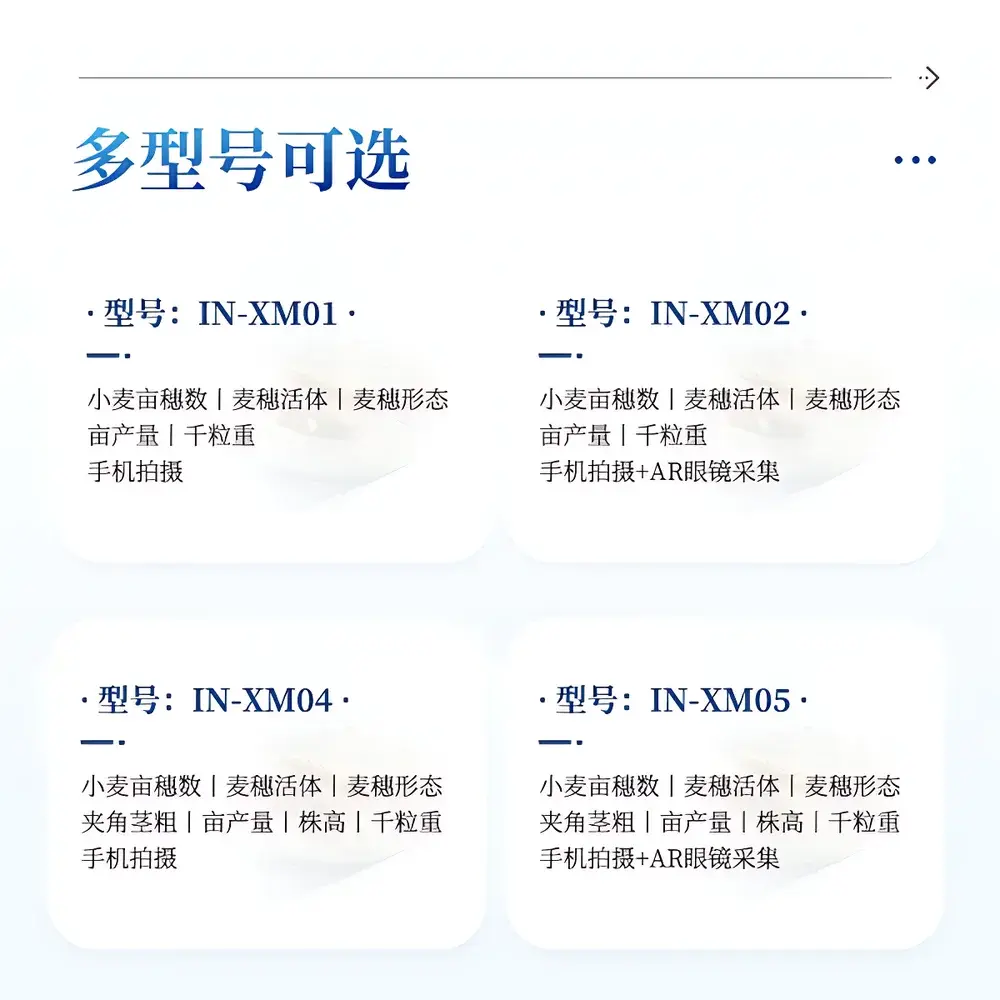
| Model | IN~XM01 |
| Imaging Resolution | 4000 × 3000 |
| Dual Camera System | 50 MP + 12 MP |
| Field Measurement Error | ≤ ±3% |
| Live-Plant Panicle Counting Accuracy | ±1% |
| Sample-Based Morphometric Error | ±1% |
| Cloud Connectivity | Wi-Fi / 4G |
| Data Export Format | Excel (.xlsx) |
| On-Device Storage | 256 GB |
| Display | Touchscreen Android OS |
| Language Support | Switchable English/Chinese |
| GPS Logging | Integrated |
| Calibration Reference | Adjustable-height dual-axis calibration bar (1000 × 1000 × [610–1120] mm and 1000 × 1000 × [1010–1920] mm variants) |
| Application Window | Grain-filling to pre-maturity stage |
| Compatible Outputs | Panicles per Mu (667 m²), theoretical yield, adjusted yield, harvested yield (with user-input grain weight & moisture) |
Overview
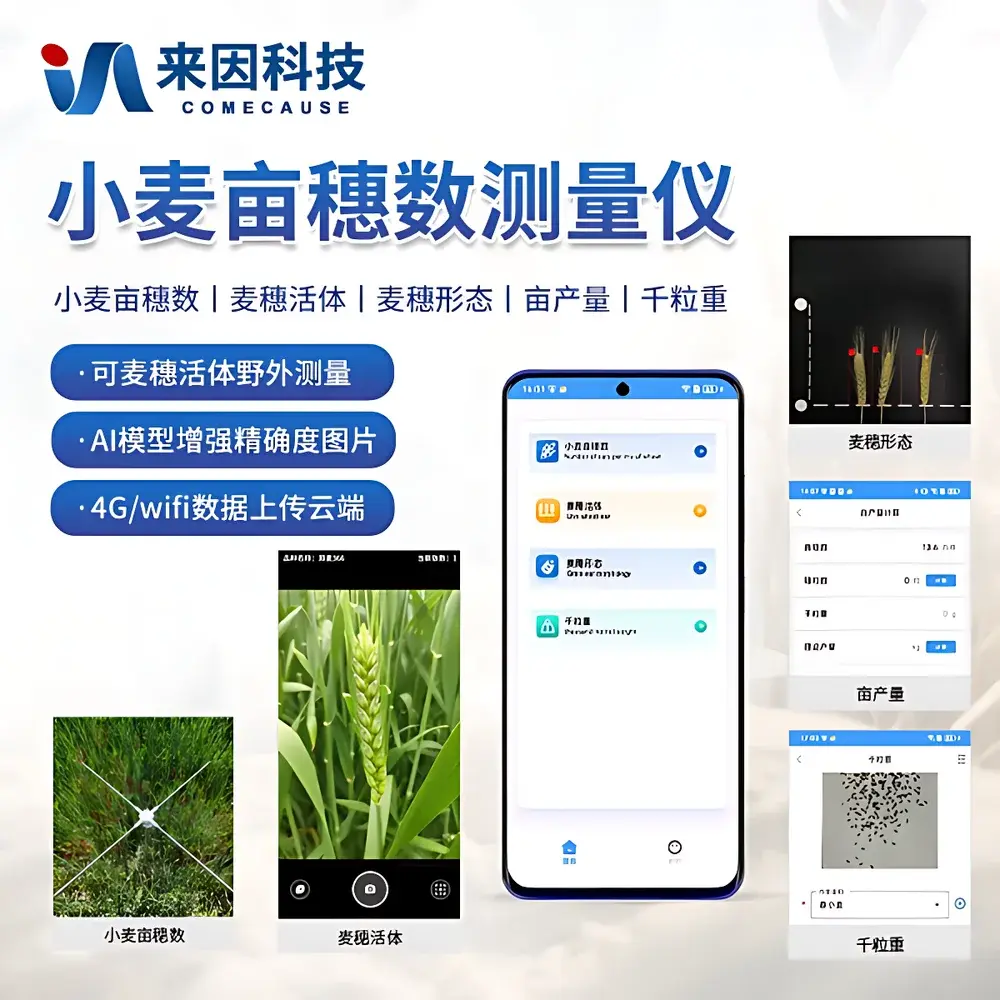
The COMECAUSE IN~XM01 Wheat Panicle Density Analyzer is a field-deployable, AI-powered plant phenotyping instrument engineered for non-destructive, standardized quantification of wheat panicle density — defined as the number of fertile spikes per mu (667 m²), a foundational agronomic trait in yield component analysis. Unlike conventional manual sampling or destructive harvest-based estimation, the IN~XM01 leverages computer vision and deep learning algorithms trained on multi-environment wheat canopy imagery to perform real-time panicle detection and spatial density mapping. Its operational principle integrates geometric calibration via adjustable dual-axis reference bars, high-fidelity dual-sensor imaging (50 MP primary + 12 MP auxiliary), and adaptive illumination compensation to ensure measurement robustness across variable field lighting conditions. The system operates without requirement for controlled lighting, dark backgrounds, or post-harvest sample preparation — enabling direct in-field use during the grain-filling to pre-maturity growth stage. As a core module within digital crop phenotyping workflows, the IN~XM01 bridges the gap between traditional agronomy and data-driven decision support by transforming qualitative field observations into traceable, georeferenced, and statistically comparable quantitative metrics.
Key Features
- AI-enhanced panicle recognition engine trained on diverse wheat genotypes and canopy architectures, delivering ≤ ±3% field measurement error and ±1% accuracy in live-plant counting mode
- Dual-camera architecture with synchronized 4000 × 3000 resolution capture, supporting both wide-field canopy assessment and high-magnification morphometric analysis
- Adjustable-height calibration bar system (two configurations: 1000 × 1000 × [610–1120] mm and 1000 × 1000 × [1010–1920] mm) for precise scale normalization under varying canopy heights
- On-device Android OS with 5-inch capacitive touchscreen, enabling real-time preview, image annotation, and immediate result visualization
- Batch processing capability for up to 60 images per session, with automated GPS tagging, timestamping, and metadata embedding
- Auto white balance and perspective correction algorithms that compensate for ambient light variation, camera tilt, and uneven ground topography
- 256 GB internal storage with chronological history log, searchable by date, location, or experimental plot ID
- Cloud synchronization over Wi-Fi or 4G networks compliant with TLS 1.2 encryption; supports role-based access control in enterprise deployments
Sample Compatibility & Compliance
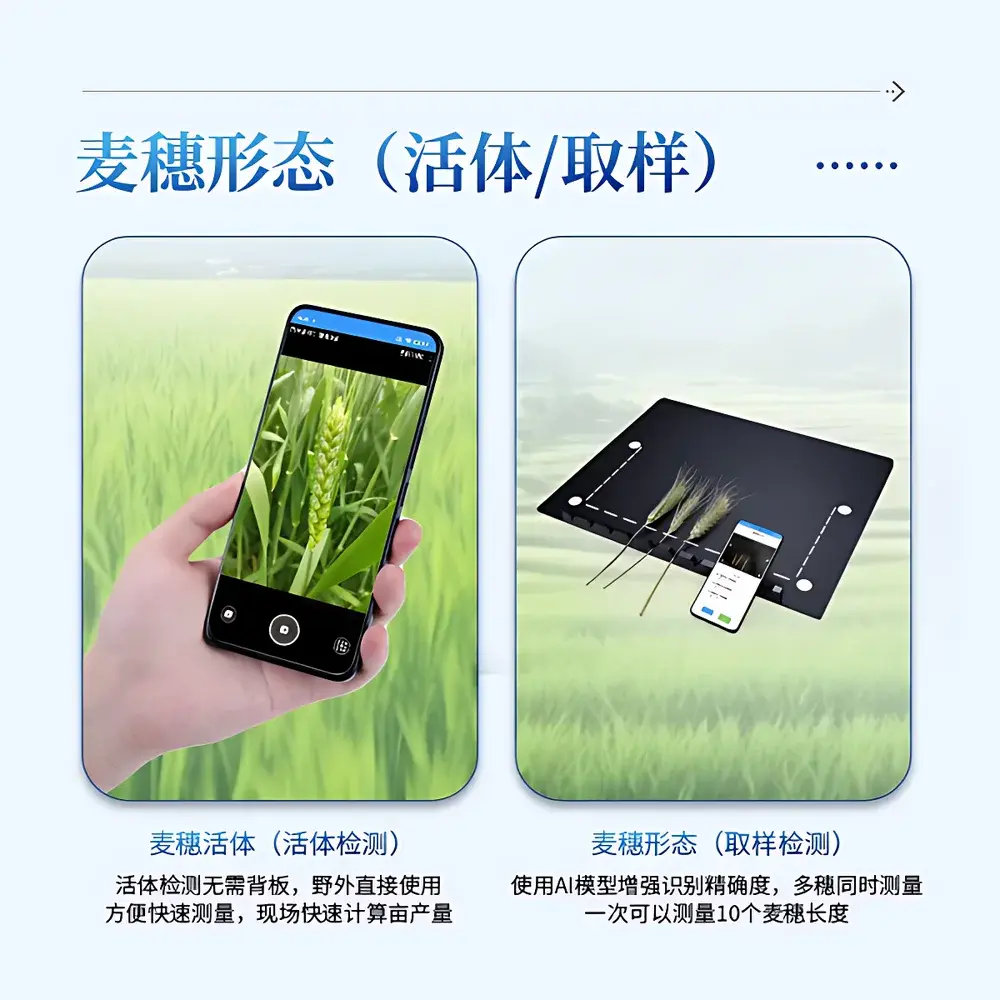
The IN~XM01 is validated for use with Triticum aestivum L. cultivars grown under standard agronomic practices across major Chinese wheat production zones. It accommodates both upright and semi-lodged canopies, provided panicles are visually discernible above the flag leaf layer. For laboratory-based morphometric analysis, the system supports optional benchtop configuration using a standardized black matte acrylic backplate (500 × 400 × 5 mm), enabling sub-centimeter length measurement of individual panicles (5–25 cm range) with ±1% repeatability. While not certified to ISO/IEC 17025 for metrological traceability, the device adheres to FAO-recommended protocols for panicle density estimation and aligns with CIMMYT’s Minimum Information about a Plant Phenotyping Experiment (MIAPPE) v1.1 metadata standards. All image acquisition and processing workflows are fully auditable, supporting GLP-compliant trial documentation when paired with external electronic lab notebooks (ELNs).
Software & Data Management
Data acquisition, processing, and export are managed through the proprietary COMECAUSE FieldPheno™ software suite, pre-installed on the device. Raw images, annotated detection masks, coordinate-aligned density heatmaps, and summary statistics (panicles/mu, coefficient of variation, spatial autocorrelation index) are stored locally and optionally synced to secure cloud repositories. Export functions generate ISO-standardized Excel (.xlsx) files containing structured columns: acquisition timestamp, WGS84 coordinates, image hash, detected panicle count, confidence score, and user-defined treatment labels. The software enforces immutable audit trails: every edit or reprocessing event is logged with operator ID, timestamp, and versioned algorithm parameters. For regulatory environments requiring electronic record integrity, the system supports integration with 21 CFR Part 11–compliant identity verification modules via optional PKI certificate enrollment.
Applications
- Breeding Program Acceleration: Enables high-throughput screening of thousands of lines in yield trials, facilitating selection for optimal tillering capacity and canopy architecture under target planting densities
- Precision Nutrient Management: Spatial panicle density maps inform variable-rate nitrogen application strategies, distinguishing zones requiring spike-promoting fertilization from those needing lodging mitigation
- Crop Modeling Calibration: Provides empirically derived initial conditions for APSIM-Wheat and DSSAT-CERES simulations, improving yield forecasting accuracy at field and regional scales
- Post-Hoc Agronomic Audit: Quantifies carryover effects of seeding rate, sowing date, and residue management by comparing observed vs. predicted panicle density distributions
- Insurance & Risk Assessment: Generates objective, timestamped evidence for pre-harvest loss estimation, supporting parametric insurance claim validation
- Phenotype–Genotype Association Studies: Serves as a quantitative endpoint in GWAS and QTL mapping experiments targeting loci governing tiller survival and spikelet fertility
FAQ
What growth stage is optimal for field measurement?
The recommended window spans mid-grain filling through pre-maturity — when panicles are fully exerted, chlorophyll degradation has not yet obscured spike morphology, and lodging incidence remains low.
Does the system require external lighting or shading?
No. The dual-camera system and embedded auto-exposure algorithm eliminate dependency on controlled illumination; measurements are valid under full sun, overcast, or early-morning diffuse light.
Can the device be used for other small-grain cereals?
While optimized for bread wheat (T. aestivum), preliminary validation shows functional utility for durum wheat and barley; species-specific model fine-tuning is available upon request.
How is measurement traceability ensured?
Each image includes embedded EXIF metadata (GPS, UTC timestamp, sensor settings), and all analytical steps are recorded in a tamper-evident processing log accessible via the device UI or cloud portal.
Is offline operation supported?
Yes. Full functionality — image capture, AI inference, local storage, and Excel export — operates without network connectivity; cloud sync occurs automatically upon reconnection.



