
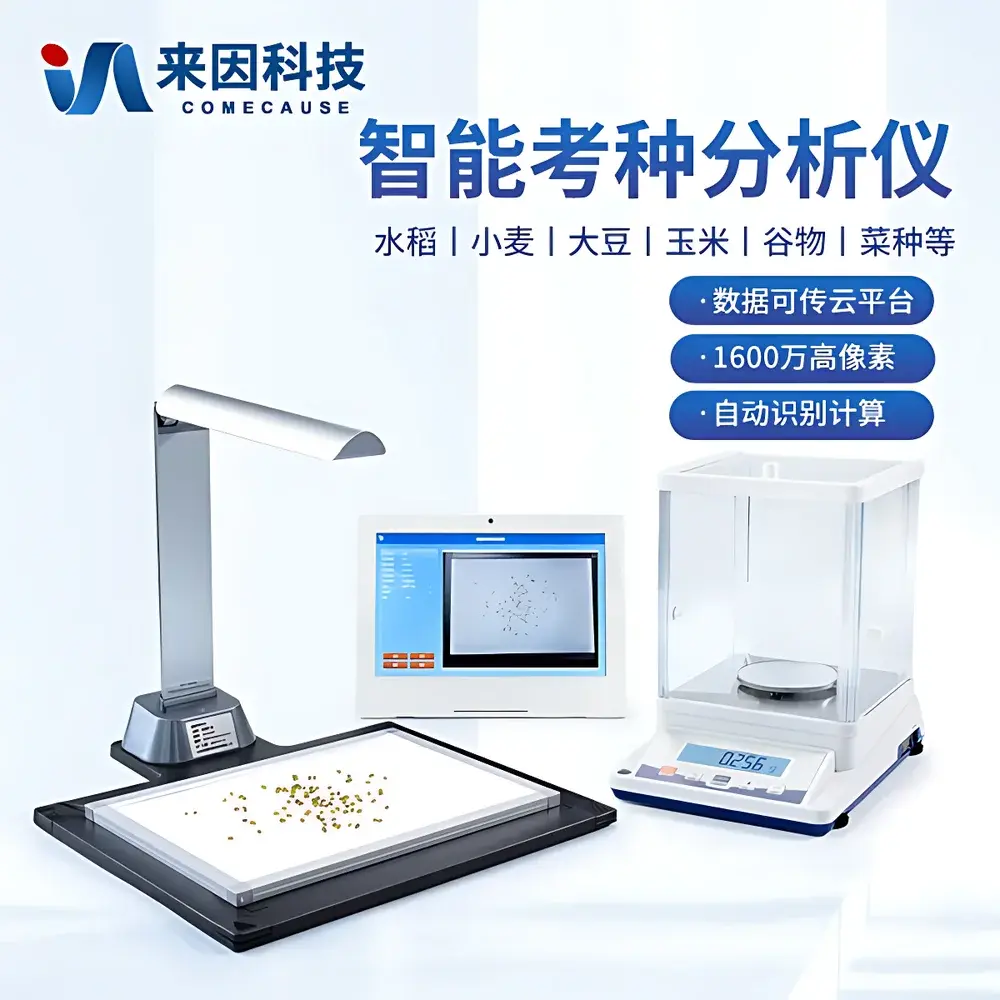
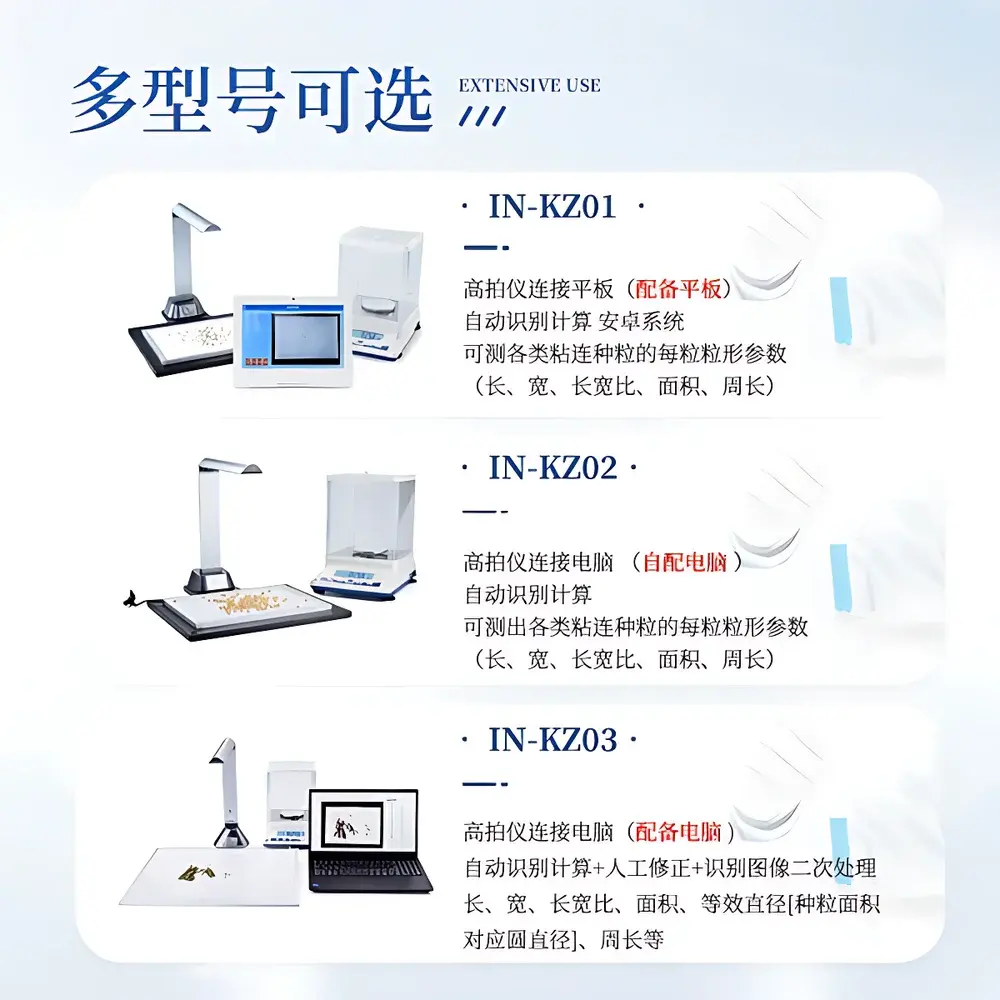


COMECAUSE IN-KZ01 Smart Seed Analyzer for Automatic Grain Counting and Thousand-Grain Weight Measurement
| Brand | COMECAUSE |
|---|---|
| Origin | Shandong, China |
| Manufacturer Type | Direct Manufacturer |
| Country of Origin | China |
| Model | IN-KZ01 |
| Price | USD 2,380 (approx.) |
| Camera Resolution | 16 MP |
| Imaging Field | 0.5–20 mm seed diameter |
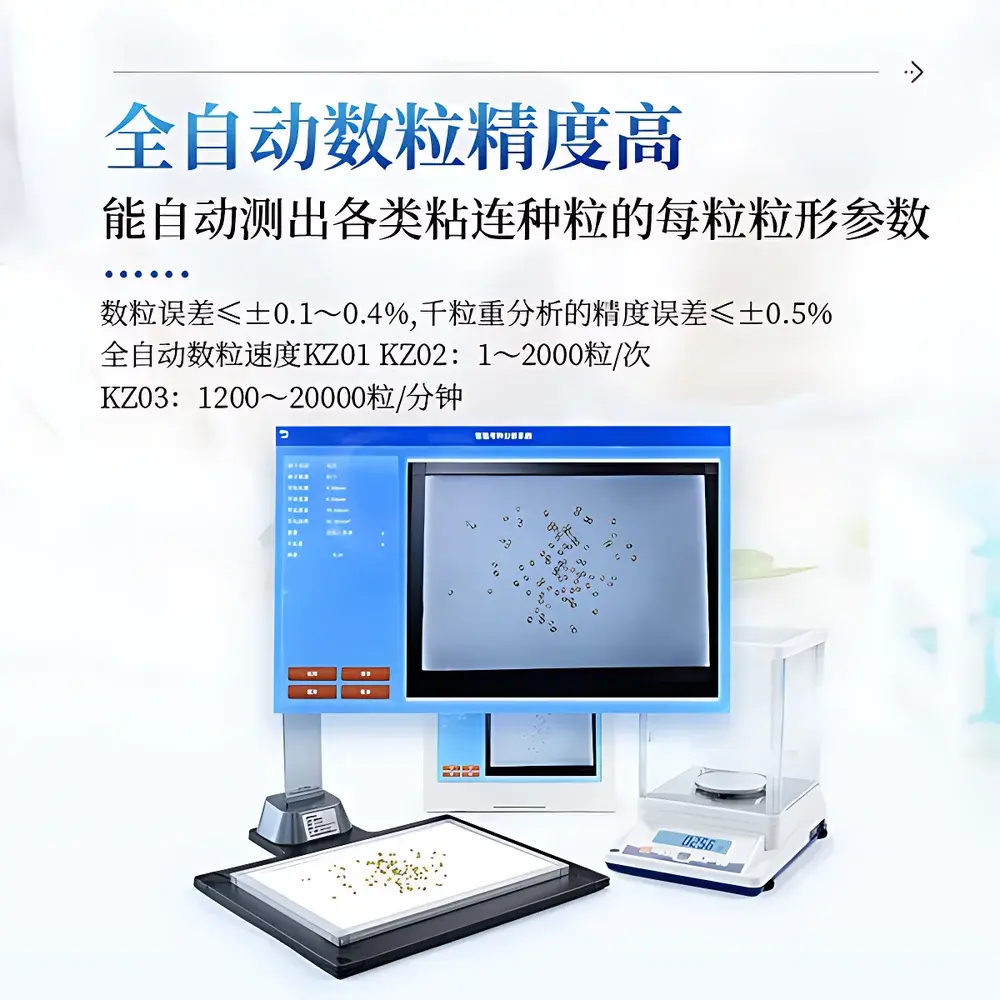
| Counting Accuracy | ≤ ±0.2% (1–2000 seeds per capture) |
| TGW Accuracy | ≤ ±1 mg |
| Operating System | Android 5.1.1+ |
| Tablet Screen | 10-inch, 800×1280 px |
| Backlight Source | High-luminance LED with nano-light-guide plate |
| Enclosure Material | Anodized aluminum alloy |
| Dimensions (Imager Unit) | 350 × 285 × 320 mm |
| Net Weight | 1.495 kg |
| Backlight Module Dimensions | 310 × 220 × 15 mm |
| Weight (Backlight Module) | 2.2 kg |
| Power Supply | DC 12 V / 1.5 A |
| Connectivity | Wi-Fi & optional 4G |
| Data Export Format | Excel (.xlsx) |
| Language Support | English & Chinese (toggleable) |
Overview
The COMECAUSE IN-KZ01 Smart Seed Analyzer is a dedicated, embedded vision-based instrument engineered for high-throughput, non-destructive seed phenotyping in agricultural research, breeding programs, and seed quality control laboratories. It operates on the principle of high-resolution backlight imaging combined with real-time morphometric analysis—leveraging geometric transformation algorithms, convex hull detection, and binary morphology to extract precise dimensional and count-based metrics from monolayer seed arrangements. Unlike manual or semi-automated counting methods, the IN-KZ01 eliminates operator subjectivity by standardizing illumination geometry, optical path calibration, and pixel-to-metric conversion. Its integrated hardware-software architecture enables full traceability of measurement conditions—including exposure time, backlight uniformity correction, and lens distortion compensation—ensuring compliance with internal QA protocols and supporting GLP-aligned data integrity requirements.
Key Features
- 16-megapixel auto-focus imaging module with real-time lens distortion correction and adaptive backlight uniformity calibration, minimizing systematic error in length/width measurement.
- Nano-structured light-guide plate and reflective backing ensure shadow-free, edge-consistent illumination across the entire 310 × 220 mm imaging area—critical for accurate perimeter and convex hull computation.
- Embedded Android OS (v5.1.1+) with 10-inch capacitive touchscreen provides intuitive, one-touch operation for image capture, batch analysis, and result review—no external PC required.
- Automated calculation of thousand-grain weight (TGW) via synchronized input of sample mass (from external analytical balance) and counted seed number—eliminating manual transcription errors.
- Comprehensive morphometric output: mean length, mean width, length-to-width ratio, projected area, and perimeter—all computed per seed and aggregated statistically (mean ± SD).
- On-device data persistence with timestamped records, including original image thumbnails, raw count logs, and metadata (operator ID, sample ID, date/time, environmental notes).
- Over-the-air (OTA) firmware updates ensure long-term software maintainability and feature scalability without physical service intervention.
Sample Compatibility & Compliance
The IN-KZ01 is validated for use with smooth-surfaced, opaque or semi-translucent seeds ranging from 0.5 mm (e.g., lettuce, mustard) to 20 mm (e.g., maize, broad bean). It supports standardized workflows for rice fertility assessment—requiring prior air-separation of filled vs. unfilled grains to compute spikelet fertility rate. While not certified to ISO 5725 or ASTM D7429 as a standalone metrological device, its measurement repeatability (≤ ±0.2% counting error; ≤ ±1 mg TGW deviation) aligns with routine QC thresholds defined in national seed testing guidelines (e.g., GB/T 3543.1–3543.7, China; ISTA Rules Chapter 5). All image processing parameters are user-accessible and auditable, facilitating internal validation and method transfer documentation.
Software & Data Management
Analysis results—including tabular summaries, statistical distributions, and thumbnail galleries—are stored locally in encrypted SQLite databases. Export functions support native Excel (.xlsx) formatting with column headers compliant with FAO Crop Ontology naming conventions (e.g., “Seed_Length_mm”, “TGW_g”). Optional cloud synchronization via secure HTTPS API enables centralized data aggregation across multi-site breeding trials. The web-based cloud dashboard supports temporal filtering, cross-trial parameter comparison (e.g., TGW trends across 5 generations), and export-ready visualization (bar charts, scatter plots). Audit trails record all user actions (login, analysis run, export event, firmware update) with timestamps and IP addresses—meeting basic FDA 21 CFR Part 11 electronic record requirements when deployed behind institutional firewalls.
Applications
- Field trial yield estimation via rapid grain count extrapolation from subsamples.
- Seed lot certification for purity, viability, and uniformity assessments per national regulatory frameworks.
- Phenotypic screening in cereal breeding programs—tracking changes in grain dimensionality across backcross generations.
- Post-harvest quality monitoring: detecting mechanical damage, shriveling, or mold incidence through shape anomaly detection.
- Educational use in agronomy labs for teaching digital image analysis fundamentals in plant science curricula.
FAQ
What seed types are supported?
Rice, wheat, barley, soybean, maize, rapeseed, sorghum, and other dicot/monocot species with smooth, non-fuzzy surfaces and minimal translucency. For rice, pre-sorting into filled/unfilled fractions is required to calculate fertility rates.
Is calibration required before each use?
No routine calibration is needed—the system performs automatic optical alignment and backlight uniformity correction at startup. However, users may perform optional verification using NIST-traceable seed standards (e.g., certified glass microspheres) for method validation.
Can the device operate offline?
Yes. All core functions—including image capture, morphometric analysis, TGW calculation, and local Excel export—function fully without internet connectivity. Cloud upload is optional and occurs only upon explicit user command.
How is measurement traceability ensured?
Each analysis file embeds EXIF-like metadata: device serial number, firmware version, timestamp, camera settings, and user-entered sample ID—enabling full reconstruction of measurement context during audits.
Does the software support custom reporting templates?
Not natively; reports follow a fixed schema optimized for seed testing compliance. However, exported Excel files can be imported into LIMS or statistical platforms (e.g., R, JMP) for customized reporting and integration with enterprise systems.




