


COMECAUSE KZ02 Smart Seed Analyzer
| Brand | COMECAUSE |
|---|---|
| Origin | Shandong, China |
| Manufacturer Type | Direct Manufacturer |
| Model | KZ02 |
| Instrument Category | Seed Testing and Inspection Instrument |
| Imaging Sensor | 16 MP Auto-Focus CMOS Camera |
| Backlight System | Uniform LED Illumination with Nano-Optic Light Guide Plate |
| Seed Diameter Range | 0.5–20 mm |
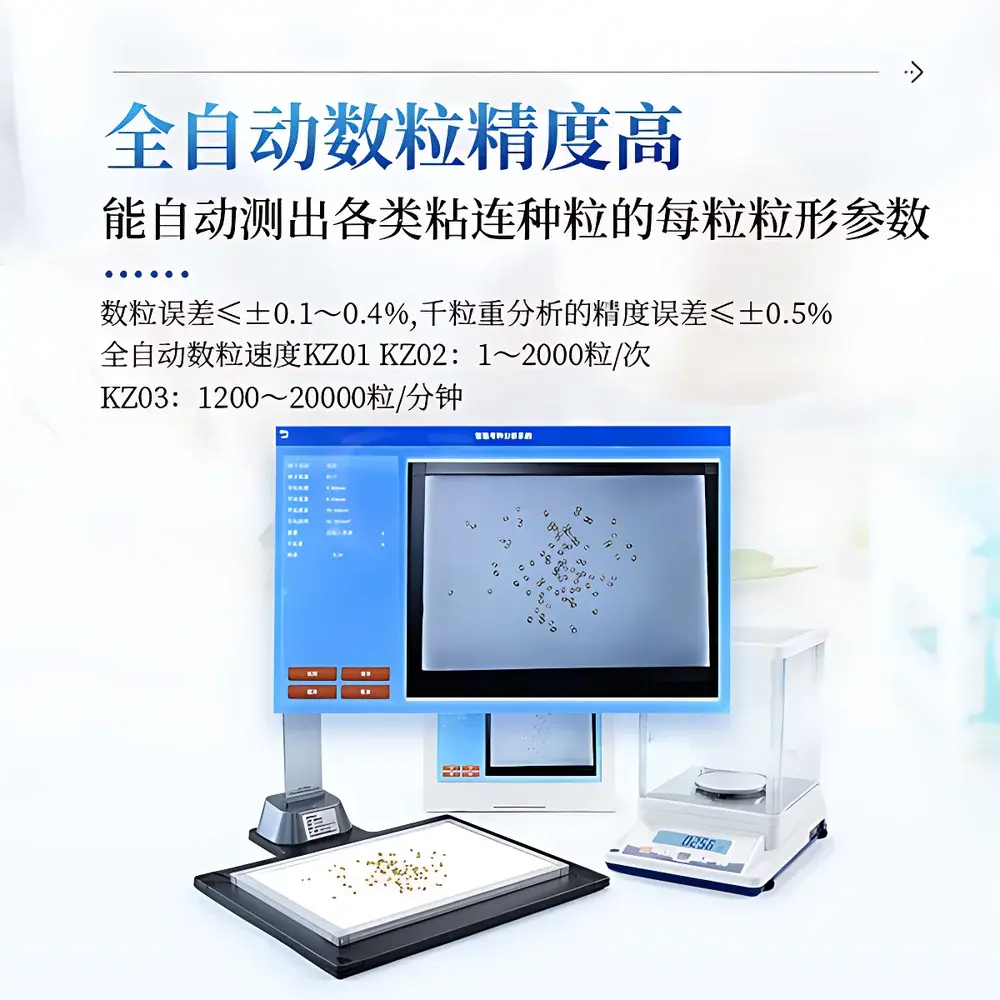
| Counting Accuracy | ±0.1–0.4% (1–2000 seeds per image) |
| Thousand-Seed Weight (TSW) Accuracy | ±0.5% |
| Supported OS | Windows 10 or later |
| Output Format | Excel (.xlsx), PDF Report, Image Archive |
| Language Interface | Embedded Bilingual (English/Chinese), One-Touch Switch |
Overview
The COMECAUSE KZ02 Smart Seed Analyzer is a dedicated digital imaging system engineered for high-throughput, non-destructive seed phenotyping and quantitative agronomic analysis. It operates on the principle of transmitted-light silhouette imaging combined with advanced computer vision algorithms—including perspective-corrected distance transformation, morphological segmentation, convex hull analysis, and sub-pixel edge detection—to extract morphometric and count-based parameters from static seed samples placed on a uniform backlight stage. Unlike manual or semi-automated counting methods, the KZ02 eliminates operator bias and inter-observer variability by standardizing illumination geometry, lens calibration, and pixel-to-metric conversion. Its design adheres to core principles of ISO 5725 (accuracy and precision of measurement methods) and supports traceable workflows required under GLP-compliant seed testing protocols. The system is optimized for field-collected or laboratory-prepared seed lots—particularly cereals (e.g., rice, wheat, barley), legumes, oilseeds, and vegetable crops—where rapid, repeatable determination of seed number, thousand-seed weight (TSW), and morphological descriptors is critical for breeding trials, variety registration, quality control, and seed certification.
Key Features
- 16-megapixel auto-focus color imaging module with real-time distortion correction and adaptive white-balance calibration
- Ultra-thin, uniform LED backlight panel integrated with nano-structured light guide plate and reflective backing—ensuring shadow-free illumination and <±2% intensity variation across active area
- Aluminum alloy frame providing mechanical rigidity, thermal stability, and long-term dimensional integrity
- Embedded image processing engine implementing multi-stage segmentation: Otsu thresholding, noise suppression, hole-filling, contour extraction, and convex hull approximation
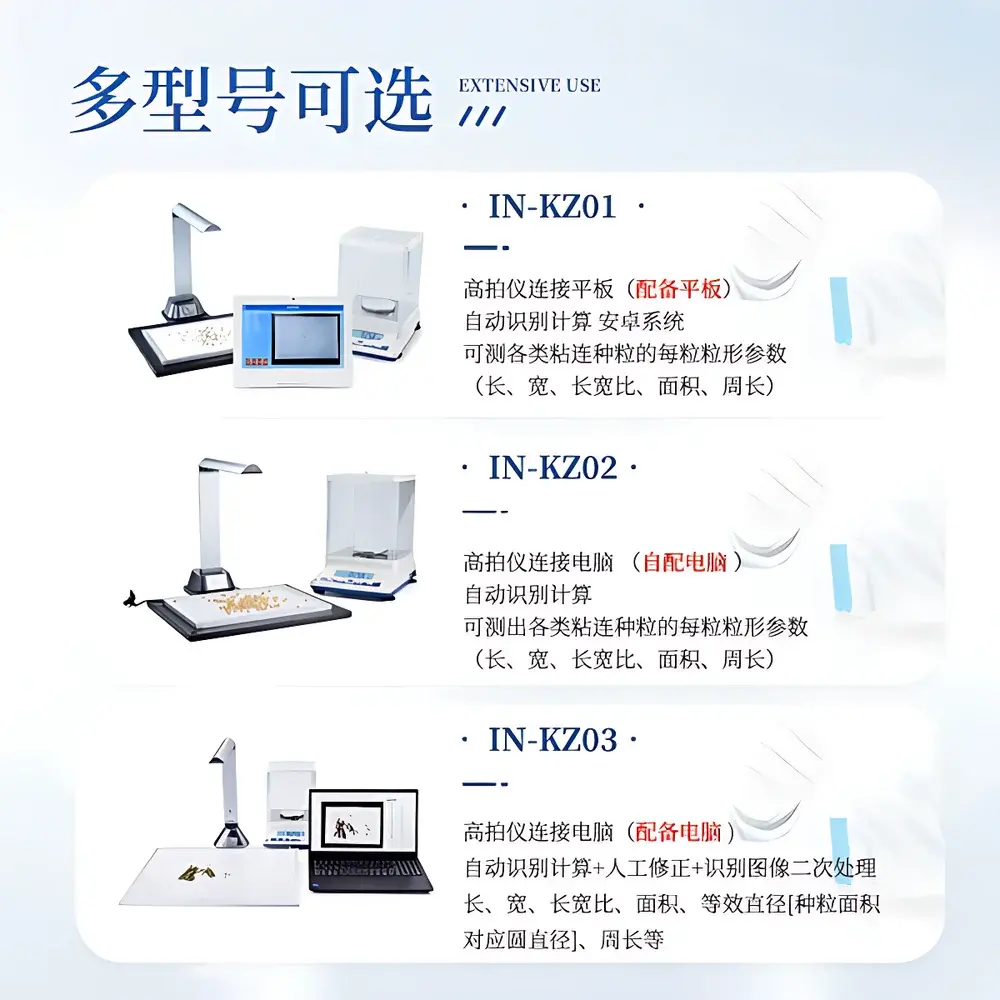
- Automated calculation of per-seed and population-level metrics: count, length, width, length-to-width ratio, projected area, perimeter, circularity, and convexity
- Integrated TSW computation workflow: user-input sample mass + automated seed count → calibrated thousand-seed weight with uncertainty propagation
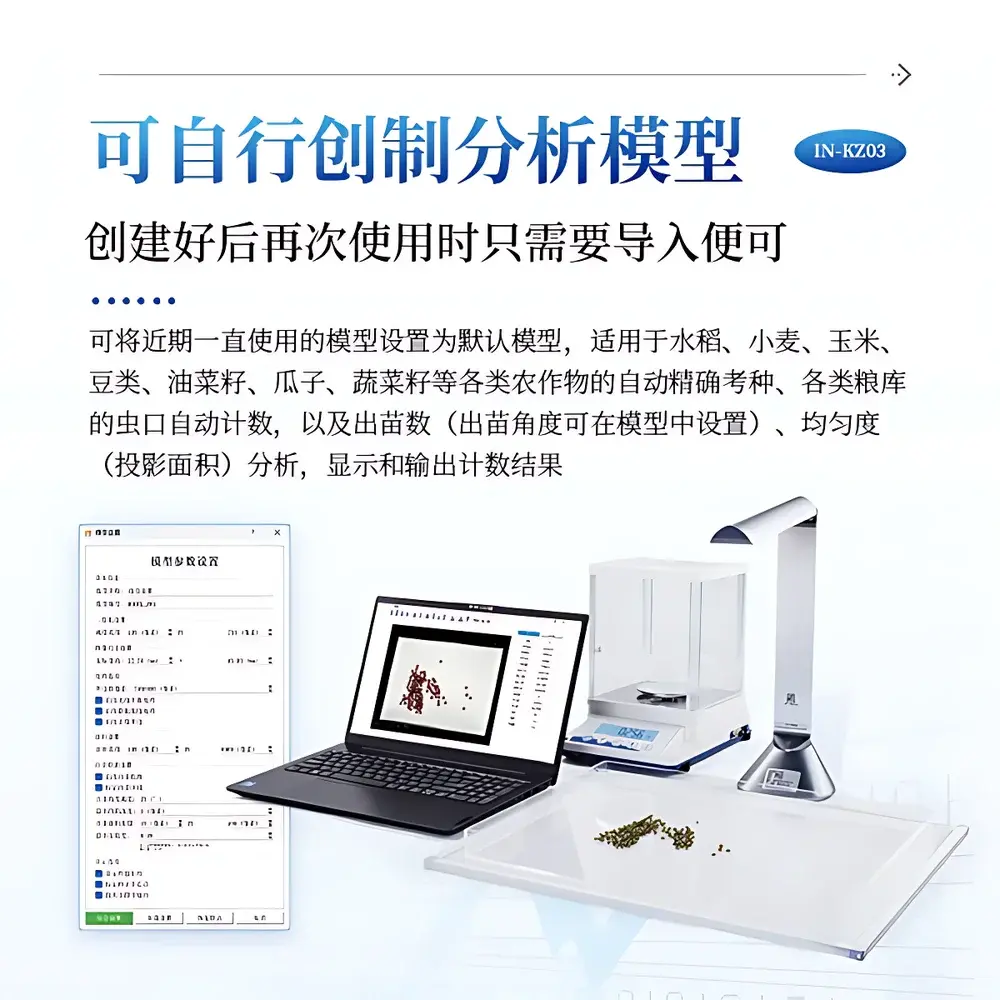
- Manual correction mode with polygonal ROI selection and drag-to-reassign functionality for borderline or overlapping seeds
- Bilingual UI (English/Chinese) with context-aware terminology mapping and one-click language toggle
Sample Compatibility & Compliance
The KZ02 accommodates dry, intact, surface-smooth seeds ranging from 0.5 mm (e.g., lettuce, carrot) to 20 mm (e.g., maize, sunflower). For species with heterogeneous morphology—such as rice—it supports sequential analysis of wind-sorted fractions (filled vs. unfilled grains) to compute physiological parameters like spikelet fertility rate. Sample preparation requires no staining, coating, or mounting; seeds are simply dispersed in a monolayer on the backlight stage. The system complies with ASTM D7293–18 (Standard Practice for Digital Image Analysis of Seeds) and aligns with FAO/IBPGR guidelines for seed quality assessment. All image metadata—including timestamp, exposure settings, lens calibration ID, and software version—is embedded in EXIF headers to support audit trails in regulated environments.
Software & Data Management
The proprietary Windows-native application (v3.2+, compatible with Windows 10/11 64-bit) features a modular architecture supporting role-based access control, audit logging, and electronic signature capture—enabling partial compliance with FDA 21 CFR Part 11 requirements when deployed with validated IT infrastructure. Each analysis session generates a self-contained project folder containing raw TIFF images, annotated overlays (PNG), structured CSV metadata, and a dynamic HTML summary report. Batch processing allows queued analysis of multiple trays or time-series acquisitions. Export options include Excel (.xlsx) with formula-locked columns for TSW derivation, PDF reports with embedded graphs (bar charts of mean length/width distribution, scatter plots of area vs. perimeter), and ZIP archives for LIMS integration. All data files conform to UTF-8 encoding and ISO 8601 timestamp formatting.
Applications
- Field trial yield estimation via panicle seed count and weight extrapolation
- Early-generation breeding line screening for grain size uniformity and shape stability
- Post-harvest quality assurance in certified seed production facilities
- Phenotypic characterization in gene function studies (e.g., mutants affecting grain development)
- Seed lot certification per national standards (e.g., GB/T 3543.3–1995 in China, ISTA Rules Annex A5)
- Educational use in plant science curricula for digital morphometrics training
FAQ
What seed types are supported without preprocessing?
Dry, non-translucent, surface-smooth seeds between 0.5 mm and 20 mm in maximum dimension—such as wheat, soybean, sorghum, and rapeseed—require no pretreatment. Rice and other paddy-type seeds must be pre-sorted (e.g., air-screened or gravity-separated) into filled/unfilled fractions prior to individual analysis.
Does the system require external calibration standards?
No. The KZ02 performs automatic optical calibration at startup using built-in reference patterns and lens distortion maps stored in firmware. Users may optionally validate scale accuracy using NIST-traceable micrometer slides.
Can the software run on virtual machines or cloud desktops?
Yes, provided the host system allocates direct USB access to the camera and meets minimum GPU-accelerated rendering requirements (DirectX 12-compatible iGPU or discrete GPU with ≥2 GB VRAM).
Is raw image data retained after analysis?
Yes. Every acquired frame is saved losslessly in 16-bit TIFF format with embedded EXIF metadata, enabling retrospective reprocessing with updated algorithms or third-party tools.
How is measurement uncertainty quantified for TSW results?
The software propagates uncertainty from both seed count variance (Poisson-distributed) and balance resolution (user-defined, e.g., ±0.001 g), reporting expanded uncertainty (k=2) alongside nominal TSW values in all export formats.





