


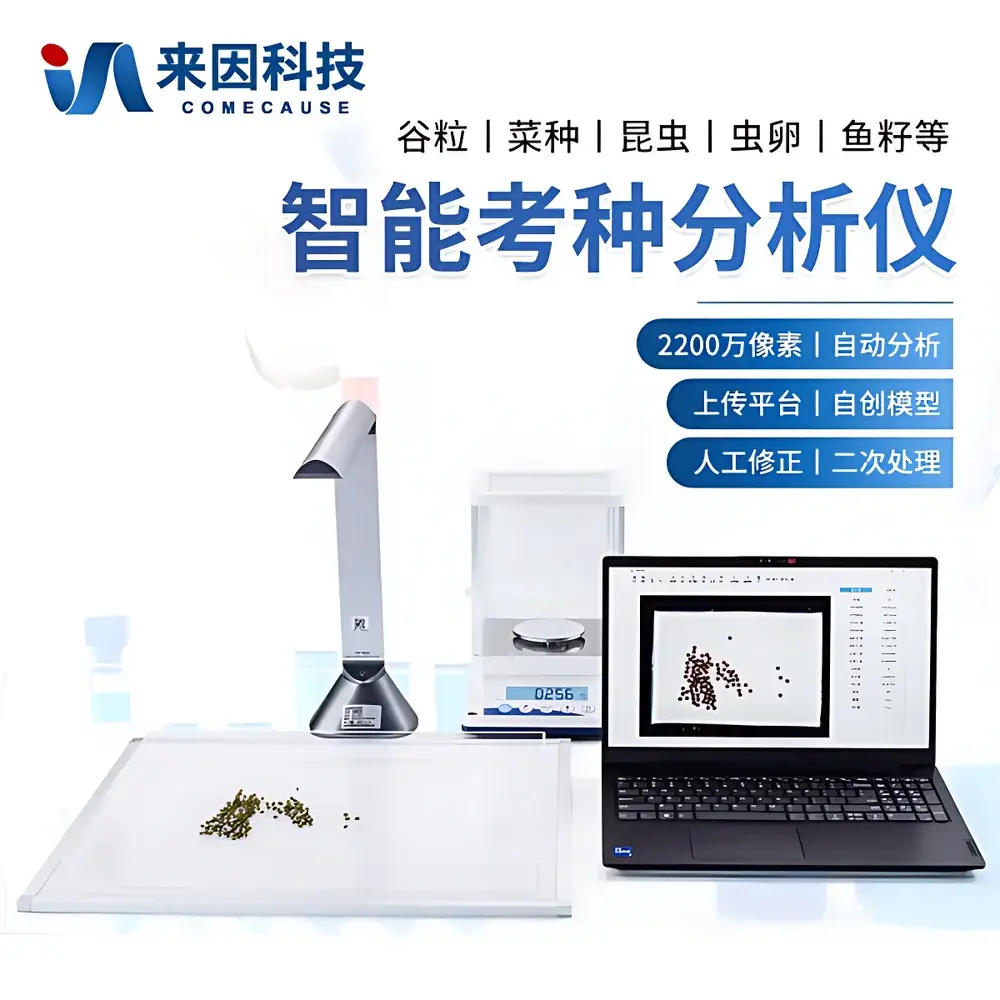
COMECAUSE IN-KZ03 Smart Seed Analysis System for Wheat and Cereal Grains
| Brand | COMECAUSE |
|---|---|
| Origin | Shandong, China |
| Manufacturer | COMECAUSE Co., Ltd. |
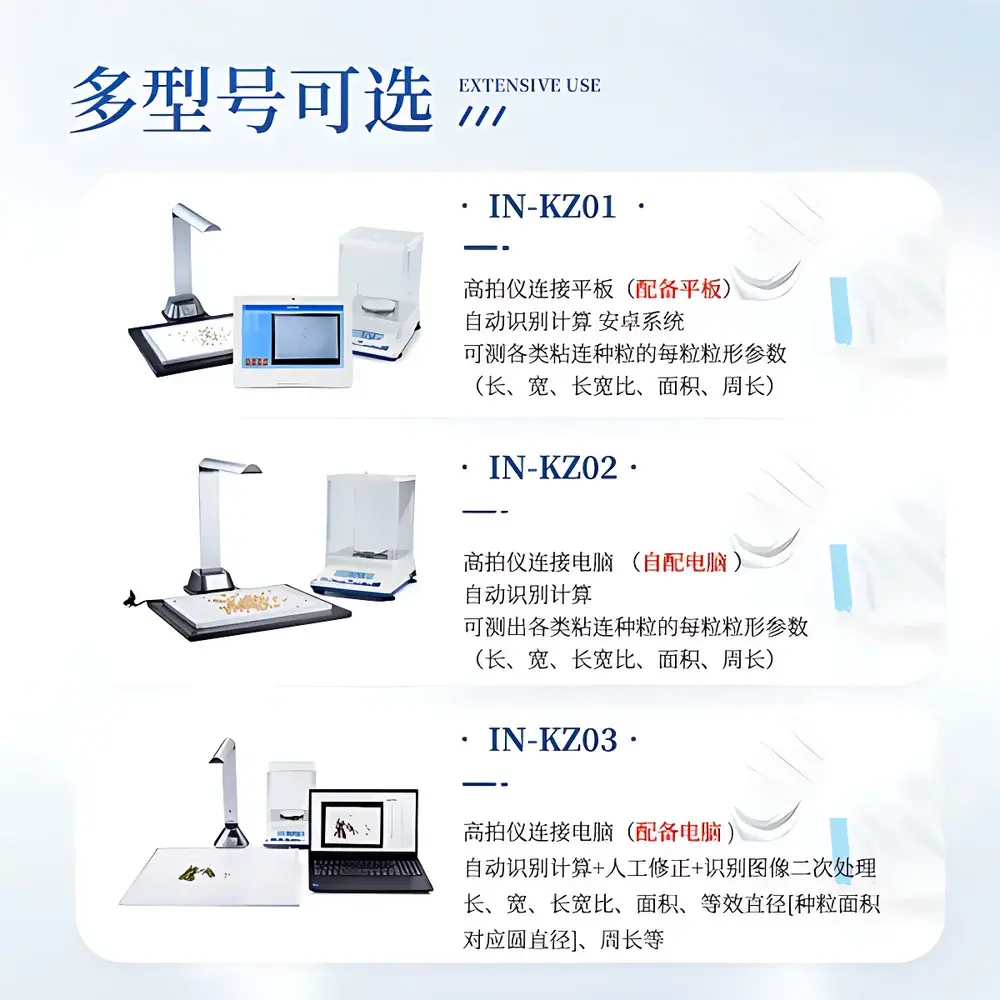
| Model | IN-KZ03 |
| Camera Resolution | 22 MP Color Imaging System |
| Backlight Panel | A3-sized Ultra-Thin Uniform LED Lightpad with Auto-Distortion & Illumination Uniformity Correction |
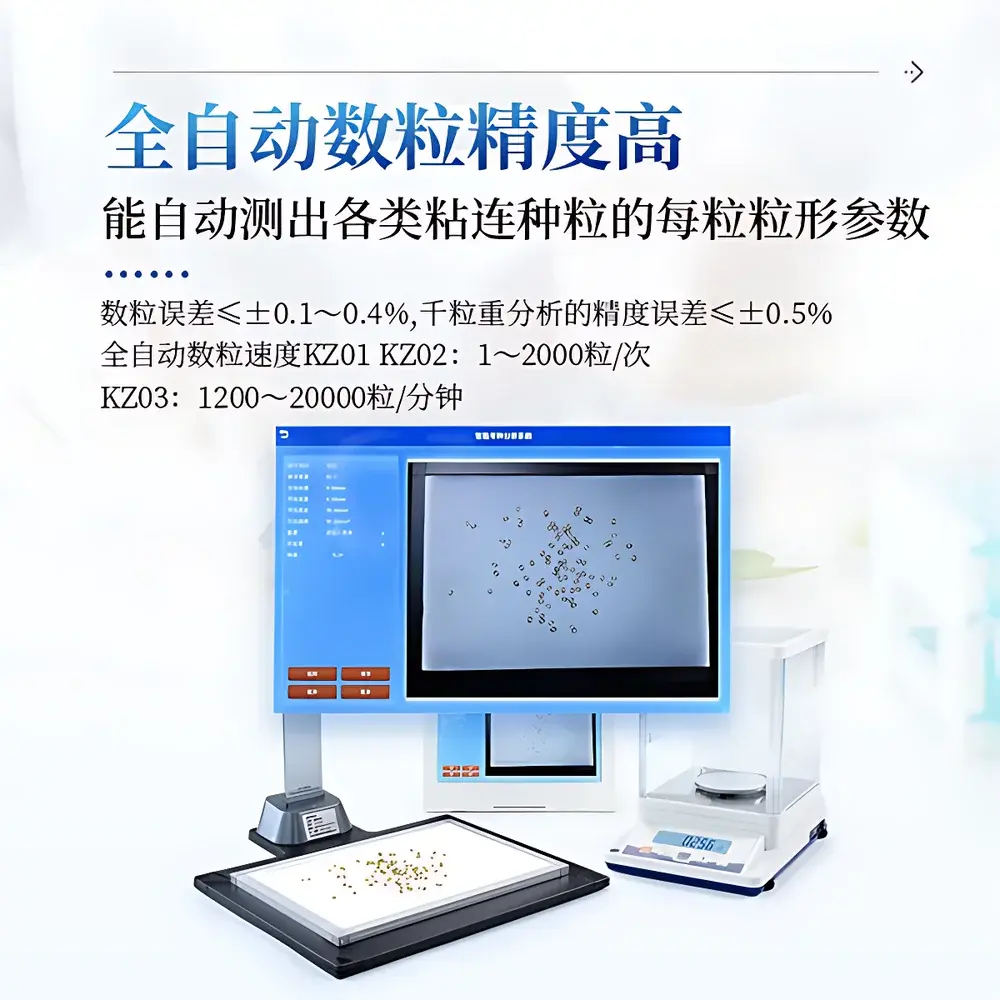
| Counting Speed | 1,200–20,000 seeds/min |
| Counting Accuracy | ≤ ±0.1–0.4% |
| Thousand-Seed Weight (TSW) Accuracy | ≤ ±0.5% |
| Measurable Seed Diameter Range | 0.5–20 mm |
| Seed Morphology Parameters | Length, Width, Aspect Ratio, Projected Area, Equivalent Diameter (Circle Diameter of Same Area), Perimeter, Bounding Rectangle |
| Software | Customizable AI-Based Seed Classification Models |
| Data Output | CSV, Sorted Distribution Charts (by Width/Length/Area), Measurement Heatmaps |
| Interfaces | RS232 (for Balance & Barcode Scanner), USB |
| Standard Accessories | 220g × 1 mg Precision Balance, Imaging Tray, Calibration Tools, Software License & USB Drive |
Overview
The COMECAUSE IN-KZ03 Smart Seed Analysis System is an automated digital imaging platform engineered for high-throughput, non-destructive morphometric analysis of agricultural seeds and small biological particles. It operates on the principle of high-resolution top-down color imaging combined with calibrated backlight illumination, enabling pixel-accurate segmentation and geometric parameter extraction via adaptive computer vision algorithms. Designed specifically for seed science laboratories, grain quality control units, and national seed certification agencies, the system delivers traceable, repeatable measurements compliant with international seed testing standards—including ISTA (International Seed Testing Association) guidelines for purity analysis, thousand-seed weight determination, and morphological characterization. Its core architecture integrates a 22-megapixel industrial-grade camera, an A3-format uniform LED backlit stage with real-time optical distortion correction, and a deterministic image processing engine capable of resolving sub-millimeter features across heterogeneous seed populations.
Key Features
- 22 MP color imaging sensor coupled with auto-corrected A3 backlit stage ensures consistent illumination and minimal lens-induced geometric error—critical for ISO 5725-compliant reproducibility in seed dimension measurement.
- Automated batch analysis of seed images with throughput ranging from 1,200 to 20,000 seeds per minute; counting accuracy validated at ≤ ±0.4% under routine operational conditions.
- Thousand-seed weight (TSW) calculation derived from combined image-based particle count and RS232-linked precision balance input (220 g × 1 mg resolution), achieving ≤ ±0.5% relative error against gravimetric reference standards.
- Configurable morphology engine computes 9 standardized descriptors per seed: length, width, aspect ratio, projected area, equivalent diameter, perimeter, convex hull area, solidity, and bounding rectangle coordinates.
- Self-adaptive classification module supports supervised learning of species- or variety-specific phenotypic signatures using user-provided annotated training sets—enabling differentiation of filled vs. shriveled grains (e.g., paddy rice vs. empty glumes) without manual threshold tuning.
- Integrated RS232 interface accepts real-time mass data from external analytical balances and barcode inputs for sample traceability—supporting GLP-aligned workflow documentation.
- Manual refinement tools allow pixel-level correction: users may add, delete, or reclassify individual objects using freehand, rectangular, or circular ROI selection directly within the analysis interface.
Sample Compatibility & Compliance
The IN-KZ03 accommodates a broad spectrum of botanical materials including but not limited to wheat, rice, maize, soybean, rapeseed, sunflower, vegetable seeds, and entomological specimens such as stored-product insect eggs (e.g., Sitophilus oryzae, Aphis gossypii) and fish roe. Its 0.5–20 mm measurable diameter range covers >98% of commercially relevant cereal and oilseed taxa. For compliance, the system facilitates adherence to ISTA Rule 5 (Purity Analysis), Rule 6 (Germination Testing Support), and OECD Seed Schemes for varietal identification. All measurement metadata—including timestamp, operator ID, instrument calibration status, and software version—is embedded in exported CSV reports, satisfying audit requirements under ISO/IEC 17025 and FDA 21 CFR Part 11 when deployed with electronic signature-enabled configurations.
Software & Data Management
The proprietary COMECAUSE SeedVision™ software provides a modular, model-driven environment for method development and routine operation. Users define analytical protocols via intuitive drag-and-drop workflows: selecting illumination presets, configuring segmentation parameters (intensity threshold, size filter, connectivity rules), and assigning class labels. Trained models are serialized and stored locally or on network drives, with version history tracking for regulatory review. Export formats include UTF-8 encoded CSV files compatible with Excel, WPS, and statistical packages (R, Python pandas); graphical outputs include ranked distribution histograms, scatter plots of length vs. width, and spatial heatmaps visualizing size heterogeneity across the imaging tray. Audit trails record all user actions, parameter modifications, and result exports—essential for GMP/GLP validation.
Applications
- Official seed certification labs performing purity analysis and TSW determination per ISTA or national regulatory frameworks (e.g., China’s GB/T 3543.3–1995).
- Plant breeding programs quantifying phenotypic variation in grain morphology across segregating populations or mutant lines.
- Grain storage facilities conducting rapid insect infestation assessment via automated egg or adult pest enumeration on grain surfaces.
- Seed processing plants verifying post-cleaning purity levels and detecting mechanical damage indicators (cracks, chips, discoloration) through shape anomaly detection.
- Academic research in seed physiology, dormancy studies, and abiotic stress response where precise morphometric datasets inform regression modeling.
FAQ
Does the IN-KZ03 support multi-species analysis in a single run?
Yes—the system allows concurrent classification of up to eight user-defined categories within one image batch, provided distinct morphological or chromatic features exist between classes.
Can it distinguish between viable and non-viable seeds?
Not inherently via morphology alone; however, when integrated with external viability assays (e.g., tetrazolium staining), the platform can quantify stained vs. unstained regions using customizable color-space thresholds.
Is remote software update capability available?
Firmware and application updates are delivered via encrypted USB media; network-based deployment is restricted to on-premise intranet environments for security compliance.
What calibration standards are recommended for daily verification?
A NIST-traceable ceramic step gauge (1–20 mm) and certified seed reference samples (e.g., ISTA-certified wheat standards) are advised for optical and morphometric validation.
How is data integrity ensured during long-duration batch processing?
All intermediate image buffers and processed results are written to non-volatile storage with checksum validation; interrupted jobs resume from last stable checkpoint without data loss.






