
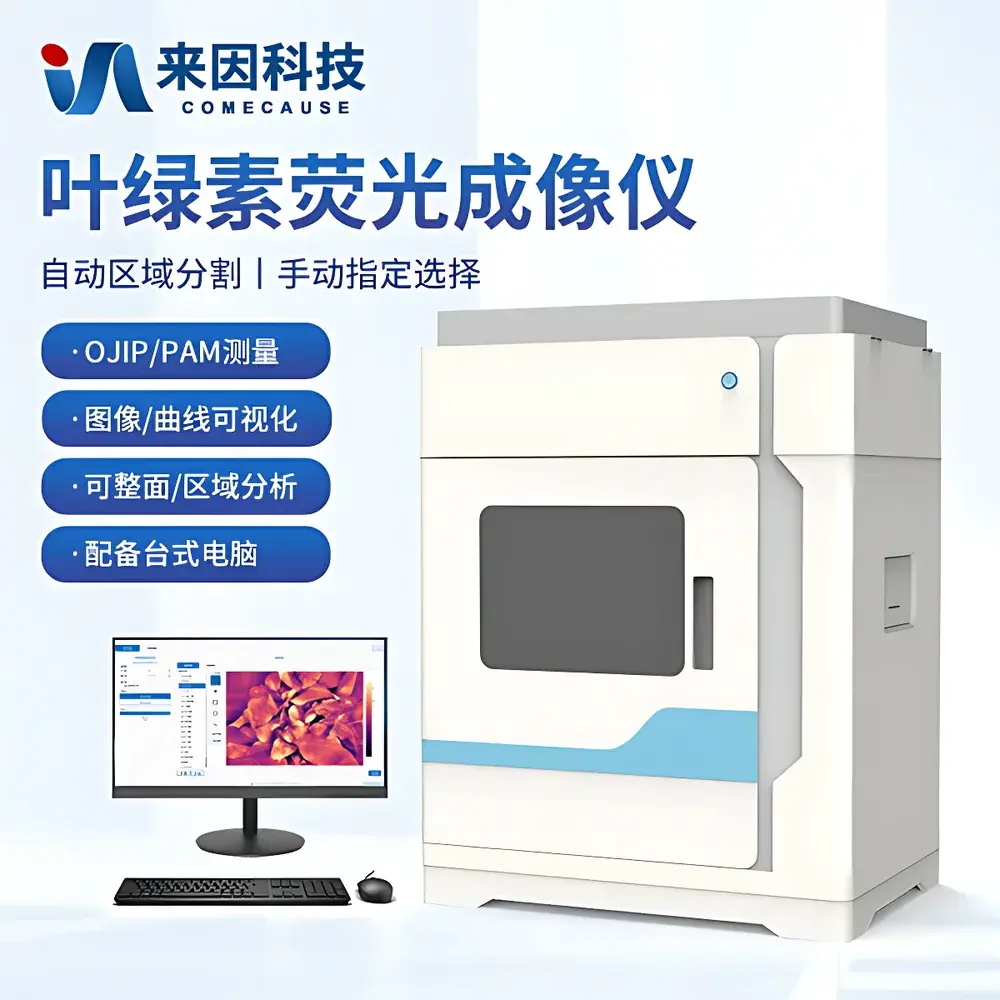
COMECAUSE IN-LeafClear Chlorophyll Fluorescence Imaging System
| Brand | COMECAUSE |
|---|---|
| Origin | Shandong, China |
| Manufacturer Type | Direct Manufacturer |
| Model | IN-LeafClear |
| Camera Resolution | 1608 × 1104 (12-bit) |
| Pixel Size | 9 µm × 9 µm |
| Frame Rate | 100 fps |
| Lens Focal Length | 12 mm |
| Max Aperture | F/2.8 (adjustable) |
| HFOV | 62.11° |
| VFOV | 44.83° |
| Max Imaging Area | 50 cm × 35 cm |
| Excitation Wavelengths | 450 nm (blue), 630 nm (red), 730 nm (far-red) |
| LED Irradiance Range | 90–1440 µmol/(m²·s) |
| OJIP Acquisition Duration | 0.1–1.0 s (10 ms min interval) |
| PAM Sampling Interval | 100 ms min |
| Fluorescence Dynamic Range | 0–4095 (12-bit) |
| SNR | >100:1 |
| Repeatability (CV) | <3% |
| Fv/Fm Accuracy | ±0.005 |
| ΦPSII Accuracy | ±0.01 |
| Spatial Resolution | ~0.3 mm/pixel (at 50 cm × 35 cm FOV) |
Overview
The COMECAUSE IN-LeafClear Chlorophyll Fluorescence Imaging System is a research-grade, non-invasive optical instrumentation platform engineered for quantitative, spatially resolved analysis of photosynthetic performance in intact plant leaves. It operates on the physical principle of chlorophyll a fluorescence induction—where absorbed light energy not utilized in photochemistry or dissipated as heat is re-emitted as red/near-infrared photons—and captures transient fluorescence kinetics with high temporal and spatial fidelity. The system integrates two complementary measurement paradigms: (1) OJIP transient analysis, which resolves sub-second fluorescence rise kinetics following saturating illumination to probe PSII reaction center integrity, electron transport chain efficiency, and energy partitioning; and (2) Pulse-Amplitude-Modulated (PAM) fluorometry, which enables real-time, actinic-light-dependent quantification of photochemical quenching (qP), non-photochemical quenching (NPQ), and effective quantum yield (ΦPSII) under physiologically relevant irradiance regimes. Designed for reproducible laboratory and controlled-environment applications, the IN-LeafClear supports standardized experimental protocols aligned with established plant physiology frameworks including the JIP-test formalism and the Kramer–Schreiber model for linear electron transport estimation.
Key Features
- High-fidelity CMOS imaging sensor (1608 × 1104, 12-bit, 100 fps) optimized for low-noise fluorescence capture at microsecond-scale temporal resolution
- Dual-mode excitation architecture: independently controllable 450 nm blue LEDs (for OJIP saturation pulses and Fm/Fm′ determination), 630 nm red LEDs (for actinic illumination in PAM mode), and 730 nm far-red LEDs (for preferential PSI-driven QA oxidation during Fo′ measurement)
- Precisely calibrated irradiance control (90–1440 µmol/(m²·s), 1%–100% stepwise adjustment) traceable to photobiological photon flux standards
- Optimized optical path: fixed 12 mm focal length lens with F/2.8 variable aperture, delivering uniform illumination and minimal vignetting across a 50 cm × 35 cm field of view at standard working distance
- Real-time spatial parameter mapping: generates pixel-wise distributions of >40 biophysically derived parameters—including Fv/Fm, ΦPSII, NPQ, PIABS, Mo, Area, ABS/RC, ETo/RC, and REo/RC—using validated JIP-test and PAM-derived algorithms
- Robust hardware synchronization: sub-millisecond LED triggering (<1 ms rise time) and camera exposure gating ensure temporal alignment between stimulus delivery and fluorescence acquisition
Sample Compatibility & Compliance
The IN-LeafClear accommodates flat, intact leaf samples up to 50 cm × 35 cm without compression or sectioning, preserving native stomatal and mesophyll architecture. It supports dark-adapted measurements (0–3600 s user-defined), multi-cycle PAM protocols (1–100 light/dark cycles), and dynamic recovery monitoring under controlled thermal and humidity conditions when integrated with environmental chambers. All fluorescence parameters adhere to internationally accepted definitions outlined in the International Society of Photosynthesis Research (ISPR) guidelines and are computationally consistent with ISO 17025–traceable calibration practices for optical biosensors. Data acquisition workflows comply with GLP principles: full audit trail logging (user, timestamp, instrument state, parameter settings), electronic signature support, and metadata embedding per image frame and parameter table. While not FDA 21 CFR Part 11–certified out-of-the-box, the software architecture supports configuration for regulated environments through configurable audit logs and export controls.
Software & Data Management
The IN-LeafClear Control Suite is a native Windows application featuring dual-language UI (English/Chinese), modular workflow navigation, and deterministic parameter persistence. Measurement configurations—including OJIP duration, PAM cycle count, actinic intensity, saturation pulse amplitude, and sampling intervals—are saved automatically to versioned XML profiles. Image processing includes adaptive Gaussian denoising, Jet-based pseudocolor scaling with user-defined min/max bounds, and region-of-interest (ROI) definition via freehand, rectangular, or circular selection tools. ROI statistics (mean, SD, min/max) update in real time across all parameter maps. Batch export supports PNG (lossless, full-resolution), CSV (tabular parameters with units), and Excel-compatible XLSX formats. File naming follows ISO-compliant convention: “[Mode]_[SequenceID]_[ParameterName].png” (e.g., “OJIP_001_FvFm.png”). Raw fluorescence time-series data (intensity vs. time, 10 ms resolution) and processed parameter matrices are stored in HDF5 format for interoperability with Python (NumPy, SciPy), MATLAB, and R analytical pipelines.
Applications
- Photosynthetic Mechanism Studies: Quantitative dissection of PSII antenna size, reaction center density, QA-to-QB electron transfer rate (via M0 and Vj), plastoquinone pool reduction status (I-step amplitude), and overall photosynthetic performance index (PIABS)
- Abiotic Stress Phenotyping: Early detection of drought-induced photoinhibition (declining Fv/Fm and PIABS), thermal damage to oxygen-evolving complex (increased F0, reduced ΦPo), and high-light acclimation (elevated NPQ and qN)
- Agricultural Trait Screening: High-throughput evaluation of cultivar-specific tolerance to nutrient deficiency, herbicide phytotoxicity, or heavy metal accumulation using spatial heterogeneity metrics (e.g., coefficient of variation across leaf area)
- Ecophysiological Field Monitoring: Integration with portable dark-adaptation chambers for pre-dawn Fv/Fm surveys; post-hoc correlation of fluorescence-derived ETR with gas-exchange measurements (A/Ci curves)
- Educational Use: Visual demonstration of light-response curves, dark relaxation kinetics, and stress-induced parameter shifts in undergraduate plant physiology laboratories
FAQ
What is the minimum detectable fluorescence signal level?
The system achieves a signal-to-noise ratio >100:1 at full well capacity, enabling reliable detection of Fo-level signals from low-fluorescing species (e.g., conifer needles) under optimal dark adaptation.
Can the IN-LeafClear be used for whole-plant or canopy-level imaging?
No—it is optimized for single-leaf or excised leaf lamina imaging within its defined 50 cm × 35 cm field of view. Canopy-scale applications require dedicated field-portable fluorometers with wider-angle optics.
Does the software support custom algorithm integration?
Yes. The SDK provides documented C++ API access to raw time-series data buffers and parameter calculation modules, permitting integration of user-defined models (e.g., alternative NPQ partitioning schemes or stress indices).
How is spatial resolution validated?
Resolution is verified using NIST-traceable USAF 1951 resolution test charts imaged under identical optical and illumination conditions; effective resolution is reported as 0.3 mm/pixel at the specified working distance and FOV.
Is remote operation supported?
The system supports LAN-based control via TCP/IP commands for integration into automated phenotyping platforms, though real-time video streaming is not implemented to preserve deterministic timing integrity.




