
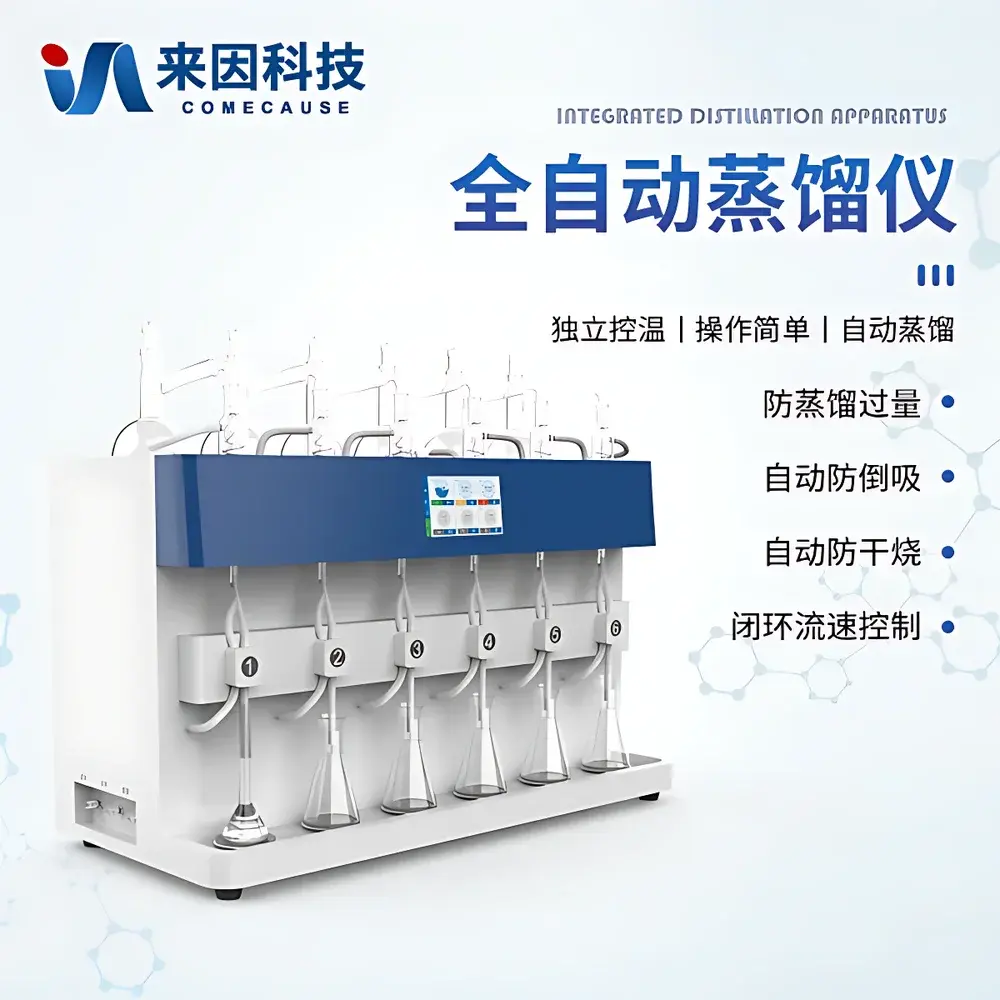
COMECAUSE IN-ZLB Intelligent Integrated Distillation Apparatus
| Brand | COMECAUSE |
|---|---|
| Origin | Shandong, China |
| Manufacturer Type | Direct Manufacturer |
| Model | IN-ZLB |
| Heating Method | Far-Infrared Ceramic Heating Bowl (Flame-Free) |
| Cooling Method | External Chilled Water Circulator or Tap Water |
| Distillation Rate | 0–10 mL/min |
| Heating Ramp Time | <20 min |
| Endpoint Control | Dual-Mode (Volume + Time) |
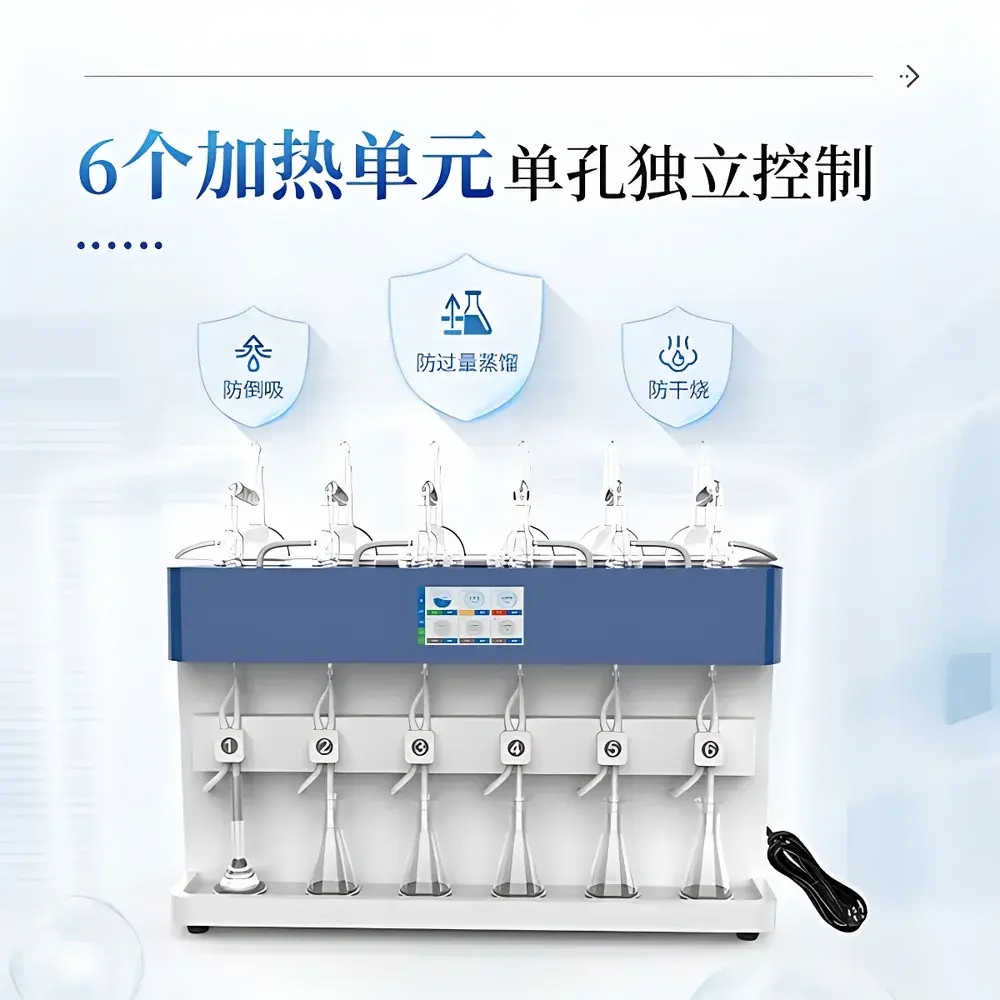
| Heating Units | 6 (Individually Controllable per Channel) |
| Distillation Volume Range | 0–500 mL |
| Accuracy | ±0.1 mL |
| Max. Heating Power per Unit | 600 W |
| Total Rated Power | 3800 W |
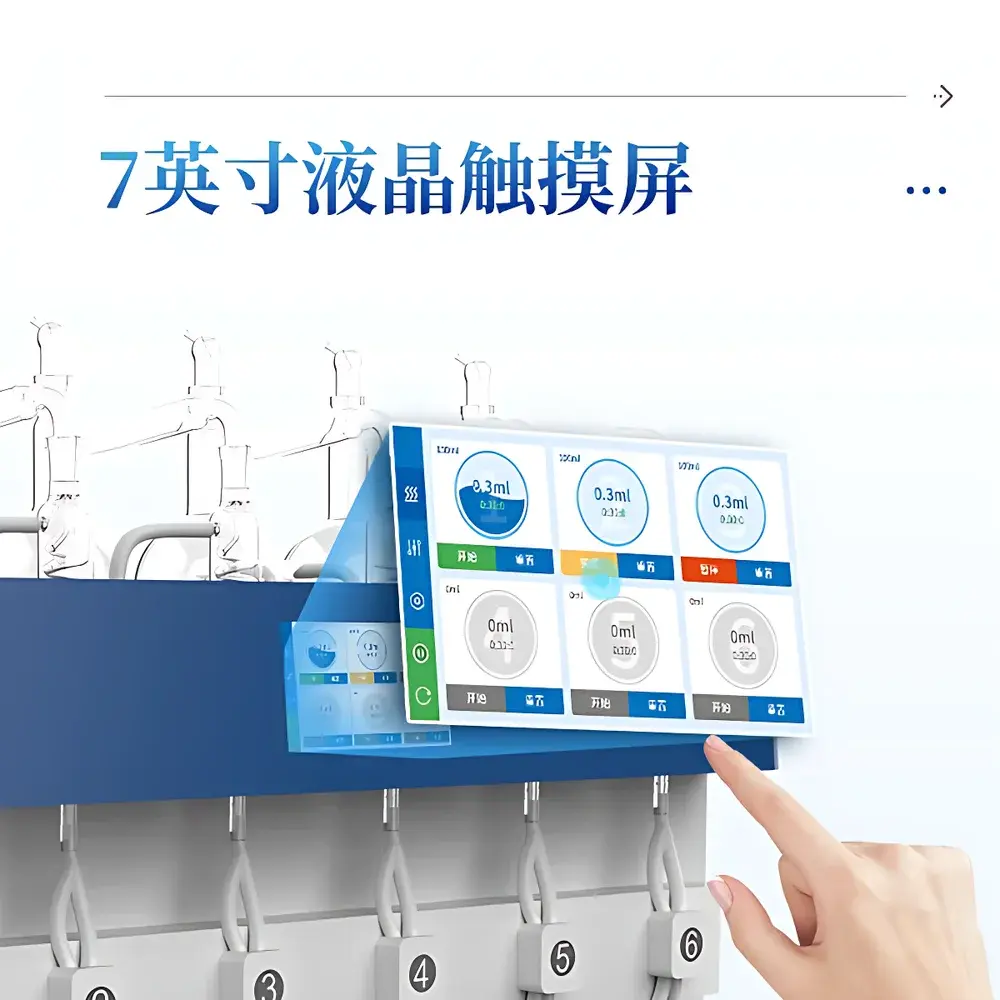
| Display | 7-inch Full-Color Touchscreen |
| Compliance | GB/T 5750.5–2023, HJ 484–2009, HJ 503–2009, HJ 502–2009, HJ 1226–2021, HJ 1191–2021, HJ 535–2009, HJ 536–2009, HJ 537–2009, HJ 745–2015, HJ 998–2018, HJ 833–2017, HJ 717–2014, GB 8538–2022, GB 5009.36–2023, GB 5009.225–2023, GB 5009.266–2016 |
| Safety Features | Anti-Suckback, Over-Distillation Prevention, Dry-Run Protection (Temperature + Flow-Based), Leakage Protection, Sealing Integrity Check |
| Software | Onboard Method Storage (≤1000 methods), Preloaded 18 Standard Methods (e.g., HJ 537–2009, GB 5009.225–2023), Auto-Load on Startup, Calibration for Volume/Weight, OTA Firmware Updates |
| Dimensions (W×D×H) | 920 × 417 × 555 mm |
| Net Weight | 75 kg (incl. glassware) |
Overview
The COMECAUSE IN-ZLB Intelligent Integrated Distillation Apparatus is a benchtop, fully automated distillation system engineered for precision, repeatability, and regulatory compliance in environmental, food safety, and public health laboratories. It implements classical wet-chemistry distillation—based on controlled thermal volatilization and condensation—within a unified, modular architecture that replaces legacy multi-component setups (separate heating mantles, condensers, receivers, and manual timers). Unlike conventional open-loop systems, the IN-ZLB integrates real-time mass-based endpoint detection with time-synchronized control logic, enabling accurate termination of distillation at user-defined volume thresholds (±0.1 mL) or elapsed time intervals (0–999 min), thereby eliminating over-distillation, sample loss, and vapor backflow. Its far-infrared ceramic heating bowls provide uniform, flame-free thermal transfer to standard 500 mL two-neck round-bottom flasks—minimizing thermal gradients and ensuring consistent boiling kinetics across all six independent channels. Designed for routine analysis of volatile analytes—including ammonia nitrogen, cyanide, phenols, sulfides, hydrazine, and ethanol—the IN-ZLB supports both batch and staggered processing workflows while maintaining full traceability and operational integrity.
Key Features
- Six independently controllable distillation channels, each equipped with dual-mode endpoint logic (volume + time), anti-suckback solenoid valves, dry-run protection (via temperature sensing and flow monitoring), and closed-loop liquid flow regulation.
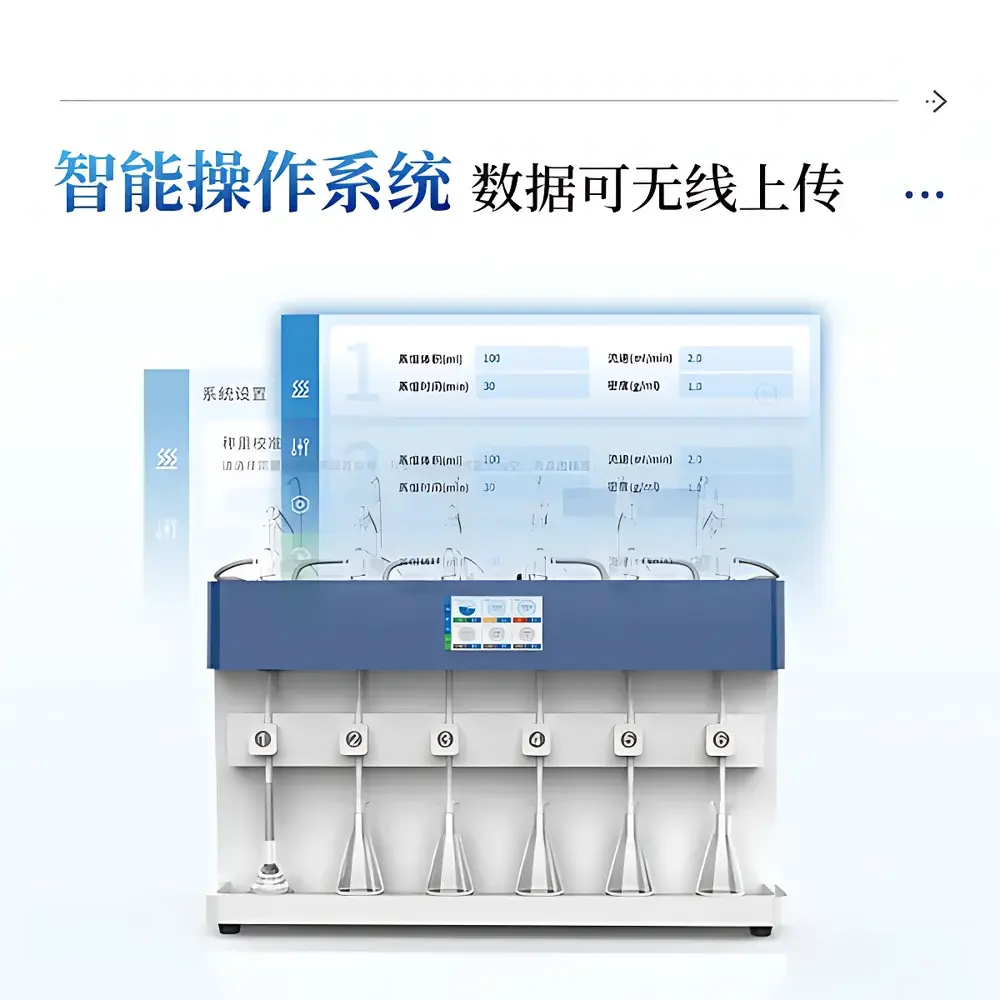
- 7-inch high-resolution color touchscreen interface with intuitive method programming, automatic calibration prompts, real-time status visualization (current volume, remaining time, power output per channel), and one-touch method recall.
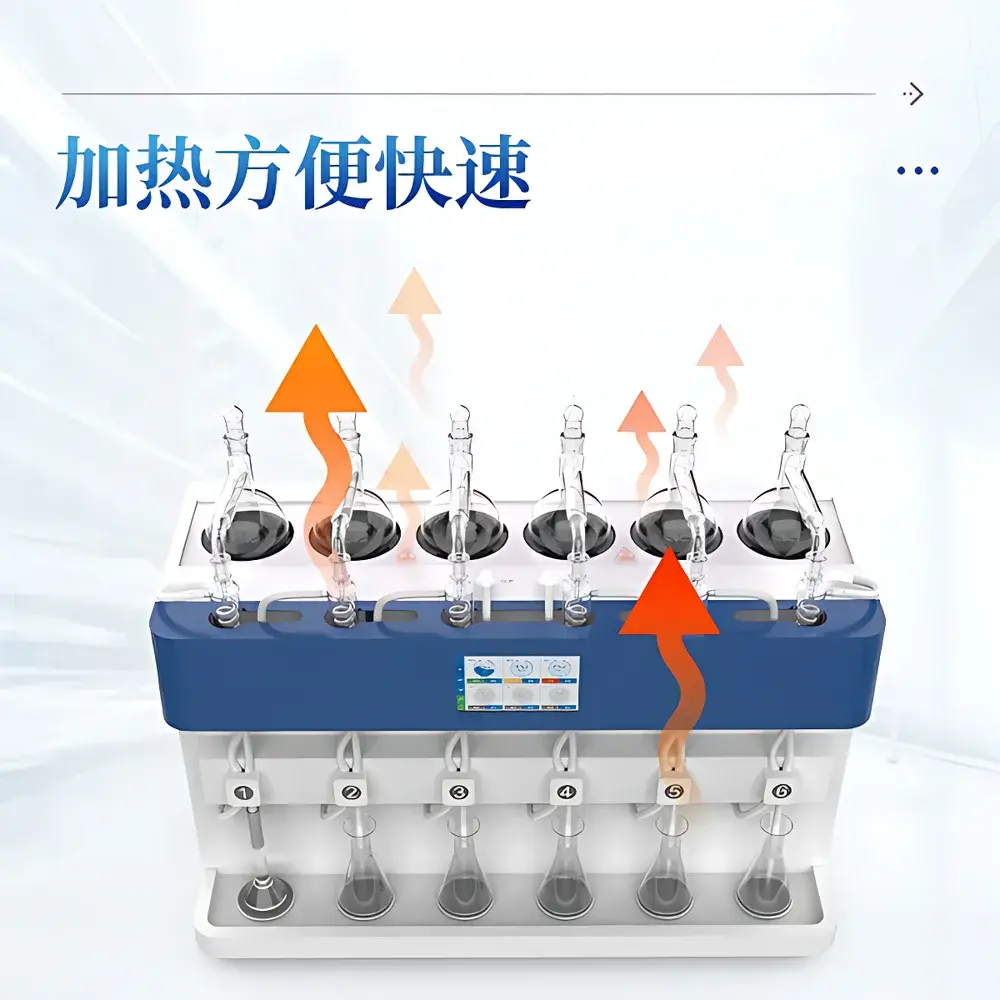
- Far-infrared ceramic heating modules with bowl-shaped geometry ensure optimal thermal coupling to round-bottom flasks; adjustable power range (0–600 W per unit) enables precise ramping and stable plateau control up to 400 °C.
- Integrated sealing integrity verification prior to run initiation, leakage current protection, and auto-shutdown upon abnormal pressure or temperature deviation.
- Onboard method library supporting ≤1000 user-defined protocols; preloaded with 18 validated national standard methods (e.g., HJ 537–2009 for ammonia nitrogen, GB 5009.225–2023 for ethanol in alcoholic beverages).
- Firmware-upgradable via Over-The-Air (OTA) connectivity, ensuring long-term compatibility with evolving analytical requirements and cybersecurity standards.
Sample Compatibility & Compliance
The IN-ZLB is validated for aqueous and semi-aqueous matrices across environmental water, wastewater, soil leachates, food extracts, and natural mineral waters. It complies with 16 major Chinese national and industry standards—including GB/T 5750.5–2023 (drinking water inorganic non-metallics), HJ 537–2009 (ammonia nitrogen by distillation–titration), HJ 503–2009 (phenols by 4-aminoantipyrine spectrophotometry), and GB 5009.266–2016 (methanol in spirits)—all of which mandate strict control over distillation duration, temperature stability, and quantitative recovery. While not certified to ISO/IEC 17025 or GLP as a standalone instrument, its audit-ready digital logbook (with timestamped method parameters, start/stop events, volume readings, and error codes) supports laboratory accreditation under CNAS-CL01 and facilitates FDA 21 CFR Part 11–compliant data handling when integrated into validated LIMS environments.
Software & Data Management
The embedded operating system records all critical process variables—including actual distilled volume (measured gravimetrically or volumetrically), cumulative heating time per channel, peak temperature, power modulation history, and fault diagnostics—in a tamper-evident binary log file. Users may export CSV-formatted reports directly via USB or network interface. Method templates include configurable fields for density correction, tare weight offset, and post-distillation rinse cycles. Automatic calibration routines verify sensor drift against reference weights before each batch. All firmware updates are cryptographically signed and require administrator authentication, aligning with IEC 62443-3-3 security guidelines for laboratory instrumentation.
Applications
- Determination of ammonia nitrogen in surface water and wastewater using distillation–acid titration (HJ 537–2009, GB 5009.36–2023).
- Quantification of total cyanide in drinking water and soil extracts via pyridine-barbituric acid spectrophotometry (HJ 484–2009, HJ 745–2015).
- Isolation of volatile phenols from environmental samples prior to 4-aminoantipyrine detection (HJ 503–2009, HJ 998–2018).
- Preparation of sulfur-free distillates for sulfide analysis by methylene blue spectrophotometry (HJ 1226–2021, HJ 833–2017).
- Alcohol content determination in fermented beverages per GB 5009.225–2023 (distillation followed by densitometry or GC-FID).
- Kjeldahl nitrogen digestion support in soil testing (HJ 717–2014), where precise ammonia liberation is essential for total nitrogen quantification.
FAQ
What types of receiving vessels are compatible with the IN-ZLB?
Standard 250 mL Erlenmeyer flasks or volumetric receivers (supplied) are used; custom adapters support alternative container geometries up to 500 mL capacity.
Does the system support unattended overnight operation?
Yes—dual-mode endpoint control, dry-run safeguards, and automatic shutdown ensure safe,无人值守 (unmanned) execution of extended distillation protocols.
Can the IN-ZLB be integrated into a laboratory information management system (LIMS)?
Raw data export (CSV) and timestamped event logs enable seamless integration with third-party LIMS platforms; API access requires optional software licensing.
Is external cooling water mandatory, or can tap water be used continuously?
Tap water is acceptable for short-duration runs (<2 hr); for reproducible condensation efficiency and prolonged operation, a recirculating chiller (5–15 °C output) is strongly recommended.
How is volume accuracy verified during operation?
Gravimetric calibration is performed using certified weights prior to first use and after any mechanical service; onboard software applies linear compensation based on ambient temperature and density inputs.



