
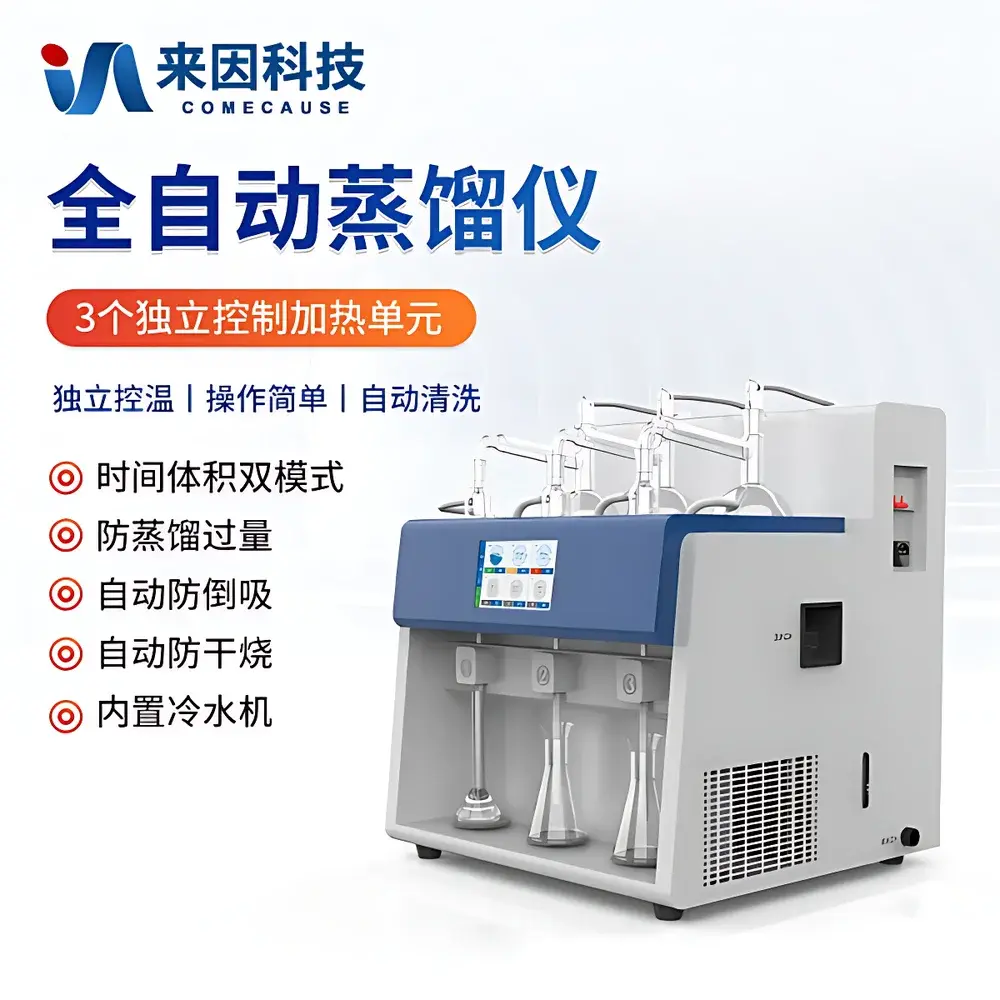
COMECAUSE IN-ZLE Automated Distillation System
| Brand | COMECAUSE |
|---|---|
| Origin | Shandong, China |
| Manufacturer Type | Direct Manufacturer |
| Model | IN-ZLE |
| Heating Method | Far-Infrared Ceramic Heating Bowl |
| Cooling Method | Integrated Closed-Loop Chiller (5–25 °C) |
| Distillation Rate | 0–12 mL/min |
| Heating Ramp Time | <20 min |
| Endpoint Control | Volume + Time |
| Heating Channels | 3 |
| Distillation Precision | ±0.1 mL |
| Max Heating Temp | 400 °C |
| Power per Channel | 600 W |
| Total Rated Power | 2000 W |
| Dimensions (W×D×H) | 560 × 533 × 634 mm |
| Weight | 46 kg (main unit + glassware) |
| Safety Features | Anti-suckback, Dry-run Protection, Overfill Prevention, Automatic Leak Test (≥−80 kPa), Auto-Backflush, Auto-Cleaning |
| Control Interface | 7″ Capacitive Touchscreen |
| Method Storage | Up to 1000 user-defined methods + 18 preloaded Chinese national standard (GB/HJ) methods |
| Compliance | Designed for GB/T 5750, HJ 484, HJ 503, HJ 537, HJ 745, GB 5009 series, and other water/soil/food distillation-based analytical standards |
Overview
The COMECAUSE IN-ZLE Automated Distillation System is an engineered solution for standardized, high-reproducibility distillation in environmental, food, and agricultural laboratories. It operates on the principle of controlled thermal separation—applying precise far-infrared ceramic heating to sample solutions within standardized 500 mL spherical-bottom flasks, followed by condensation and volumetric collection of distillates under closed-loop temperature-regulated cooling. Unlike manual or semi-automated setups, the IN-ZLE integrates full process autonomy: from initial system integrity verification (vacuum leak test ≥−80 kPa) and pre-heating ramp control (<20 min to target temperature), through real-time distillate flow monitoring and dual-parameter endpoint detection (volume + time), to post-run auto-cleaning and condenser backflush. Its architecture supports method-driven workflows compliant with ISO/IEC 17025–aligned laboratory practices, where traceability, repeatability, and operator-independent execution are prerequisites—not features.
Key Features
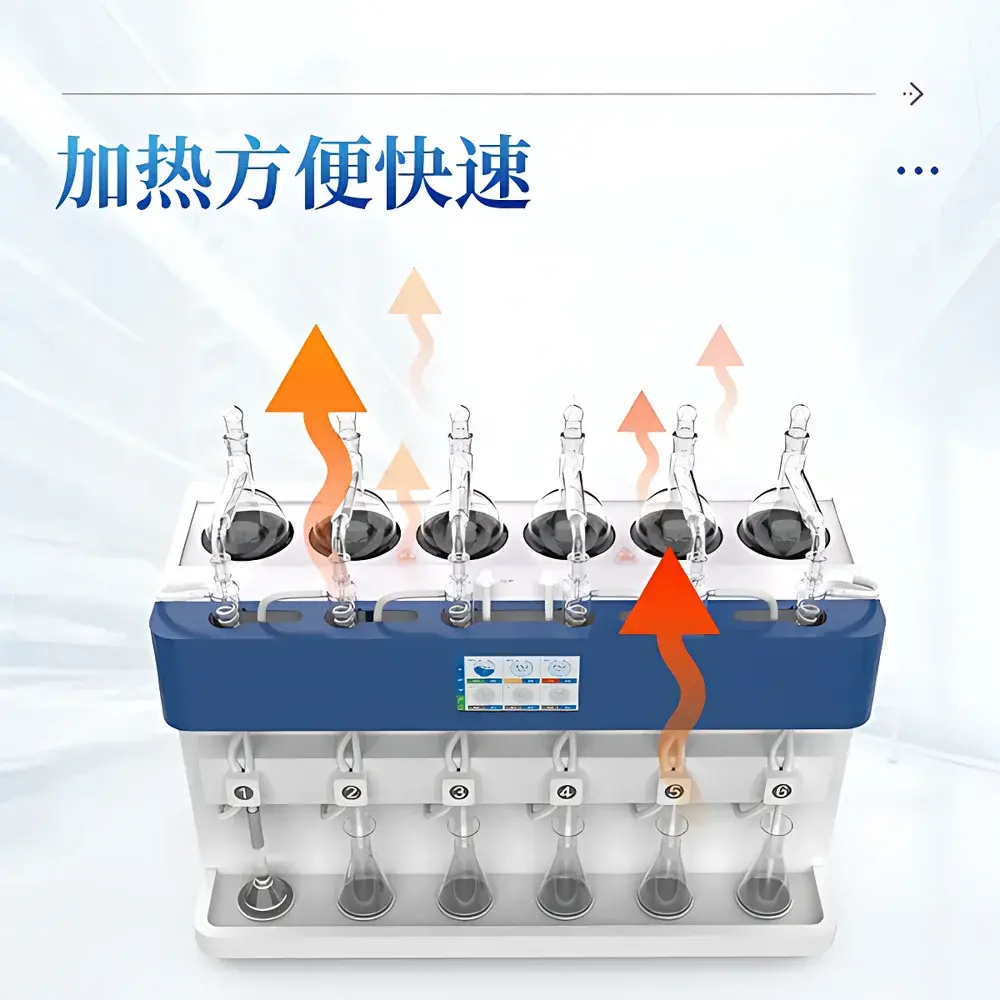
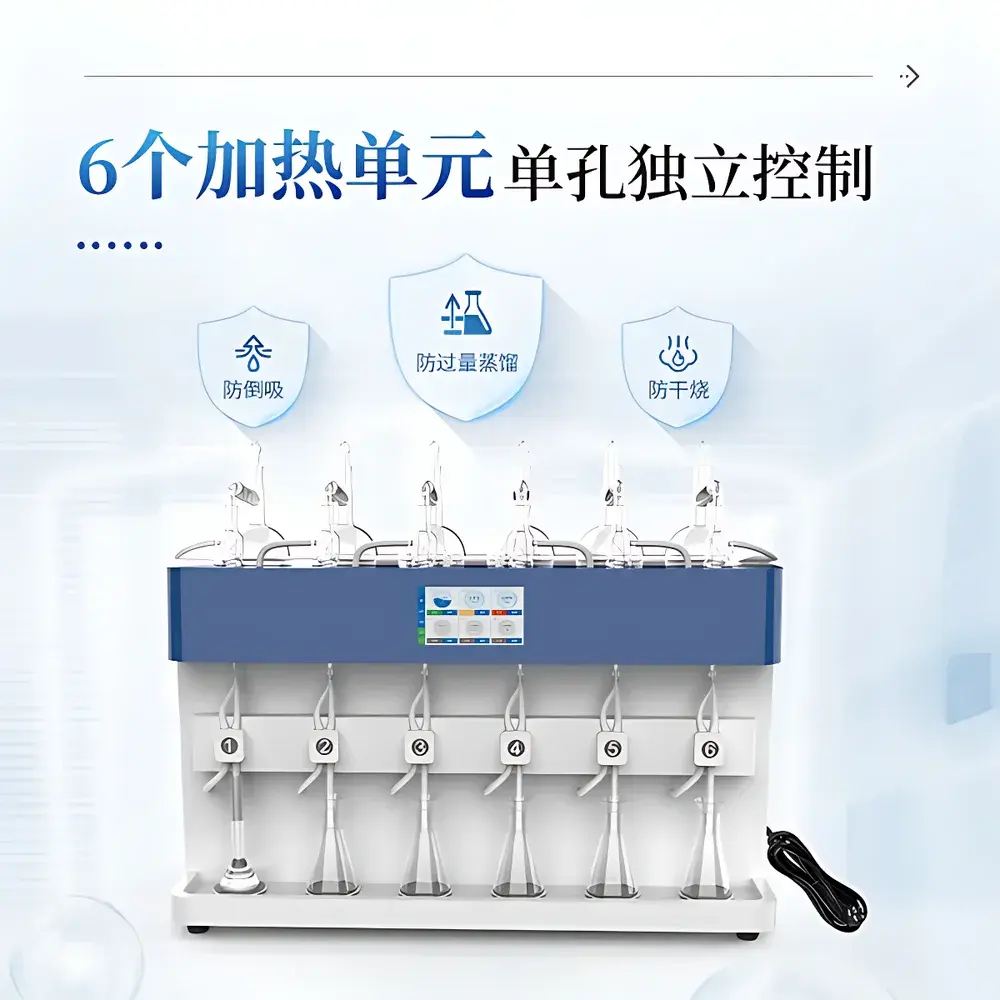
- Triple independent heating channels: Each 600 W far-infrared ceramic heating bowl operates autonomously with individual temperature ramping, power modulation, and endpoint logic—enabling parallel analysis of heterogeneous samples without cross-contamination or thermal interference.
- Closed-loop chiller integration: Built-in refrigeration unit maintains condenser coolant at a stable 5–25 °C with ±0.5 °C setpoint accuracy, eliminating dependency on external tap water or recirculating chillers and ensuring consistent condensation efficiency across ambient fluctuations.
- Dual-mode endpoint detection: Combines gravimetric/volumetric measurement (±0.1 mL resolution) with programmable time limits (0–999 min), allowing method-specific termination criteria—e.g., fixed-volume collection for ammonia nitrogen (HJ 537-2009) or timed distillation for volatile phenols (HJ 503-2009).
- Robust safety architecture: Real-time dry-run prevention via temperature-rate-of-change monitoring; anti-suckback valves activated upon pressure differential reversal; overfill cutoff triggered by liquid-level sensors in 250 mL receiving vessels; and automatic system purge after each run.
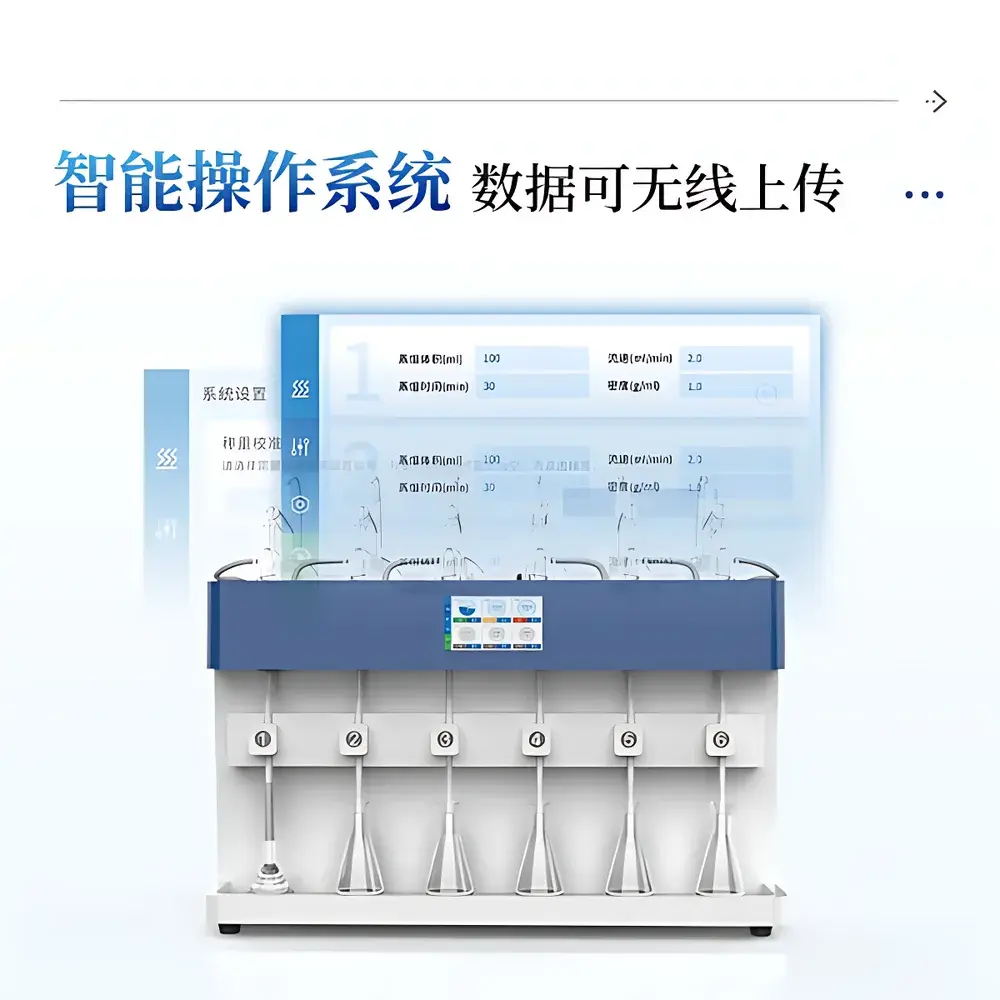
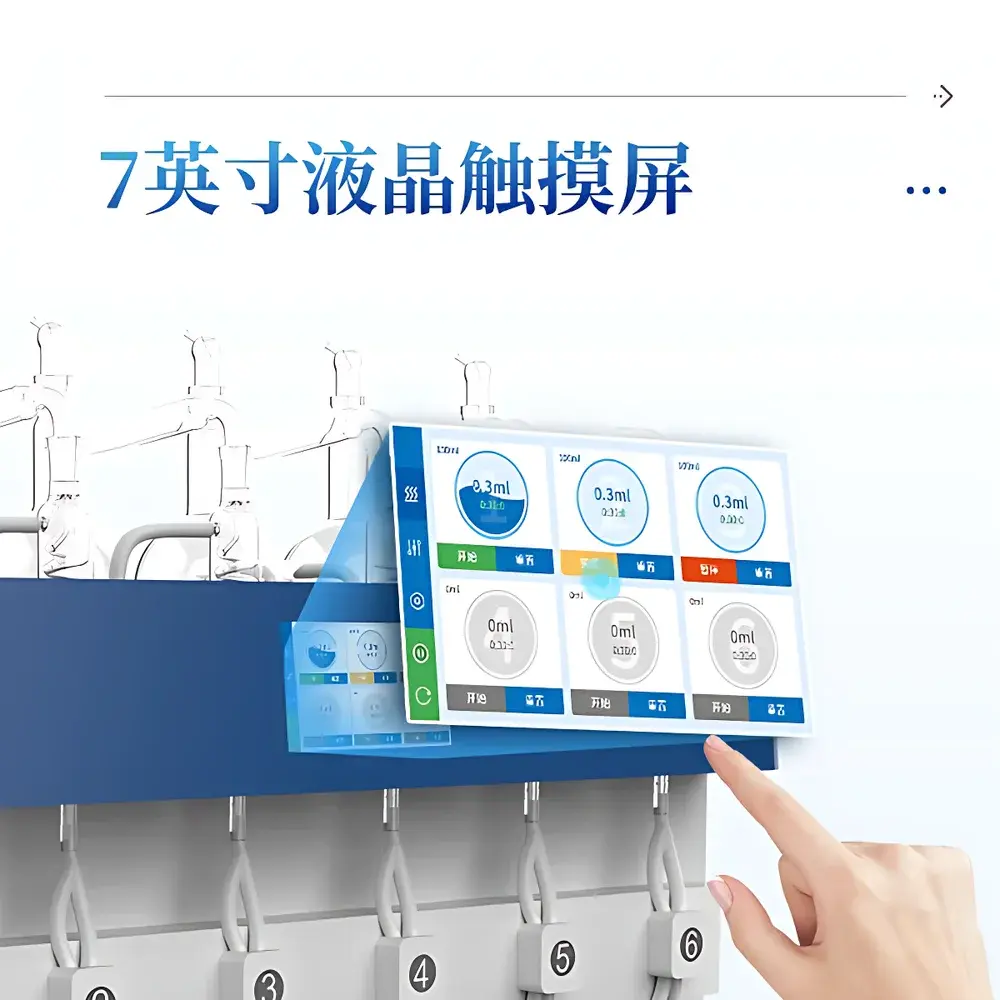
- Method-centric touchscreen interface: 7″ capacitive display supports creation, naming, versioning, and recall of up to 1000 user-defined protocols. Eighteen preloaded Chinese national standard methods—including GB 5009.36 (cyanide), HJ 537 (ammonia nitrogen), and HJ 745 (soil cyanide)—are validated against original regulatory text and instrument response curves.
Sample Compatibility & Compliance
The IN-ZLE is validated for aqueous matrices (drinking water, wastewater, leachates), digested soil/sediment extracts, and homogenized food composites (e.g., alcoholic beverages, dairy, grain products). Its 500 mL ball-joint round-bottom flasks accommodate standard Kjeldahl digestion residues, alkaline distillation mixtures for cyanide liberation, and acidified media for sulfide volatilization. All operational parameters align with method requirements in GB/T 5750.5–2023, HJ 1226–2021, HJ 1191–2021, GB 5009.225–2023, and HJ 833–2017. While not certified to UL/CE for North American or EU markets, its mechanical design, electrical isolation (IP20 enclosure), and grounding meet IEC 61010-1:2010 Class II safety requirements for laboratory equipment. Data logs include timestamped method ID, start/end times, actual volume collected, peak temperature, chiller setpoint deviation, and leak-test pass/fail status—supporting GLP documentation and internal audit readiness.
Software & Data Management
Instrument control firmware stores all run metadata locally in non-volatile memory, with optional USB export of CSV-formatted reports containing sequence ID, operator tag, method name, raw volume/time stamps, and system health flags (e.g., “Chiller temp deviation >±1.0°C”). No cloud connectivity is embedded; however, the OTA (Over-The-Air) update capability allows secure, authenticated firmware patches via local network upload—ensuring compatibility with evolving regulatory language (e.g., updates to HJ 537 annexes) without hardware modification. Audit trails retain 30 days of full event logs (including failed leak tests and aborted runs), compliant with basic 21 CFR Part 11 principles when paired with lab-controlled user authentication workflows.
Applications
- Water quality analysis: Ammonia nitrogen (HJ 537), cyanide (HJ 484), volatile phenols (HJ 503), sulfide (HJ 1226), azide (HJ 1191), and chloride (via steam distillation prior to titration).
- Soil and sediment testing: Total cyanide (HJ 745), volatile phenols (HJ 998), sulfide (HJ 833), and total Kjeldahl nitrogen (HJ 717), using matrix-matched calibration and digestion-distillation coupling.
- Food and beverage compliance: Ethanol concentration (GB 5009.225), methanol (GB 5009.266), and cyanogenic glycosides (GB 5009.36), where distillate purity and recovery yield directly impact limit-of-quantitation performance.
FAQ
Does the IN-ZLE comply with U.S. EPA or ASTM distillation methods?
The IN-ZLE is designed to meet the procedural intent of EPA 300.0 (anions), EPA 350.1 (ammonia), and ASTM D129–22 (sulfur in petroleum), but has not undergone formal third-party validation against those standards. Users must perform in-house method adaptation and verification per their SOPs.
Can the system be integrated into a LIMS environment?
Yes—via USB-exported CSV files containing structured run metadata. Native API or Ethernet communication is not supported; integration requires middleware scripting (e.g., Python-based file watchers) to ingest and map fields into LIMS data models.
What maintenance is required for the built-in chiller?
The sealed refrigeration circuit requires no routine refrigerant servicing. Users should inspect coolant level quarterly and clean the air-intake filter biannually. Chiller performance validation (cool-down time from 25°C to 10°C ≤8 min) is recommended every six months.
Is glassware included and standardized?
Yes—the system ships with three 500 mL ball-joint round-bottom flasks, three 250 mL graduated receiving flasks, and matched condensers conforming to GB/T 12806–2011 dimensional tolerances. All items feature borosilicate 3.3 glass (DIN ISO 3585) with ground joints meeting ISO 1770 specifications.
How is calibration verified?
Volume calibration uses NIST-traceable Class A volumetric cylinders (10–100 mL) and certified weights. Temperature verification employs a calibrated Pt100 probe inserted into a thermowell adjacent to the heating bowl surface. Certificate of Conformance (CoC) with as-tested values is provided with each unit.



