
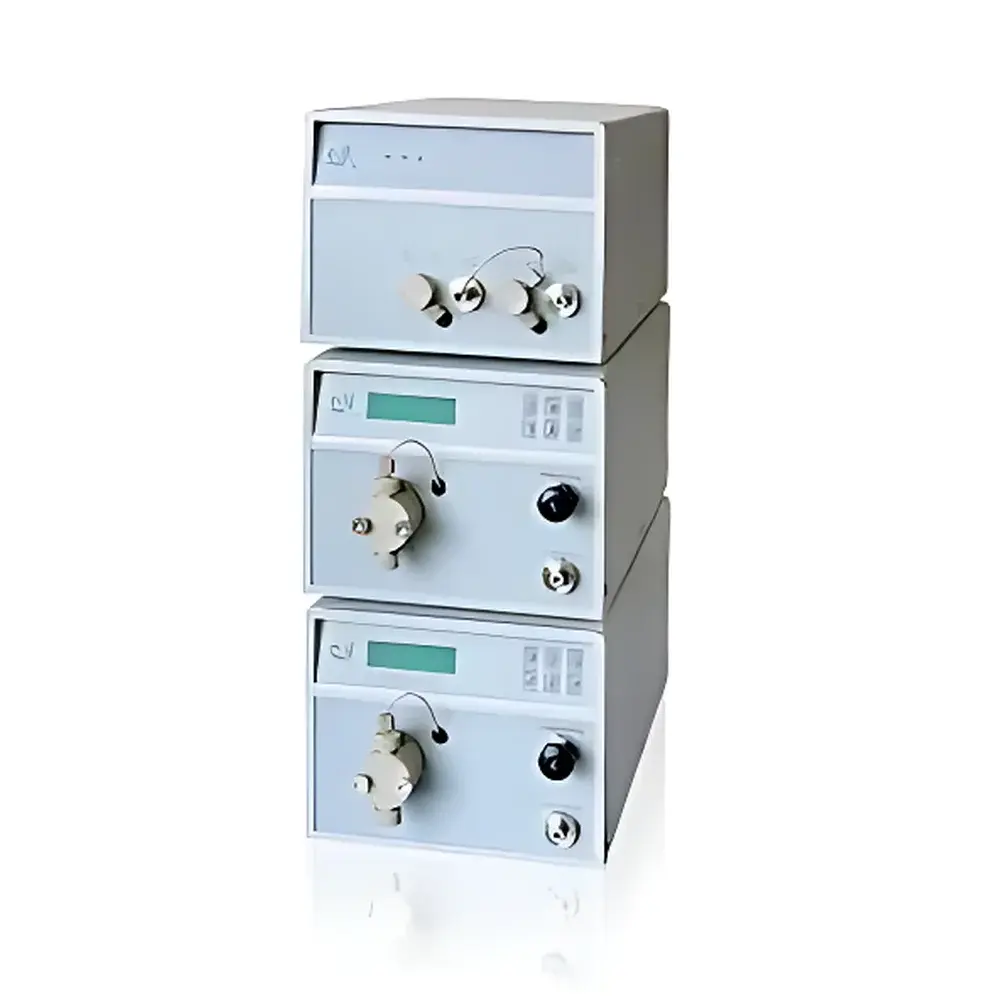
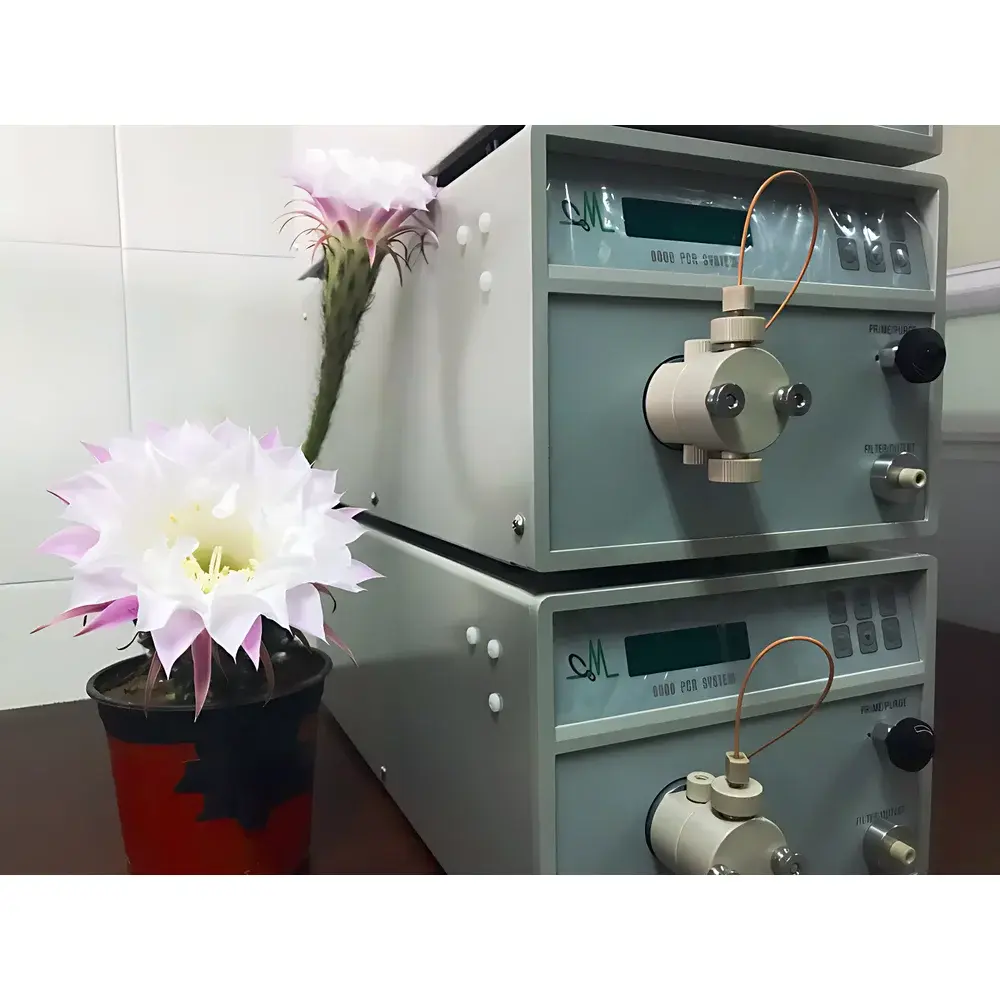
CoMetro COM 6000 Dual Post-Column Derivatization System
| Brand | CoMetro |
|---|---|
| Origin | Imported |
| Model | COM 6000 |
| Temperature Range | Ambient + 5 °C to 150 °C |
| Derivatization Reagent Flow Rate | 0.001–5 mL/min or 0.01–10 mL/min |
| Reaction Flow Path | Full PEEK |
Overview
The CoMetro COM 6000 Dual Post-Column Derivatization System is an engineered solution for enhancing detection sensitivity and selectivity in high-performance liquid chromatography (HPLC) and ultra-high-performance liquid chromatography (UHPLC) applications. It operates on the principle of post-column chemical derivatization—introducing a reagent downstream of the analytical column to convert non-chromophoric or weakly fluorescent analytes into stable, highly detectable derivatives prior to detection (typically by fluorescence or UV-Vis). This system supports both single-step and sequential two-step derivatization protocols, enabling precise control over reaction kinetics, temperature, and reagent delivery—critical for quantitative analysis of low-abundance compounds in complex matrices.
Designed for regulatory-compliant laboratories, the COM 6000 integrates seamlessly into existing HPLC workflows without requiring column or detector modifications. Its architecture adheres to fundamental chromatographic integrity principles: minimal band broadening, zero dead volume at junctions, and thermally stable reaction environments—all contributing to high reproducibility (RSD < 0.2% for flow, ±0.4 °C temperature repeatability) and method robustness across extended run times.
Key Features
- Modular dual-reaction core configuration: Supports simultaneous heated and ambient-temperature derivatization steps—ideal for multi-analyte methods requiring orthogonal reaction conditions (e.g., o-phthalaldehyde followed by iodine oxidation).
- Full-Peek fluidic path: Chemically inert, low-metal-leaching construction compatible with aggressive reagents (e.g., sodium hypochlorite, ortho-phthalaldehyde, ninhydrin, potassium permanganate) and high-pH mobile phases.
- Front-panel digital interface: Real-time display of setpoint/actual temperature per reaction module, reagent flow rate, line pressure, and pressure limits; intuitive keypad navigation for rapid parameter entry.
- Tool-free reaction core exchange: Two-fitting connection design enables replacement of 0.15 mL, 0.5 mL, or 1.5 mL reaction coils in under 90 seconds—minimizing system downtime during method development.
- Intelligent derivatization pumps: Stepper-motor-driven with built-in PEEK exhaust valves, automatic online seal cleaning cycles, and integrated pressure transducers (0–4000 psi range); flow accuracy ±1%, precision 0.2% RSD.
- Multi-mode control: Local operation via front panel or remote command via RS-232 interface—enabling synchronization with HPLC system controllers and LIMS integration for audit-trail compliant data acquisition.
Sample Compatibility & Compliance
The COM 6000 is validated for use in accredited testing environments performing analyses aligned with ISO/IEC 17025, AOAC Official Methods®, EPA Methods (e.g., EPA 544 for glyphosate), and pharmacopoeial standards (USP , EP 2.2.46). It routinely supports derivatization of primary amines (amino acids, taurine), secondary amines (carbamate pesticides), hydrazides (mycotoxins), aldehydes (biogenic amines), and phosphonic acids (glyphosate, glufosinate). The system’s thermal stability (±1 °C accuracy, 150 °C stabilization in ≤30 min) and leak-resistant front-panel fitting layout meet GLP/GMP requirements for trace-level residue quantification in environmental water, food extracts, biological fluids, and pharmaceutical intermediates.
Software & Data Management
While the COM 6000 operates as a standalone hardware module, its RS-232 interface permits bidirectional communication with third-party chromatography data systems (CDS) such as Thermo Chromeleon, Waters Empower, or Agilent OpenLab. All operational parameters—including temperature setpoints, flow rates, pressure thresholds, and system readiness status—are logged with timestamps. When deployed in FDA-regulated settings, the system supports 21 CFR Part 11 compliance when paired with CDS platforms offering electronic signatures, audit trails, and user-access controls. No proprietary software installation is required; configuration files are stored locally on non-volatile memory.
Applications
- Amino acid profiling in clinical diagnostics (e.g., phenylketonuria and maple syrup urine disease screening)
- Carbamate pesticide quantification in drinking water and agricultural commodities (e.g., carbaryl, methomyl, aldicarb)
- Herbicide residue analysis including glyphosate, glufosinate, paraquat, and diquat
- Mycotoxin detection: aflatoxins (B1/B2/G1/G2), deoxynivalenol (DON), domoic acid, and saxitoxins
- Aminoglycoside and polyether antibiotic assays in feed and tissue samples
- Pharmaceutical impurity testing: voglibose, erythromycin, and related polar APIs
- Inorganic speciation: Cr(VI), bromate, formaldehyde, and guanidine derivatives
FAQ
What types of detectors are compatible with the COM 6000?
Fluorescence (FLD), ultraviolet-visible (UV-Vis), and electrochemical (ECD) detectors are fully supported. The system’s low dispersion reaction coil preserves chromatographic resolution for narrow peaks typical in UHPLC applications.
Can the COM 6000 be used for gradient HPLC methods?
Yes—the full-PEEK flow path is compatible with common HPLC gradients (including acetonitrile/water and methanol/water), provided solvent miscibility with derivatization reagents is verified prior to method transfer.
Is validation documentation available for IQ/OQ/PQ protocols?
CoMetro provides a comprehensive User Requirements Specification (URS) template and factory test reports covering temperature uniformity, flow accuracy, pressure response, and leak integrity—serving as foundational documents for laboratory-based qualification.
How does the system prevent carryover between injections?
The derivatization pumps feature programmable auto-purge cycles, and the reaction coils are designed with laminar-flow geometry and minimal hold-up volume (as low as 0.15 mL), reducing residual analyte retention.
What maintenance intervals are recommended?
Seals and pump tubing should be inspected every 500 operating hours; reaction coils require cleaning with appropriate solvents after high-matrix-load runs. No routine calibration is needed—the system maintains traceable performance via factory-certified transducers and thermal sensors.





