
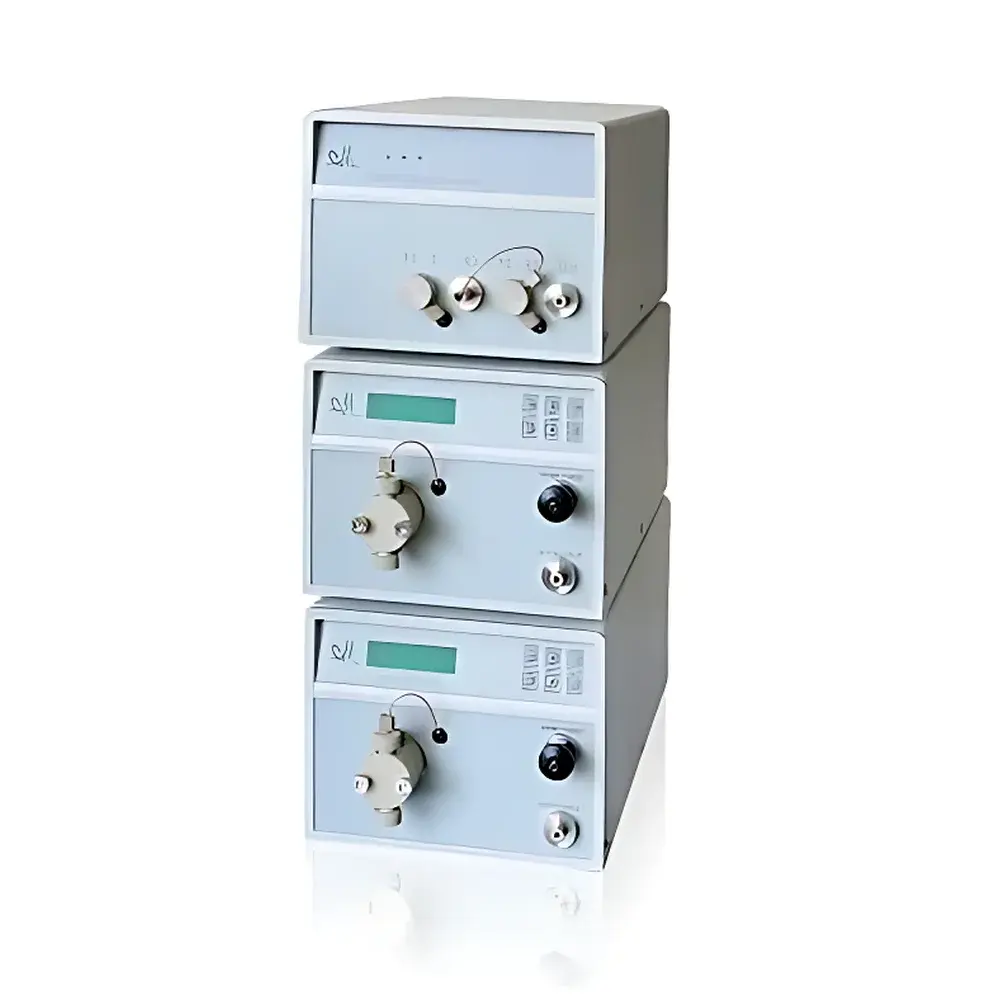
CoMetro 6000 PCR Post-Column Derivatization System
| Brand | CoMetro |
|---|---|
| Origin | Imported |
| Manufacturer Type | Authorized Distributor |
| Model | 6000 PCR |
| Temperature Range | Ambient +10 °C to 150 °C |
| Derivatization Reagent Flow Rate | 0.001–10 mL/min |
| Reaction Coil Material | PEEK |
Overview
The CoMetro 6000 PCR Post-Column Derivatization System is an engineered solution for enhancing detection sensitivity and selectivity in high-performance liquid chromatography (HPLC) and ultra-high-performance liquid chromatography (UHPLC) applications. Designed around the principle of post-column chemical derivatization—where analytes eluting from the separation column undergo controlled, on-line reaction with reagents prior to detection—the system enables fluorescence or absorbance-based quantification of otherwise non-chromophoric or weakly detectable compounds. Its core architecture integrates thermally regulated reaction coils, precision-controlled reagent delivery, and fully inert PEEK fluidic pathways to ensure reproducible derivatization kinetics, minimal band broadening, and long-term compatibility with aggressive reagents (e.g., o-phthalaldehyde, iodine, potassium permanganate, or sodium hypobromite). The system operates as a standalone module or integrates seamlessly into existing HPLC workflows via standard 1/16″ tubing interfaces and RS232 communication, supporting regulatory-compliant environments including those governed by USP , ISO/IEC 17025, and FDA 21 CFR Part 11 when paired with validated software.
Key Features
- Modular reactor design supporting single- or dual-core configurations—enabling simultaneous high-temperature and ambient-temperature derivatization steps within one platform.
- Front-panel digital interface with real-time display of setpoint/actual temperature per reactor zone, reagent flow rate, line pressure, and pressure limits.
- Thermally stable reaction coils (0.15 mL, 0.5 mL, or 1.5 mL volume options) fabricated entirely from PEEK, delivering ±5% volumetric accuracy and ±0.4 °C temperature repeatability.
- Derivatization pump with stepper-motor-driven syringe mechanism, offering 0.001–10 mL/min flow range, ±1% flow accuracy, and 0.2% RSD precision; includes automatic online seal-washing and integrated PEEK vent valves.
- Full PEEK fluidic path—including fittings, tubing, and reactor coils—ensuring chemical resistance to strong oxidants, acids, and bases used in amino acid, mycotoxin, pesticide, and pharmaceutical derivatization protocols.
- RS232 port for external control and monitoring; compatible with third-party CDS platforms (e.g., Waters Empower, Thermo Chromeleon, Agilent OpenLab) for synchronized method execution and audit-trail generation.
- Rapid reactor cartridge exchange—completed with only two fittings—minimizing downtime during method switching or maintenance.
Sample Compatibility & Compliance
The CoMetro 6000 PCR supports derivatization of diverse compound classes across environmental, food safety, clinical, and pharmaceutical testing domains. Validated applications include but are not limited to: aflatoxins (B1, B2, G1, G2), ochratoxin A, deoxynivalenol (DON), patulin, carbamate pesticides (e.g., carbaryl, aldicarb), glyphosate, paraquat, diquat, amino acids (including taurine), aminoglycoside antibiotics, macrolides (e.g., erythromycin), voglibose, biogenic amines, bromate, hexavalent chromium, formaldehyde, and phenylketonuria (PKU) metabolites. All components comply with RoHS directives and meet mechanical integrity requirements outlined in ASTM D7219 (for HPLC accessory qualification) and ICH Q2(R2) guidelines for analytical method validation. System configuration and operational parameters are documented to support GLP/GMP audit readiness.
Software & Data Management
While the 6000 PCR operates autonomously via its embedded microcontroller, full traceability and remote orchestration are achieved through RS232 integration with laboratory information management systems (LIMS) or chromatography data systems (CDS). Instrument logs—including temperature ramp profiles, flow rate deviations, pressure excursions, and alarm events—are timestamped and exportable in CSV format. When deployed in regulated environments, the system supports electronic signatures, user access levels, and audit trails aligned with 21 CFR Part 11 requirements—provided the host CDS implements appropriate security controls. Firmware updates are delivered via secure USB or serial interface, with version history retained in non-volatile memory.
Applications
This system is routinely deployed in accredited laboratories performing residue analysis per EU Regulation No. 401/2013 (mycotoxins), EPA Method 548/549 (pesticides), AOAC Official Methods℠ (e.g., 2005.02 for aflatoxins), and ISO 15742 (glyphosate in feed). It is also applied in clinical toxicology labs for newborn screening (PKU, maple syrup urine disease), pharmaceutical QC for potency and impurity profiling, and environmental monitoring of disinfection by-products in drinking water. Its modular flexibility allows method development for emerging analytes requiring orthogonal derivatization chemistries—such as oxidative bromination for chlorophenols or hydrazine-based tagging for carbonyl-containing toxins.
FAQ
What types of detectors are compatible with the CoMetro 6000 PCR?
The system is optimized for fluorescence (FLD) and UV-Vis absorbance (UV/VIS) detectors. It supports standard 1/16″ stainless steel or PEEK capillary connections and maintains backpressure compatibility up to 4000 PSI.
Can the 6000 PCR perform two-step derivatization in series?
Yes—using the dual-core configuration, users can configure one reactor for initial derivatization (e.g., iodine oxidation of aflatoxins) and a second for secondary labeling (e.g., post-oxidation cyclohexanone addition), all under independent thermal and flow control.
Is the system suitable for use with corrosive reagents such as sodium hypobromite?
Yes—the entire fluidic path—including pumps, valves, reactors, and fittings—is constructed from PEEK and other chemically inert polymers, ensuring long-term stability with oxidizing, acidic, and alkaline reagents.
How is temperature stability verified during routine operation?
Each reactor zone includes a calibrated PT100 sensor and PID controller; temperature accuracy is ±1 °C against NIST-traceable references, with stability maintained within ±0.4 °C over 24-hour continuous operation at 150 °C.
Does the system include validation documentation for IQ/OQ/PQ protocols?
CoMetro provides a comprehensive User Requirements Specification (URS), Factory Acceptance Test (FAT) report, and Installation Qualification (IQ) template. Operational Qualification (OQ) and Performance Qualification (PQ) protocols must be executed by the end user in accordance with local regulatory expectations and method-specific criteria.




