
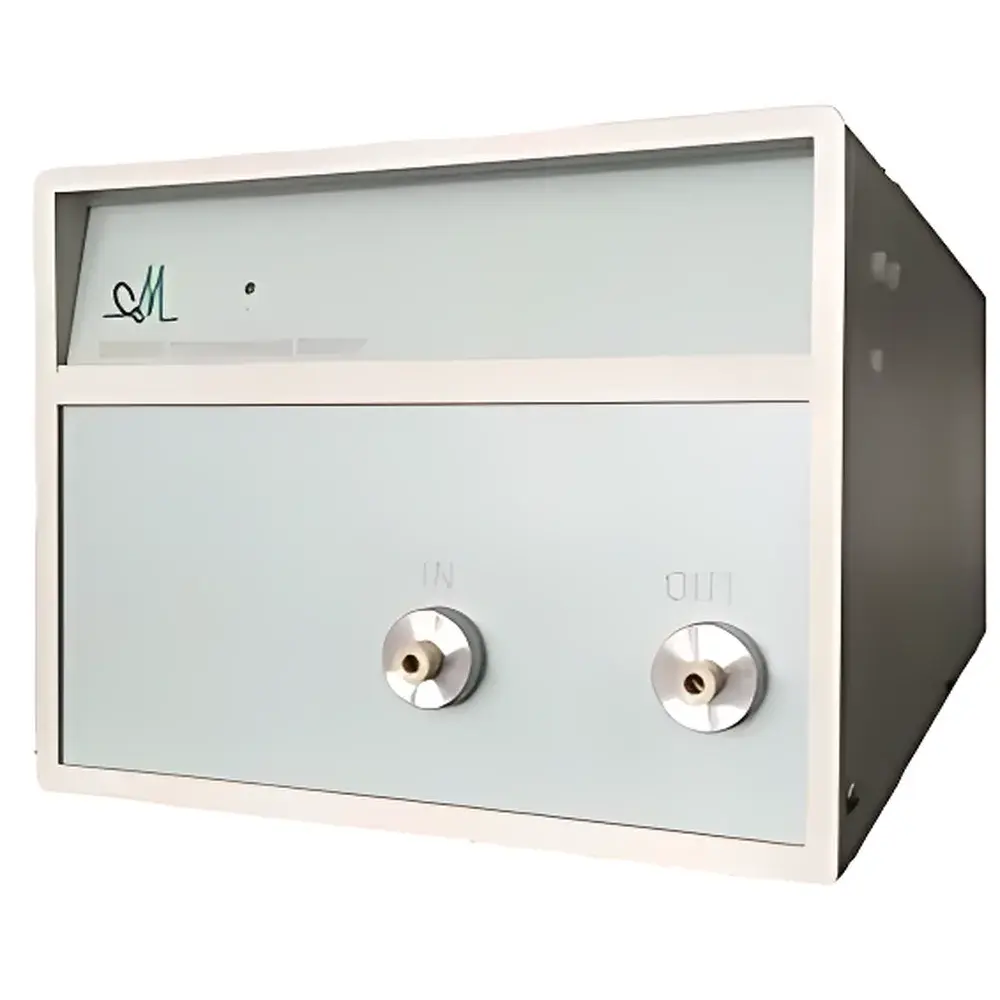
CoMetro 6000 Photochemical Derivatization System
| Brand | CoMetro |
|---|---|
| Origin | Imported |
| Manufacturer Type | Authorized Distributor |
| Model | 6000 Photochemical Derivatization System |
| Light Source | Cold UV LED |
| Output Power | 8 mW |
| Wavelength | 254 nm |
| Reactor Design | Köhler Illumination Optics |
| Maximum Flow Rate | 3 mL/min |
| Cooling Method | Forced-Air Temperature Control |
| Derivatization Type | Post-Column, Reagent-Free Photochemical Activation |
Overview
The CoMetro 6000 Photochemical Derivatization System is a precision-engineered post-column derivatization device designed for integration into high-performance liquid chromatography (HPLC) workflows. It operates on the principle of ultraviolet-mediated photochemical activation—specifically utilizing 254 nm cold UV light to induce structural modification of analytes immediately after elution from the analytical column but prior to detection. This system is optimized for the quantitative analysis of mycotoxins—particularly aflatoxin B₁ and G₁—as well as sulfonamide antibiotics, where native fluorescence is weak or absent. By enabling in-line photolysis-driven derivatization without chemical reagents, the 6000 system eliminates post-column mixing complexity, avoids solvent compatibility issues, and preserves chromatographic integrity—including peak shape, resolution, and column efficiency. Its compact, modular architecture supports seamless coupling with standard HPLC systems equipped with fluorescence (FLD) or UV-Vis detectors.
Key Features
- Cold UV LED light source emitting at precisely 254 nm with stable 8 mW output—engineered for long-term spectral consistency and minimal thermal load on the reaction stream
- Köhler illumination optics ensuring uniform photon flux across the entire capillary reaction zone, maximizing derivatization yield reproducibility
- Reagent-free operation: no pumps, no chemical reservoirs, no gradient mismatch concerns—reducing system complexity and maintenance overhead
- No additional dead volume: integrated 1/16″ stainless steel or fused silica reaction coil maintains hydraulic continuity between column and detector
- Forced-air thermal management maintaining reactor temperature stability within ±2 °C under continuous operation at up to 3 mL/min flow rate
- Plug-and-play mechanical interface compatible with standard 10–32 threaded fittings and PEEK/SS tubing configurations
Sample Compatibility & Compliance
The CoMetro 6000 is validated for use in regulated environments requiring adherence to pharmacopeial and food safety standards. It supports analytical methods compliant with AOAC Official Method 2005.08 (aflatoxins in feeds), USDA-FSIS Directive 10,010.1 (mycotoxin surveillance), and EU Commission Regulation (EC) No 401/2006. When deployed in GLP or GMP laboratories, the system’s passive, non-invasive derivatization mechanism facilitates straightforward method validation per ICH Q2(R2) guidelines. As it introduces no new chemical species into the flow path, it does not require revalidation of existing HPLC method robustness or system suitability criteria. The absence of reactive reagents also eliminates risks associated with carryover, precipitation, or detector fouling—enhancing inter-batch reproducibility in routine QC testing.
Software & Data Management
The 6000 system operates independently of proprietary software; it functions as a hardware-level enhancement to existing HPLC data acquisition platforms (e.g., Waters Empower, Thermo Chromeleon, Agilent OpenLab). All operational parameters—including lamp status, cumulative irradiation time, and ambient temperature—are logged via embedded non-volatile memory and accessible through optional RS-232 or USB diagnostics interface. While no dedicated control software is provided, its plug-and-play design ensures full compatibility with 21 CFR Part 11-compliant audit trail configurations when paired with validated chromatography data systems (CDS). Lamp lifetime (>10,000 hours) and optical alignment stability are tracked manually during scheduled instrument qualification (IQ/OQ/PQ), supporting ongoing compliance with FDA and EMA expectations for analytical instrument lifecycle management.
Applications
- Quantification of aflatoxin B₁ and G₁ in cereal grains, nuts, spices, and animal feed using HPLC-FLD with native fluorescence enhancement
- Detection of sulfonamide residues (e.g., sulfamethazine, sulfadimethoxine) in meat, milk, and honey matrices following LC-UV analysis
- Supporting multi-residue mycotoxin screening protocols where photochemical derivatization improves signal-to-noise ratio without altering chromatographic selectivity
- Enabling trace-level analysis in environmental water samples containing photolabile heterocyclic contaminants amenable to 254 nm activation
- Method development for regulatory submissions requiring documented derivatization efficiency and photostationary state verification
FAQ
Does the 6000 system require calibration or periodic lamp intensity verification?
Yes—while the cold UV LED exhibits excellent long-term output stability, users should perform quarterly irradiance verification using a NIST-traceable UV radiometer at 254 nm to ensure consistent derivatization efficiency.
Can the 6000 be used with UHPLC systems operating above 3 mL/min?
No—the maximum rated flow rate is 3 mL/min; exceeding this may reduce residence time below the minimum required for complete photochemical conversion and compromise sensitivity.
Is the reactor coil replaceable, and what materials are available?
Yes—the standard reactor is constructed from 0.25 mm ID fused silica with PTFE insulation; stainless steel and PEEK alternatives are available upon request for aggressive solvent compatibility.
Does photochemical derivatization affect method transfer between laboratories?
When coupled with standardized lamp output verification and Köhler-optic alignment procedures, the 6000 demonstrates high inter-laboratory reproducibility—making it suitable for collaborative studies and reference method adoption.
How does the forced-air cooling system impact ambient laboratory noise levels?
The fan operates at <35 dBA at 1 m distance—designed for quiet integration into shared analytical laboratories without disrupting adjacent instrumentation or personnel concentration.





