
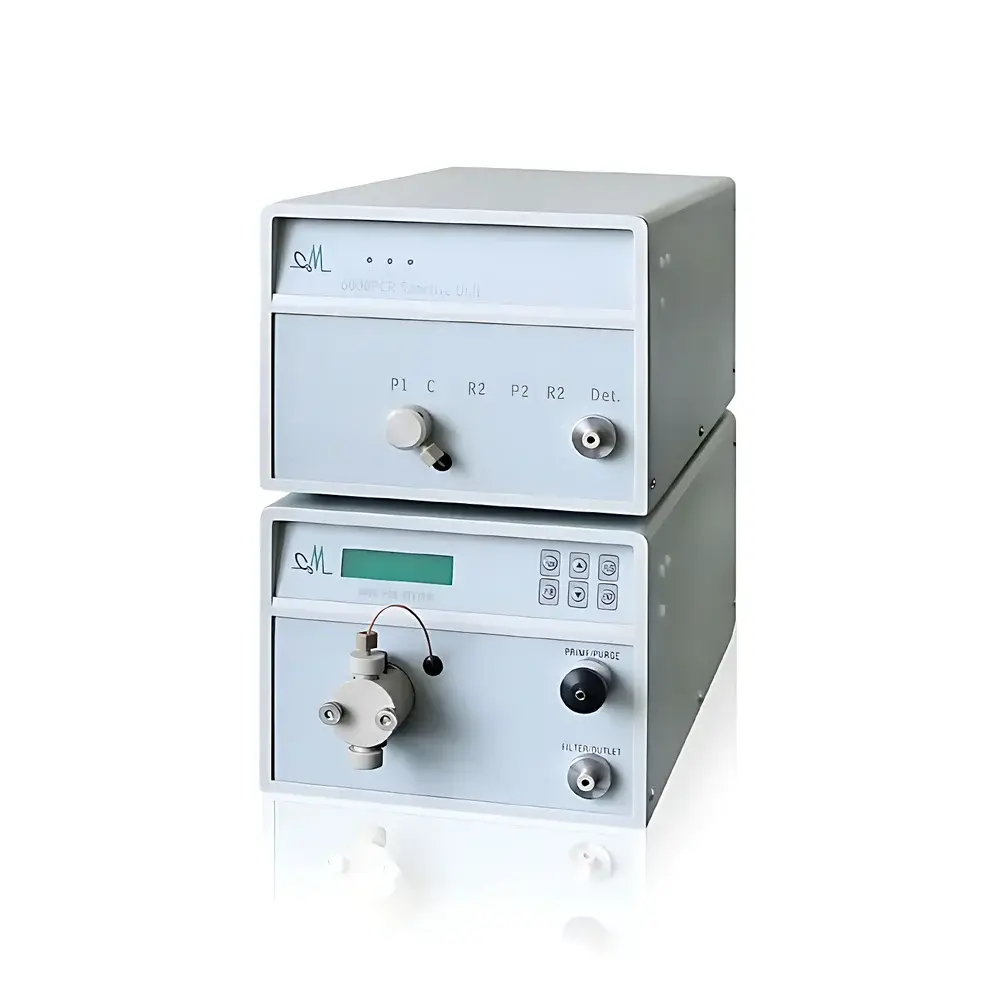
CoMetro COM 6000 Series Post-Column Derivatization System
| Brand | CoMetro |
|---|---|
| Origin | Imported |
| Manufacturer Type | Authorized Distributor |
| Model | COM 6000 Series |
| Temperature Control Range | ±1 °C (accuracy), ±0.4 °C (reproducibility), 20–150 °C (operating range) |
| Derivatization Solvent Flow Rate | 0.001–10 mL/min |
| Reaction Coil Volumes | 0.15 / 0.5 / 1.5 mL (user-selectable) |
| Flow Path Material | All-PEEK |
| Pressure Range | 0–4000 psi |
| Flow Accuracy | ±1% |
| Flow Precision | ≤0.2% RSD |
| Safety Cutoff Temperature | 160 °C |
| Warm-up Time to 150 °C | ≤30 min |
Overview
The CoMetro COM 6000 Series Post-Column Derivatization System is an engineered solution for enhancing detection sensitivity and selectivity in high-performance liquid chromatography (HPLC) and ultra-high-performance liquid chromatography (UHPLC) workflows. Designed around the principle of controlled, on-line chemical derivatization—where analytes eluting from the chromatographic column undergo rapid, temperature-regulated reaction with a derivatizing reagent—the system enables quantitative analysis of compounds lacking native chromophores or fluorophores. Its architecture supports both thermal and ambient derivatization steps, accommodating sequential two-stage reactions (e.g., hydrolysis followed by derivatization) without manual intervention. The system integrates seamlessly into existing LC platforms via standard 1/16″ stainless steel or PEEK tubing connections and is widely deployed in regulated environments requiring trace-level quantification across food safety, environmental monitoring, clinical diagnostics, and pharmaceutical quality control.
Key Features
- All-PEEK fluidic path ensures exceptional chemical resistance to aggressive reagents—including o-phthalaldehyde (OPA), ninhydrin, ortho-phenylenediamine (OPD), and sodium nitroprusside—eliminating metal-induced degradation or adsorption artifacts.
- Modular reactor design with front-panel accessible quick-connect fittings allows tool-free replacement of reaction coils (0.15 mL, 0.5 mL, or 1.5 mL volumes) using only two connections per module—minimizing dead volume and peak dispersion.
- Dual-mode temperature control: each reactor core maintains setpoint accuracy of ±1 °C and reproducibility of ±0.4 °C across a range of 20–150 °C; safety cutoff at 160 °C prevents thermal runaway.
- Intelligent derivatization pumps feature integrated PEEK exhaust valves, stepper-motor-driven precision metering, and real-time pressure sensing (0–4000 psi); flow rate resolution down to 0.001 mL/min with ≤0.2% RSD precision.
- Front-panel digital interface displays real-time temperature, flow rate, pressure, and status indicators (e.g., “Ready”, “Heating”, “Error”); all parameters configurable locally or remotely via RS232.
- Reduced connection count and front-mounted ports significantly lower risk of leakage—critical for long-duration unattended operation in GLP-compliant laboratories.
Sample Compatibility & Compliance
The COM 6000 Series supports derivatization of primary and secondary amines, aldehydes, thiols, and hydrazides under controlled thermal or ambient conditions. It is routinely applied in validated methods aligned with AOAC Official Methods of Analysis®, ISO 18362 (amino acids), EPA Method 549.2 (carbamate pesticides), EN 15662 (glyphosate, glufosinate, paraquat), and USP for analytical instrument qualification. All firmware and hardware configurations support audit trail generation and user-access logging, enabling compliance with FDA 21 CFR Part 11 requirements when integrated with compliant LIMS or CDS platforms.
Software & Data Management
While the COM 6000 operates as a standalone peripheral, its RS232 interface permits bidirectional communication with third-party chromatography data systems (CDS) such as Thermo Chromeleon, Waters Empower, or Agilent OpenLab. Remote parameter setting—including pump flow rates, pressure limits, and reactor temperature setpoints—is supported through ASCII command protocol. System events (e.g., temperature deviation, pressure alarm, pump stall) are logged with timestamps and can be exported for inclusion in electronic batch records. No proprietary software installation is required; configuration remains fully transparent and scriptable.
Applications
- Amino acid profiling in infant formula, dietary supplements, and clinical plasma samples (including taurine, cystine, and branched-chain amino acids).
- Residue analysis of carbamate insecticides (e.g., carbofuran, methomyl) and bipyridyl herbicides (e.g., diquat, paraquat) in drinking water and agricultural commodities.
- Quantification of mycotoxins (aflatoxin B1, deoxynivalenol, domoic acid) and marine biotoxins (saxitoxin, okadaic acid) following pre-column or post-column oxidation/derivatization.
- Analysis of aminoglycoside antibiotics (gentamicin, neomycin), macrolides (erythromycin), and antidiabetic agents (voglibose) in pharmaceutical intermediates and dosage forms.
- Newborn screening for inborn errors of metabolism—e.g., phenylketonuria (PKU) and maple syrup urine disease (MSUD)—via derivatized amino acid quantitation.
- Monitoring of biogenic amines (histamine, tyramine), bromate in bottled water, hexavalent chromium in wastewater, and guanidine derivatives in biological matrices.
FAQ
What types of derivatization chemistries are compatible with the COM 6000 Series?
The system supports OPA, ninhydrin, OPD, FMOC-Cl, and sodium nitroprusside-based protocols, as well as acid-catalyzed hydrolysis prior to derivatization.
Can the COM 6000 be used with UHPLC systems operating above 1000 bar?
Yes—its all-PEEK flow path and 4000 psi pressure rating accommodate backpressure from sub-2 µm particle columns when configured with low-volume reactors (0.15 mL coil).
Is temperature calibration traceable to NIST standards?
Each reactor module includes factory calibration documentation; users may perform in-house verification using certified RTD probes per ISO/IEC 17025 guidelines.
How is maintenance performed on the derivatization pumps?
Pumps feature automatic in-line solvent purge cycles and self-flushing routines; seal lifetime is extended via PEEK-compatible wetted materials and programmable pressure-limit protection.
Does the system meet regulatory requirements for 21 CFR Part 11 compliance?
The hardware supports electronic signatures, audit trails, and role-based access when interfaced with validated CDS software—full compliance depends on site-specific procedural controls and validation documentation.
Related Products






