
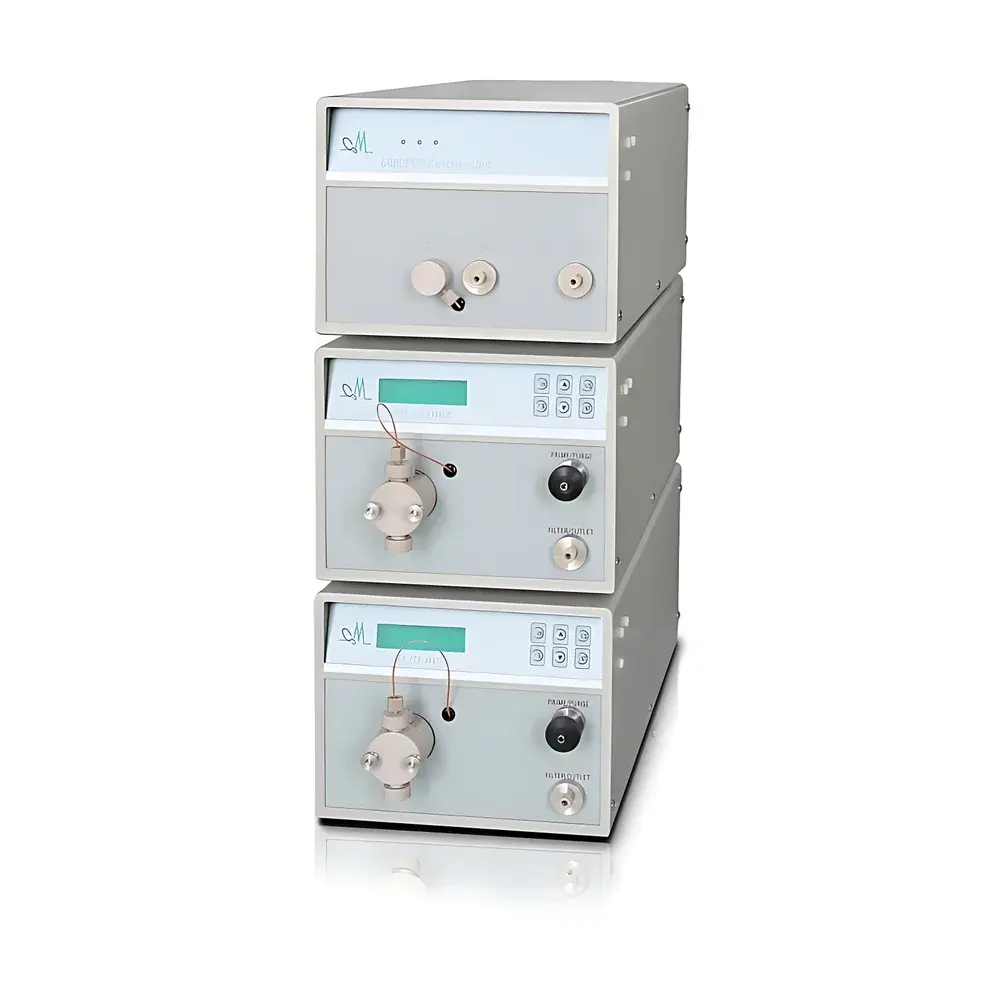
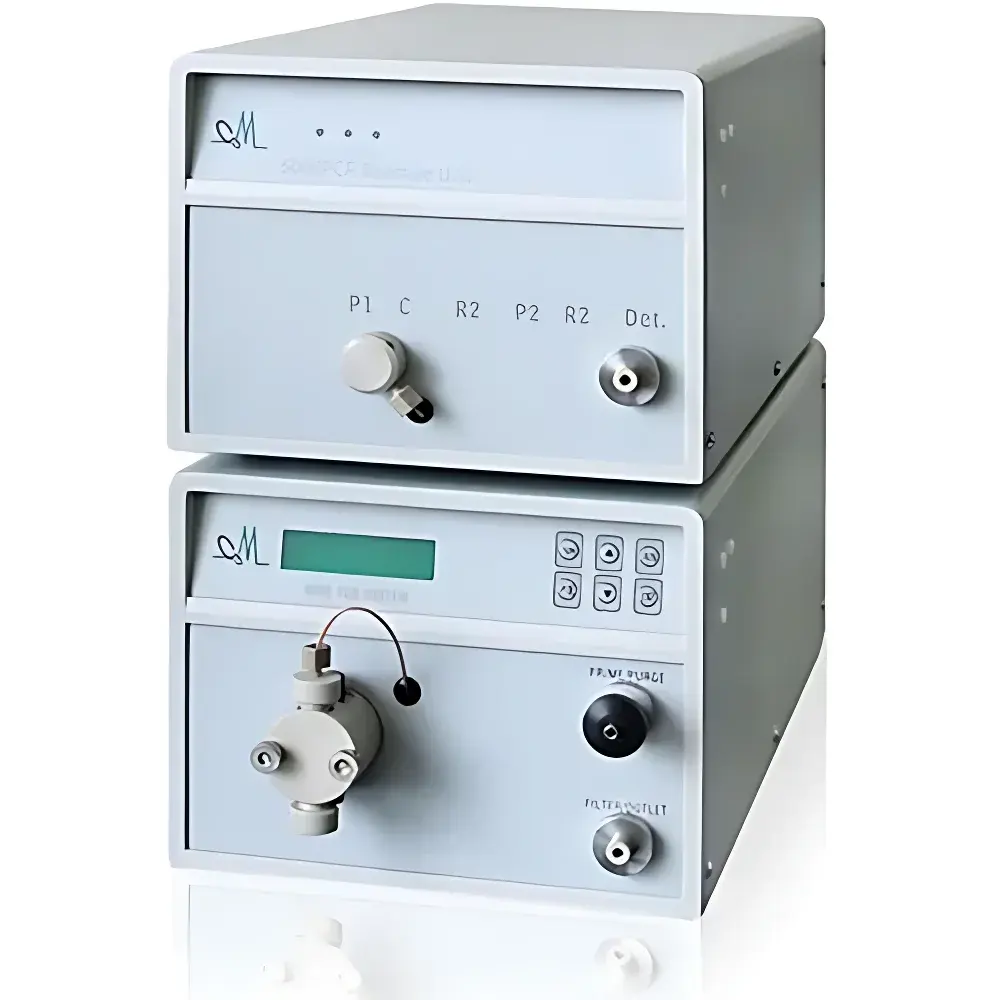
CoMetro 6000 Series Post-Column Derivatization System
| Brand | CoMetro |
|---|---|
| Origin | Imported |
| Manufacturer Type | Authorized Distributor |
| Model | 6000 Series |
| Derivatization Reagent Flow Rate | 0.001–5 mL/min or 0.01–10 mL/min |
| Reaction Coil Material | PEEK |
| Temperature Control Range | Ambient +10 °C to 150 °C |
| Temperature Accuracy | ±1 °C |
| Temperature Reproducibility | ±0.4 °C |
| Reaction Volume Options | 0.15 / 0.5 / 1.5 mL |
| Flow Accuracy | ±1% |
| Flow Precision | 0.2% RSD |
| Maximum Pressure | 4000 PSI |
| System Fluidic Path | Full PEEK |
Overview
The CoMetro 6000 Series Post-Column Derivatization System is a precision-engineered, modular platform designed for integration with high-performance liquid chromatography (HPLC) and ultra-high-performance liquid chromatography (UHPLC) systems. It enables sensitive and selective detection of analytes that lack native chromophores or fluorophores—by introducing controlled chemical derivatization immediately after column elution but prior to detection. The system operates on the principle of post-column reaction kinetics under precisely regulated thermal and flow conditions, leveraging continuous-flow reaction coil geometry to ensure consistent residence time, minimized band broadening, and high reproducibility. Engineered for compliance-critical environments, it supports both isothermal and two-step sequential derivatization (e.g., heating followed by ambient reaction), making it suitable for applications requiring multi-stage chemistry such as o-phthalaldehyde (OPA), ninhydrin, or ortho-diaminobenzoic acid (ODAB)-based amino acid analysis.
Key Features
- Modular architecture supporting single- or dual-reaction core configurations for parallel or sequential derivatization workflows.
- Front-panel digital interface with real-time display of setpoint/actual temperature per reaction core, reagent flow rate, line pressure, and pressure limits.
- Full PEEK fluidic path—including reaction coils, pump heads, valves, and fittings—ensuring chemical inertness, low metal leaching, and compatibility with aggressive reagents (e.g., sodium acetate buffer, iodine solutions, alkaline cyanide).
- Rapid-swap reaction cores secured with only two fittings; optimized coil geometry reduces peak dispersion and improves resolution in trace-level analyses.
- Derivatization pumps feature step-motor-driven precision metering, integrated PEEK exhaust valves, automatic online seal-wash cycles, and pressure feedback control to maintain stable delivery across viscosity gradients.
- Temperature-controlled reaction modules with ±1 °C accuracy, ±0.4 °C reproducibility, and programmable safety cutoff at 160 °C; stabilization to 150 °C achieved within 30 minutes.
- RS232 serial interface enables full remote operation—including flow rate ramping, temperature profiling, alarm logging, and status polling—compatible with LIMS and chromatography data systems (CDS) for 21 CFR Part 11–compliant audit trails.
Sample Compatibility & Compliance
The 6000 Series supports derivatization of primary and secondary amines, hydrazides, aldehydes, thiols, and other nucleophilic functional groups. It is routinely deployed in laboratories adhering to ISO/IEC 17025, AOAC Official Methods®, EPA Method 544 (for microcystins), USP , and ICH Q2(R2) validation guidelines. Its design facilitates method transfer between instruments and meets GLP/GMP documentation requirements when paired with validated CDS software. Reaction volumes (0.15 mL, 0.5 mL, 1.5 mL) are selected based on analyte dwell time requirements and detector response kinetics—critical for minimizing carryover and ensuring linear dynamic range in regulated bioanalysis.
Software & Data Management
While the system operates autonomously via front-panel controls, its RS232 interface allows bidirectional communication with third-party chromatography software (e.g., Thermo Chromeleon, Waters Empower, Agilent OpenLab). All operational parameters—including flow rates, temperature setpoints, pressure thresholds, and fault codes—are timestamped and exportable as CSV or XML logs. When integrated into a validated workflow, the system supports electronic signatures, user access levels, and change-control records required under FDA 21 CFR Part 11 and EU Annex 11. No proprietary software installation is required; configuration and monitoring are performed through standard terminal emulation or custom API endpoints.
Applications
- Amino acid profiling (including taurine) in clinical serum, infant formula, and hydrolyzed proteins.
- Detection of carbamate pesticides (e.g., carbaryl, methomyl) in food and environmental matrices using naphthol-based fluorescence derivatization.
- Analysis of glyphosate, glufosinate, paraquat, and diquat via post-column oxidation and imine formation.
- Quantification of mycotoxins (aflatoxins, deoxynivalenol, domoic acid) and marine biotoxins (saxitoxins, okadaic acid) following acid hydrolysis and derivatization.
- Assay of aminoglycoside and polyether antibiotics in veterinary tissues and milk.
- Monitoring of pharmaceutical impurities (e.g., voglibose degradation products) and active pharmaceutical ingredients (APIs) such as erythromycin.
- Newborn screening for phenylketonuria (PKU) and maple syrup urine disease (MSUD) via tandem mass spectrometry–coupled derivatization.
- Trace-level determination of biogenic amines (histamine, tyramine), bromate, formaldehyde, Cr(VI), and guanidines in water, feed, and beverage samples.
FAQ
What types of detectors are compatible with the CoMetro 6000 Series?
The system interfaces seamlessly with fluorescence (FLD), ultraviolet-visible (UV-Vis), and mass spectrometric (LC-MS/MS) detectors. Its low-dead-volume connections and minimal extra-column dispersion preserve peak integrity for high-resolution detection.
Can the 6000 Series perform simultaneous dual derivatization?
Yes—using the optional dual-core configuration, independent temperature and flow control enable orthogonal reactions (e.g., OPA followed by FMOC) in sequence without manual intervention.
Is the system compliant with regulatory data integrity standards?
When operated under validated procedures and integrated with compliant CDS, it supports ALCOA+ principles and satisfies audit requirements for FDA, EMA, and PMDA inspections.
How is maintenance performed on the derivatization pumps?
Seal-wash cycles are automated and configurable; PEEK pump heads require no lubrication, and all wetted parts are accessible without tools for routine inspection or replacement.
What is the maximum allowable backpressure for the reaction coils?
The system is rated for continuous operation up to 4000 PSI; pressure sensors provide real-time feedback and automatic shutdown if preset limits are exceeded.
Related Products






