
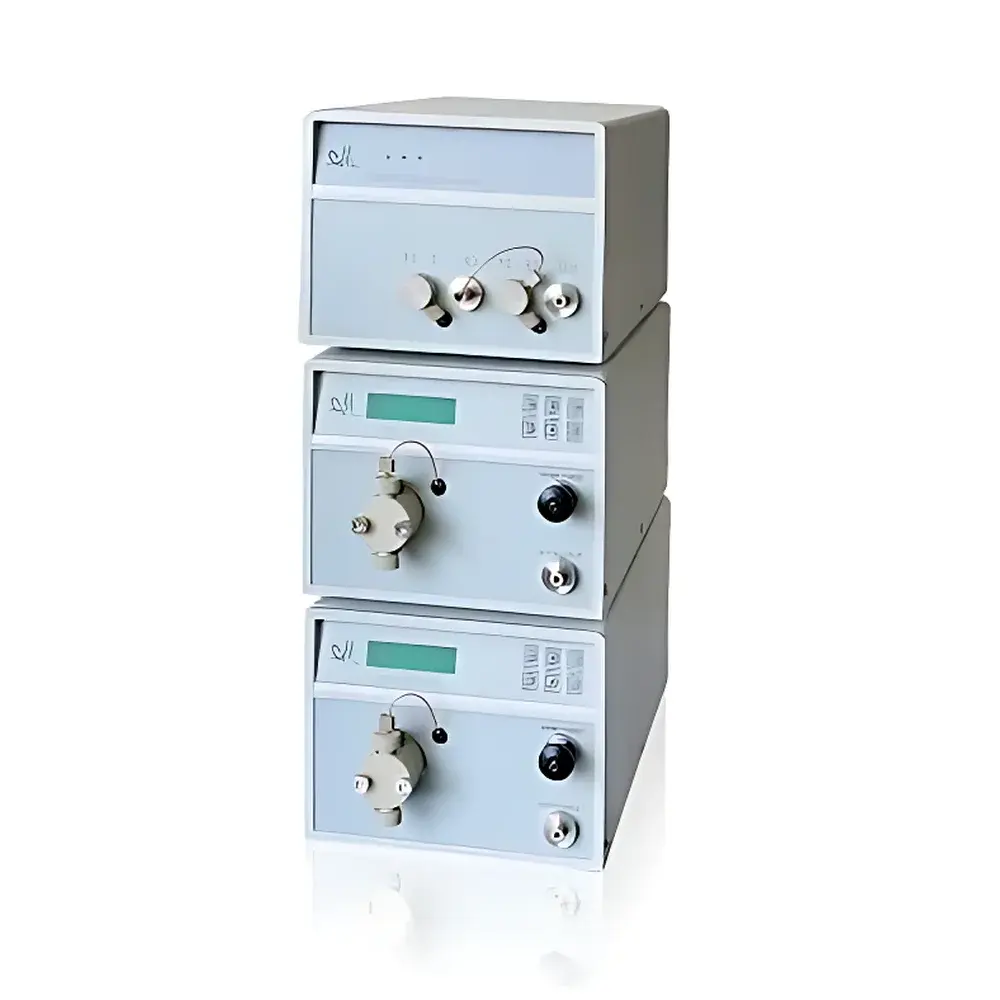
CoMetro 6000 Series Post-Column Derivatization System
| Brand | CoMetro |
|---|---|
| Origin | Imported |
| Manufacturer Type | Authorized Distributor |
| Model | 6000 Series |
| Temperature Range | Ambient +10 °C to 150 °C |
| Derivatization Reagent Flow Rate | 0.001–10 mL/min |
| Reaction Coil Material | Full PEEK |
Overview
The CoMetro 6000 Series Post-Column Derivatization System is an engineered solution for enhancing detection sensitivity and selectivity in high-performance liquid chromatography (HPLC) and ultra-high-performance liquid chromatography (UHPLC) workflows. It operates on the principle of post-column chemical derivatization—introducing a controlled reagent stream downstream of the analytical column but prior to the detector—to convert non-chromophoric or weakly fluorescent analytes into highly detectable derivatives. This system is specifically designed for applications requiring trace-level quantification of primary and secondary amines, hydrazides, aldehydes, and other reactive functional groups under precisely regulated thermal and flow conditions. Its architecture supports both isocratic and gradient-compatible derivatization protocols, making it suitable for routine QC laboratories as well as method development environments governed by regulatory frameworks such as USP , ISO/IEC 17025, and FDA 21 CFR Part 11.
Key Features
- Modular reactor design with interchangeable reaction coils (0.15 mL, 0.5 mL, and 1.5 mL volumes), enabling optimization of residence time and conversion efficiency across diverse analyte classes.
- Independent temperature control per reaction module, with setpoint accuracy of ±1 °C and reproducibility of ±0.4 °C over the full operating range (ambient +10 °C to 150 °C); safety cutoff at 160 °C prevents thermal degradation of reagents or tubing.
- Full PEEK fluidic path—including pump heads, valves, reactors, and interconnects—ensuring chemical inertness, low metal leaching, and compatibility with aggressive reagents (e.g., o-phthalaldehyde, ninhydrin, ortho-dianisidine).
- Front-panel digital interface with real-time display of coil temperature, reagent flow rate, system pressure, and pressure limits; intuitive keypad navigation eliminates reliance on external software for basic operation.
- RS232 serial interface for remote parameter control, event logging, and integration into LIMS or chromatography data systems (CDS) for audit-trail-compliant workflows.
- Integrated auto-purge function and PEEK-built-in vent valves minimize carryover and extend seal lifetime; step-motor-driven pumps deliver flow precision of ±1% absolute accuracy and ≤0.2% RSD across the full 0.001–10 mL/min range.
Sample Compatibility & Compliance
The 6000 Series supports derivatization of amino acids (including taurine), carbamate pesticides, glyphosate, paraquat, diquat, aflatoxins, deoxynivalenol (DON), domoic acid, aminoglycoside antibiotics, macrolides (e.g., erythromycin), voglibose, and biogenic amines. It meets material compatibility requirements for EPA Method 544 (microcystins), AOAC Official Method 2005.02 (glyphosate), and ISO 15284 (biogenic amines in food). All wetted components comply with USP Class VI standards, and system firmware supports electronic signatures and audit trail generation per FDA 21 CFR Part 11 when integrated with validated CDS platforms.
Software & Data Management
While the system operates autonomously via front-panel controls, its RS232 port enables bidirectional communication with third-party chromatography software (e.g., Thermo Chromeleon, Waters Empower, Agilent OpenLab CDS). Configuration parameters—including temperature setpoints, flow rates, pressure thresholds, and pump priming cycles—are logged with timestamps and user IDs. Optional firmware upgrades support GLP/GMP-compliant data archiving, including change history tracking and role-based access control for critical settings.
Applications
- Environmental monitoring: Quantification of bromate, hexavalent chromium, formaldehyde, and polar herbicides in drinking water per EPA Methods 300.1 and 552.2.
- Food & feed safety: Multi-residue analysis of mycotoxins and veterinary drug residues in cereals, dairy, and animal feed matrices.
- Clinical diagnostics: Newborn screening for phenylketonuria (PKU) and maple syrup urine disease (MSUD) via HPLC-fluorescence detection of branched-chain amino acids.
- Pharmaceutical quality control: Assay of amine-containing active pharmaceutical ingredients (APIs) and genotoxic impurities under ICH Q2(R2) validation guidelines.
- Research laboratories: Method development for novel derivatization chemistries requiring precise thermal staging (e.g., sequential heating-cooling steps in two-core configurations).
FAQ
Is the CoMetro 6000 Series compatible with UHPLC systems operating at 1000 bar?
Yes—the full PEEK fluidic path and pressure-rated fittings support maximum backpressures up to 4000 PSI (275 bar), ensuring safe integration with most UHPLC platforms when used with appropriately sized reaction coils.
Can multiple derivatization reagents be delivered simultaneously?
The system supports up to three independently controlled reagent pumps (optional configuration), allowing for multi-step derivatization sequences or dual-reagent mixing directly within the reactor coil.
Does the system include validation documentation?
Factory-installed IQ/OQ documentation is available upon request; PQ protocols must be developed in situ per laboratory-specific SOPs and regulatory requirements.
What maintenance intervals are recommended for pump seals and reactor coils?
Under typical usage (8 h/day, aqueous/organic solvent blends), PEEK pump seals require replacement every 12–18 months; reaction coils show no performance drift over ≥5000 injections when operated within specified temperature and pH limits.
Is remote firmware update capability supported?
Firmware updates are performed locally via USB-to-serial adapter; network-based updates are not implemented to maintain data integrity and regulatory compliance in validated environments.




