
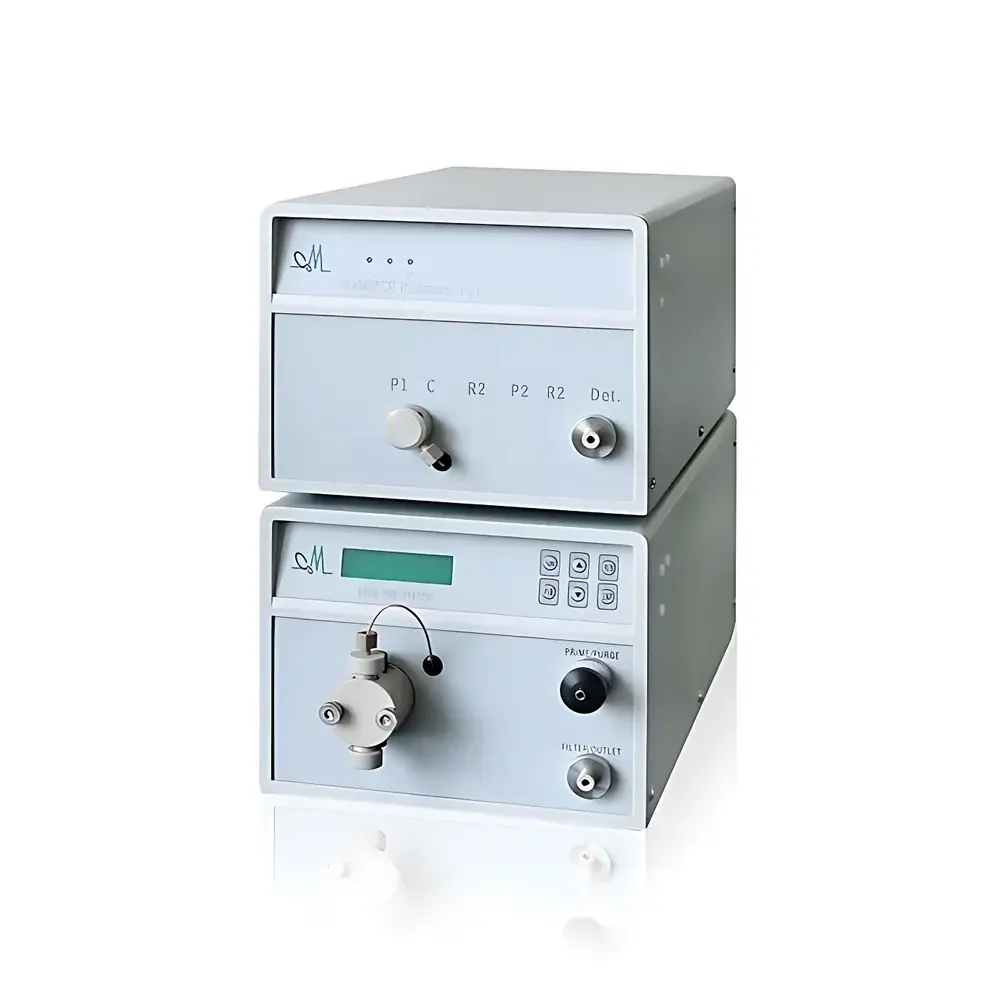
CoMetro 6000 Series Post-Column Derivatization System for Aflatoxin Analysis
| Brand | CoMetro |
|---|---|
| Origin | Imported |
| Model | 6000 |
| Temperature Range | Room Temperature +10 °C to 150 °C |
| Derivatization Reagent Flow Rate | 0.001–10 mL/min |
| Reaction Coil Material | PEEK |
Overview
The CoMetro 6000 Series Post-Column Derivatization System is a precision-engineered, modular platform designed to enhance detection sensitivity and selectivity in high-performance liquid chromatography (HPLC) applications requiring chemical derivatization after column elution. It operates on the principle of controlled, thermally assisted post-column reaction—where analytes eluting from the HPLC column are mixed with a derivatizing reagent under precisely regulated temperature and flow conditions, forming stable, fluorescent or UV-absorbing derivatives prior to detection. This system is specifically optimized for trace-level quantification of mycotoxins—including aflatoxin B₁, B₂, G₁, and G₂—where derivatization significantly improves detection limits and chromatographic resolution. Its architecture supports both single-step and sequential two-step derivatization protocols (e.g., oxidation followed by condensation), enabling method flexibility across diverse compound classes without hardware reconfiguration.
Key Features
- Modular reactor design with interchangeable PEEK reaction coils (0.15 mL, 0.5 mL, or 1.5 mL volumes), enabling rapid adaptation to different reaction kinetics and residence time requirements.
- Independent temperature control per reaction module, with setpoint range from ambient +10 °C to 150 °C, accuracy ±1 °C, and reproducibility ±0.4 °C; safety cutoff at 160 °C prevents thermal degradation of reagents or tubing.
- Dual-mode operation: simultaneous heated and ambient-temperature reaction zones support multi-step derivatization schemes—critical for analytes such as ochratoxin A or deoxynivalenol requiring staged chemistry.
- PEEK-only fluidic path throughout the entire system—including pump heads, valves, reaction coils, and interconnects—ensuring chemical inertness, low metal leaching, and compatibility with aggressive reagents (e.g., bromine, iodine, or ortho-phthalaldehyde).
- Front-panel digital interface with real-time display of coil temperature (setpoint and actual), pump flow rate, line pressure, and pressure limits; intuitive numeric keypad for parameter entry.
- RS232 serial interface enables full remote control and monitoring via external PC or LIMS integration—supporting audit-ready operation in GLP/GMP environments.
- Integrated auto-purge function and PEEK-built-in vent valves minimize bubble formation and extend seal lifetime; step-motor-driven pumps deliver flow accuracy ±1% and precision ≤0.2% RSD over full 0.001–10 mL/min range.
Sample Compatibility & Compliance
The CoMetro 6000 system is validated for use in regulatory-compliant workflows aligned with AOAC Official Method 2005.08, ISO 16050:2003, and EU Commission Regulation (EC) No 401/2006 for aflatoxin analysis in food and feed matrices. Its PEEK-based construction meets USP Class VI biocompatibility standards and resists corrosion from common derivatization reagents including trifluoroacetic acid, sodium iodide, and potassium bromide solutions. The system supports derivatization of primary amine-containing analytes (e.g., amino acids, aminoglycosides, β-lactams), carbonyl compounds (e.g., aldehydes, ketones), and heterocyclic toxins (e.g., patulin, citrinin). All firmware and control logic are designed to support 21 CFR Part 11–compliant electronic records when paired with validated third-party chromatography data systems.
Software & Data Management
While the CoMetro 6000 operates as a standalone hardware module, its RS232 interface allows bidirectional communication with major HPLC data systems (e.g., Thermo Chromeleon, Waters Empower, Agilent OpenLab CDS). Users can log temperature profiles, pump status, pressure trends, and alarm events directly into acquisition software timelines. Audit trail functionality—including user ID, timestamp, parameter change history, and system readiness flags—is maintained locally on the instrument’s non-volatile memory. For centralized lab management, optional OPC UA gateway modules enable seamless integration into enterprise-level laboratory information management systems (LIMS) and manufacturing execution systems (MES), supporting ICH-GCP and FDA inspection readiness.
Applications
This system is routinely deployed in accredited laboratories performing routine monitoring of regulated contaminants across multiple sectors: food safety testing (aflatoxins in nuts, spices, and dairy; glyphosate and paraquat in cereals); environmental water analysis (bromate, formaldehyde, Cr(VI)); clinical toxicology (homocysteine, neurotransmitters, acylcarnitines in newborn screening); pharmaceutical QC (residual solvents, genotoxic impurities, antibiotic potency); and animal feed surveillance (zearalenone, fumonisins, tetrodotoxin). Its modular architecture also supports emerging applications in metabolomics and biomarker validation where derivatization enhances MS ionization efficiency or LC–UV detectability.
FAQ
What types of detectors are compatible with the CoMetro 6000 system?
The system interfaces seamlessly with fluorescence detectors (FLD), UV-Vis absorbance detectors, and mass spectrometers equipped with electrospray ionization (ESI) sources—provided appropriate flow-cell configurations and backpressure management are implemented.
Can the 6000 Series perform dual derivatization in series?
Yes. Using optional dual-reactor modules and independent reagent pumps, the system supports sequential derivatization—such as iodine-mediated oxidation followed by o-phthalaldehyde condensation—for analytes requiring multi-stage chemistry.
Is method validation documentation available for regulatory submissions?
CoMetro provides IQ/OQ documentation templates and performance qualification protocols aligned with ASTM E2500 and ISO/IEC 17025 requirements; final PQ must be conducted in the end-user’s operational environment.
How often does the PEEK reaction coil require replacement?
Under typical use (≤150 °C, pH 2–10, no halogenated solvents), PEEK coils demonstrate service life exceeding 12 months; visual inspection for discoloration or flow restriction is recommended quarterly.
Does the system support gradient-compatible derivatization?
Yes—the flow-controlled reagent delivery and thermally stabilized reaction zone maintain consistent derivatization efficiency across HPLC gradients, provided mobile phase composition remains compatible with reagent stability.
Related Products






