
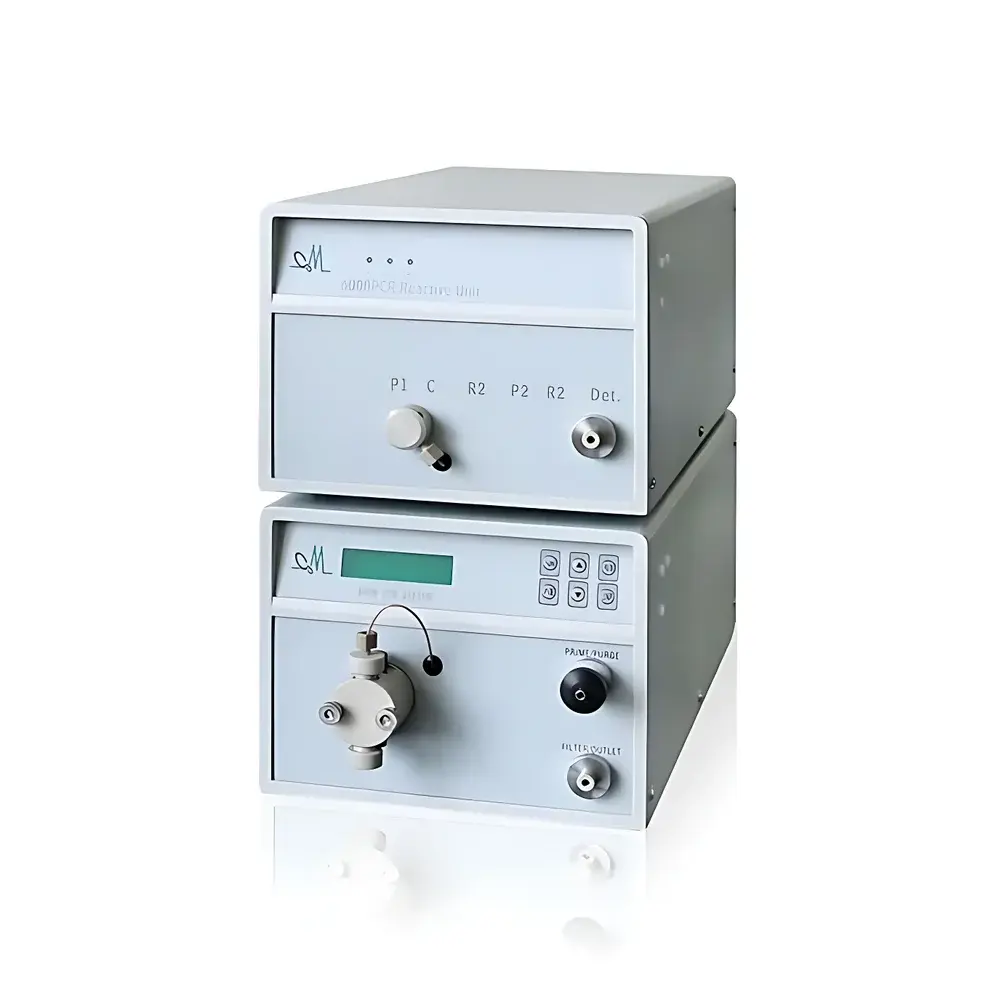
CoMetro 6000 Series Post-Column Derivatization System for Free Formaldehyde Detection in Surfactants and Cosmetic Formulations
| [Brand | CoMetro |
|---|---|
| Origin | Imported |
| Model | 6000 Series |
| Temperature Range | 10–150 °C |
| Derivatization Reagent Flow Rate | 0.001–10 mL/min |
| Reaction Coil Material | PEEK |
| Reactor Volume Options | 0.15 / 0.5 / 1.5 mL |
| Temperature Accuracy | ±1 °C |
| Temperature Reproducibility | ±0.4 °C |
| Max Pressure | 4000 psi |
| Flow Accuracy | ±1% |
| Flow Precision | 0.2% RSD] |
Overview
The CoMetro 6000 Series Post-Column Derivatization System is an engineered solution for sensitive, reproducible quantification of free formaldehyde in surfactant-based formulations, cosmetic products, and pharmaceutical excipients—compliant with the Chinese National Medical Products Administration (NMPA) Notice No. 12 (2019), which mandates adherence to the Cosmetic Safety Technical Specifications (2015 Edition) for formaldehyde testing effective January 1, 2020. This system operates on the principle of post-column reaction between eluted formaldehyde and a derivatizing reagent—typically acetylacetone or chromotropic acid—under precisely controlled thermal conditions, generating a stable chromophore detectable by UV-Vis or fluorescence detection. Integrated into high-performance liquid chromatography (HPLC) workflows, it eliminates pre-column derivatization artifacts, improves analyte stability, and enhances method robustness for trace-level formaldehyde (detection limits typically sub-ppb under optimized conditions). Its modular architecture supports both single-step and sequential two-stage derivatization protocols, making it suitable for complex matrices where interferences from surfactants, preservatives, or polymeric additives must be minimized.
Key Features
- Modular reactor design with front-panel accessible dual-core configuration—enabling simultaneous heated and ambient-temperature reaction zones for multi-step derivatization (e.g., hydrolysis followed by condensation).
- PEEK-only fluidic path throughout the entire system—including pump heads, tubing, connectors, and reaction coils—to ensure chemical inertness, low metal leaching, and compatibility with aggressive reagents (e.g., strong acids, oxidants, or chelating agents).
- Digital front-panel interface with real-time display of reactor setpoint/actual temperature, derivatization reagent flow rate, line pressure, and pressure limits—supporting immediate operational verification without software dependency.
- Rapid reactor core exchange: only two fittings required per replacement; no tools needed. Optimized coil geometry minimizes band broadening, preserving chromatographic resolution (peak width increase <5% vs. underivatized baseline).
- Derivatization pump with integrated PEEK exhaust valve, auto-purge function, and stepper-motor-driven precision metering—achieving 0.2% RSD flow precision across the full 0.001–10 mL/min range.
- RS232 serial interface for external control and monitoring via LIMS or HPLC data systems—enabling synchronized temperature ramping, flow initiation, and event logging aligned with gradient elution programs.
Sample Compatibility & Compliance
The system is validated for use with CoMetro Comatex PR1545 C18 columns (250 × 4.6 mm, 5 µm) in formaldehyde analysis per NMPA Method 1.2.17 (2019), and extends to diverse analyte classes requiring post-column enhancement: amino acids (e.g., taurine), carbamate pesticides, glyphosate, paraquat, diquat, aflatoxins, deoxynivalenol, macrolides (e.g., erythromycin), voglibose, biogenic amines, bromate, Cr(VI), and guanidine derivatives. It meets essential requirements for GLP-compliant laboratories: full audit trail capability (when paired with compliant chromatography data systems), temperature and flow parameter logging, and hardware-level safety cutoff at 160 °C. While not certified to ISO/IEC 17025 out-of-box, its design aligns with key elements of ASTM D5504 (formaldehyde in water), USP <1058> (analytical instrument qualification), and FDA 21 CFR Part 11 when deployed within validated workflows.
Software & Data Management
No proprietary software is required for basic operation; all parameters are configured and monitored via the embedded front-panel controller. For integrated deployment, RS232 enables bidirectional communication with third-party chromatography data systems (CDS) such as Empower, Chromeleon, or OpenLab. The system logs timestamped temperature and flow events—critical for method traceability—and supports automated start/stop triggers synchronized with detector signal acquisition. When used in regulated environments, users implement electronic signatures, change control, and backup procedures per their internal SOPs and applicable regulatory frameworks (e.g., GMP Annex 11, MHRA GPG).
Applications
- Regulatory compliance testing of free formaldehyde in cosmetics, shampoos, conditioners, and surfactant blends per NMPA 2019-12 and ISO 105-E04 adaptations.
- Residue monitoring in feed and food matrices: glyphosate in soy flour, acrylamide precursors in fried starches, or biogenic amines in fermented products.
- Clinical screening: phenylketonuria (PKU) and maple syrup urine disease (MSUD) via amino acid profiling with o-phthalaldehyde (OPA) or naphthalene-2,3-dicarboxaldehyde (NDA) derivatization.
- Pharmaceutical QC: assay of formaldehyde-releasing preservatives (e.g., bronopol, DMDM hydantoin) and degradation product monitoring in parenteral formulations.
- Environmental analysis: Cr(VI) speciation in wastewater using diphenylcarbazide derivatization; bromate in drinking water following EPA Method 300.1 derivatization protocols.
FAQ
Is the CoMetro 6000 Series compatible with UHPLC systems operating above 600 bar?
Yes—its PEEK fluidic architecture and 4000 psi pressure rating support integration with most UHPLC platforms when used with low-backpressure derivatization chemistries and appropriately sized reaction coils (e.g., 0.15 mL volume option).
Can the system perform dual derivatization—for example, first hydrolyze a prodrug, then label the released amine?
Yes—the dual-core module allows independent temperature and flow control for two sequential reactors, enabling staged reactions such as acid hydrolysis followed by OPA labeling.
What validation documentation is provided with the system?
Factory calibration certificates for temperature and flow sensors are included. Users are responsible for IQ/OQ/PQ per their internal validation protocol and applicable regulatory guidance (e.g., ASTM E2500, USP <1058>).
Does the system meet FDA 21 CFR Part 11 requirements for electronic records?
The hardware itself does not enforce Part 11 controls; however, its RS232 output and parameter logging functionality are fully compatible with Part 11–enabled CDS platforms when configured with appropriate access controls, audit trails, and electronic signatures.
How often does the PEEK reaction coil require replacement?
Under typical use with aqueous-acetonitrile mobile phases and acetylacetone reagent, coil lifetime exceeds 12 months. Replacement frequency increases with highly acidic (pH <2) or alkaline (pH >10) derivatization chemistries—monitor peak shape and backpressure trends to determine service intervals.





