
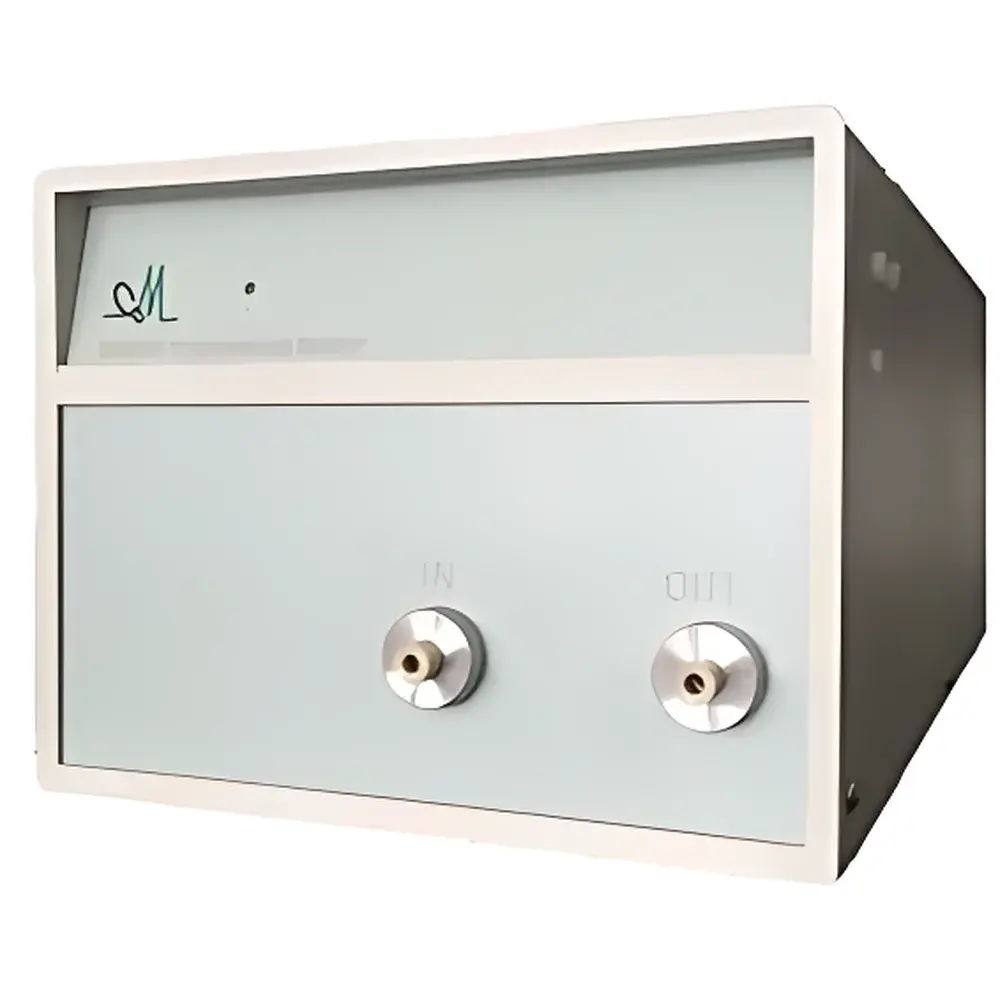
CoMetro 6000PER Photochemical Derivatization System
| Brand | CoMetro |
|---|---|
| Origin | Imported |
| Model | 6000PER |
| Temperature Control | Ambient (Forced Air Cooling) |
| Derivatization Reagent Flow Rate | 0–3 mL/min |
| Reaction Coil Material | Stainless Steel |
| Light Source | Cold UV Lamp |
| Wavelength | 254 nm |
| Output Power | 8 mW |
| Optical Design | Köhler Illumination |
| Max. Flow Rate | 3 mL/min |
| Compliance | Designed for HPLC Post-Column Derivatization per ASTM D7891 & USP <1092> |
Overview
The CoMetro 6000PER Photochemical Derivatization System is an engineered post-column derivatization module designed for integration into high-performance liquid chromatography (HPLC) workflows requiring enhanced detection sensitivity for native-fluorescent or photoactivatable analytes. Unlike thermal or chemical derivatization methods, the 6000PER employs low-intensity, monochromatic 254 nm ultraviolet irradiation to induce controlled photolytic cleavage and structural rearrangement—specifically enabling the conversion of non-fluorescent or weakly fluorescent compounds (e.g., aflatoxin B₂ and G₂) into highly fluorescent derivatives (aflatoxin B₁ and G₁). This process occurs continuously in-flow within a precisely illuminated stainless-steel reaction coil, positioned between the HPLC column outlet and the fluorescence detector. The system operates at ambient temperature with forced-air cooling to maintain thermal stability of the reaction zone and prevent UV-induced degradation of labile analytes or mobile phase components. Its optical architecture utilizes Köhler illumination to ensure uniform photon flux across the entire inner surface of the reaction coil, minimizing axial intensity gradients and maximizing derivatization reproducibility.
Key Features
- UV-C cold lamp source (254 nm, 8 mW output) with stable spectral emission and >5,000-hour lifetime
- Stainless-steel reaction coil optimized for minimal band broadening and zero added system dead volume
- No reagent pumps, mixing tees, or chemical reservoirs—eliminates cross-contamination, gradient disturbance, and maintenance-intensive fluidic pathways
- Forced-air thermal management maintains consistent coil surface temperature under variable flow conditions (0–3 mL/min)
- Plug-and-play HPLC compatibility: standard 1/16″ OD stainless-steel tubing connections (female VCR or Swagelok® compatible)
- Optical path fully enclosed and interlocked for operator safety and compliance with IEC 61010-1 Class I requirements
Sample Compatibility & Compliance
The 6000PER is validated for use in regulatory-compliant testing of mycotoxins—including aflatoxin B₁, B₂, G₁, and G₂—in food, feed, and pharmaceutical raw materials per AOAC Official Method 2005.08 and EU Commission Regulation (EC) No. 401/2006. It supports derivatization of sulfonamide antibiotics (e.g., sulfamethoxazole, sulfadiazine) when coupled with fluorescence or tandem mass spectrometric detection. The system’s reagent-free operation avoids introduction of reactive chemicals that could compromise LC column longevity or interfere with electrospray ionization (ESI) sources. All wetted materials meet USP Class VI biocompatibility standards; the device is suitable for GLP and GMP environments where audit trails and instrument qualification (IQ/OQ/PQ) are required. While the unit itself does not generate electronic records, its passive design ensures full compatibility with LIMS-integrated data acquisition systems compliant with FDA 21 CFR Part 11 when paired with validated HPLC control software.
Software & Data Management
As a hardware-only, analog signal-enhancing module, the 6000PER requires no embedded firmware, drivers, or proprietary software. It functions transparently within any vendor-neutral HPLC data system (e.g., Thermo Chromeleon™, Waters Empower®, Agilent OpenLab CDS). Derivatization efficiency is assessed via comparative peak area ratios (derivatized vs. underivatized standards) and confirmed through system suitability tests defined in USP for post-column reaction systems. Users may document operational parameters—including flow rate, lamp activation time, and ambient temperature—in instrument logbooks or electronic lab notebooks (ELN) as part of routine system suitability protocols. Lamp usage hours can be tracked manually or via external timer relays for preventive maintenance scheduling.
Applications
- Quantification of aflatoxins in cereals, nuts, spices, and dairy products using HPLC-FLD
- Residue analysis of sulfonamide antimicrobials in animal tissues and aquaculture samples
- Method development for photo-labile heterocyclic amines and nitroaromatic compounds in environmental water extracts
- Supporting ICH Q5C stability-indicating assays where photoderivatization improves selectivity against degradants
- Replacement of hazardous bromine-based or o-phthalaldehyde (OPA) chemical derivatization in QC laboratories seeking greener analytical workflows
FAQ
Does the 6000PER require calibration or routine photometric verification?
No—its performance is verified through system suitability testing using certified aflatoxin reference standards. UV lamp output stability is monitored indirectly via consistent derivative peak response (RSD ≤ 3.0% over 24 h).
Can the 6000PER be used with UHPLC systems operating above 600 bar?
Yes, provided the stainless-steel reaction coil and connecting fittings are rated for the system’s maximum pressure; standard configuration supports up to 1,000 bar with optional high-pressure coil variants.
Is ozone generation a concern during extended operation?
No—the 254 nm lamp emits below the ozone-generation threshold (185 nm); no ozone scrubbers or ventilation modifications are required.
How does the Köhler illumination design improve derivatization consistency?
It eliminates hot spots and radial intensity falloff, ensuring uniform photon fluence across the entire coil length—critical for first-order photochemical kinetics and quantitative reproducibility.
What maintenance is required beyond lamp replacement?
None—no fluidic valves, seals, or reactors require periodic servicing. Lamp replacement (every ~5,000 h) is the sole scheduled maintenance task.





