
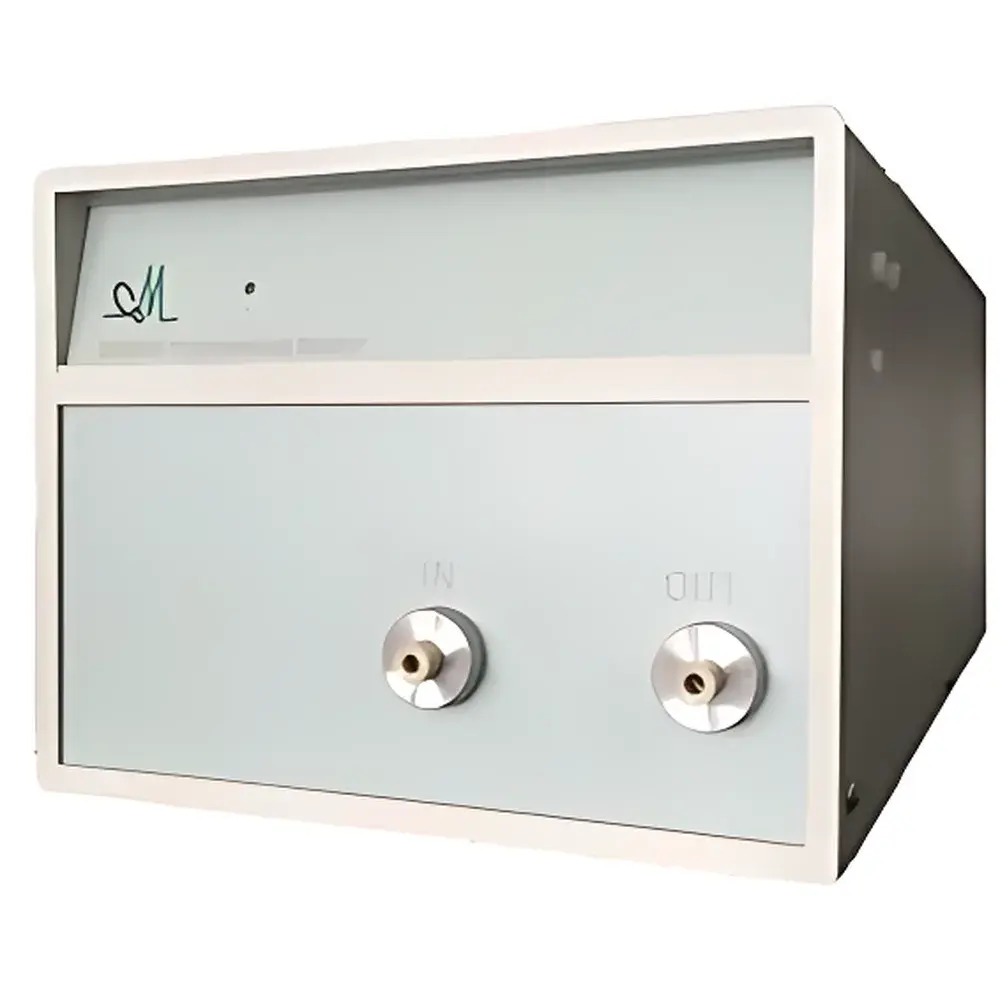
CoMetro 6000PER Photochemical Post-Column Derivatization System
| Brand | CoMetro |
|---|---|
| Origin | Imported |
| Manufacturer Type | Authorized Distributor |
| Model | 6000PER Photochemical |
| Derivatization Flow Rate | 3 mL/min |
| Reaction Coil Material | Stainless Steel |
| Light Source | Cold Cathode UV Lamp |
| Wavelength | 254 nm |
| Output Power | 8 mW |
| Illumination Geometry | Köhler Illumination |
| Temperature Control | Forced-Air Cooling |
| Compliance | Designed for ASTM D7112, USP <232>/<233>, and ICH Q2(R2) compliant workflows |
Overview
The CoMetro 6000PER Photochemical Post-Column Derivatization System is an engineered solution for enhancing the sensitivity and selectivity of high-performance liquid chromatography (HPLC) detection—specifically for analytes requiring photochemical activation prior to fluorescence or UV detection. Unlike thermal or chemical derivatization methods, the 6000PER employs a precisely controlled 254 nm ultraviolet cold cathode lamp operating under Köhler illumination geometry to induce in-line photolysis of target compounds immediately after column elution and before detector entry. This design ensures consistent photon flux across the entire cross-section of the stainless-steel reaction coil, minimizing axial dispersion while maintaining chromatographic integrity. The system is optimized for regulatory-compliant analysis of mycotoxins—including aflatoxin B₁ and G₁—as well as sulfonamide antibiotics, where photochemical conversion yields highly fluorescent derivatives without reagent addition, mixing valves, or post-reaction washing steps.
Key Features
- UV-C cold cathode lamp with stable 254 nm output (8 mW nominal power), engineered for long-term spectral consistency and minimal thermal load on the flow path
- Köhler illumination configuration ensures uniform irradiance distribution across the internal diameter of the stainless-steel reaction coil, eliminating hot-spot degradation and improving reaction reproducibility
- Forced-air cooling maintains ambient thermal stability (< ±2 °C fluctuation) during extended operation—critical for retention time precision and detector baseline stability
- No chemical reagents required; eliminates risks associated with reagent preparation, pump synchronization, gradient mismatch, or carryover contamination
- Zero dead-volume integration: compact coil design (316L stainless steel) mounts directly between column outlet and detector inlet, preserving peak shape and resolution (theoretical plate count unaffected)
- Plug-and-play compatibility with standard HPLC systems using 1/16″ OD stainless-steel or PEEK tubing; no electrical interface beyond 100–240 VAC input
Sample Compatibility & Compliance
The 6000PER supports validated methods for regulated food safety and pharmaceutical QC testing. It is routinely deployed in laboratories performing analyses per AOAC Official Method 2005.08 (aflatoxins in nuts and grains) and EU Commission Regulation (EC) No. 401/2006. Its reagent-free operation aligns with green chemistry principles outlined in ICH Q5C and reduces method validation burden under FDA 21 CFR Part 11 and EU Annex 11 requirements. The stainless-steel flow path meets USP extractables profiling thresholds for Class VI plastics-equivalent inertness. All firmware logic and operational logs (where integrated with third-party CDS) support ALCOA+ data integrity principles when used within GLP/GMP environments.
Software & Data Management
As a hardware-only derivatization module, the 6000PER does not include embedded firmware or proprietary software. It operates independently of chromatography data systems (CDS), requiring no driver installation or protocol configuration. However, its deterministic response enables seamless integration into validated workflows using Empower 3, Chromeleon 7.3+, or OpenLab CDS. Instrument qualification documentation—including Installation Qualification (IQ), Operational Qualification (OQ), and Performance Qualification (PQ) templates—is provided to support audit readiness. UV lamp intensity decay can be monitored indirectly via system suitability testing (e.g., signal-to-noise ratio of aflatoxin B₁ peak at defined injection levels), satisfying periodic verification requirements per ISO/IEC 17025:2017 Clause 7.7.
Applications
- Quantitation of aflatoxin B₁, B₂, G₁, and G₂ in cereal, feed, and nut matrices per AOAC, ISO 16050, and GB 5009.22–2016 (adapted)
- Detection of sulfadiazine, sulfamethoxazole, and sulfamerazine in animal tissue and milk using fluorescence enhancement post-photolysis
- Analysis of chloramphenicol residues in aquaculture products where photochemical cleavage improves LOD versus direct UV detection
- Support for multi-residue pesticide screening protocols incorporating photolytic activation steps prior to tandem mass spectrometry
- Method development for emerging mycotoxins (e.g., cyclopiazonic acid) where UV-induced structural rearrangement yields detectable chromophores
FAQ
Does the 6000PER require calibration or routine lamp output measurement?
No routine radiometric calibration is specified. Lamp performance is verified through system suitability tests using certified reference standards—consistent with USP Analytical Instrument Qualification guidelines.
Can the reaction coil be replaced with alternative materials such as fused silica or PEEK?
No. The stainless-steel coil is integral to the optical path design and thermal management architecture. Substitution compromises Köhler illumination efficiency and may induce UV-induced leaching or adsorption artifacts.
Is the 6000PER compatible with UHPLC systems operating above 1000 bar?
Yes—when installed downstream of the column and upstream of the detector, it imposes no backpressure and is rated for continuous operation at flow rates up to 3 mL/min and pressures ≤ 1500 bar when using appropriate fittings.
What maintenance is required beyond lamp replacement?
Lamp replacement every 1,500–2,000 hours of operation is the sole scheduled maintenance item. No cleaning, alignment, or fluidic recalibration is necessary due to the static optical and hydraulic design.
Does CoMetro provide application notes or method transfer support?
Yes—validated HPLC-FLD methods for aflatoxin analysis, including mobile phase composition, column selection, and detector settings, are available upon request under NDA.



