
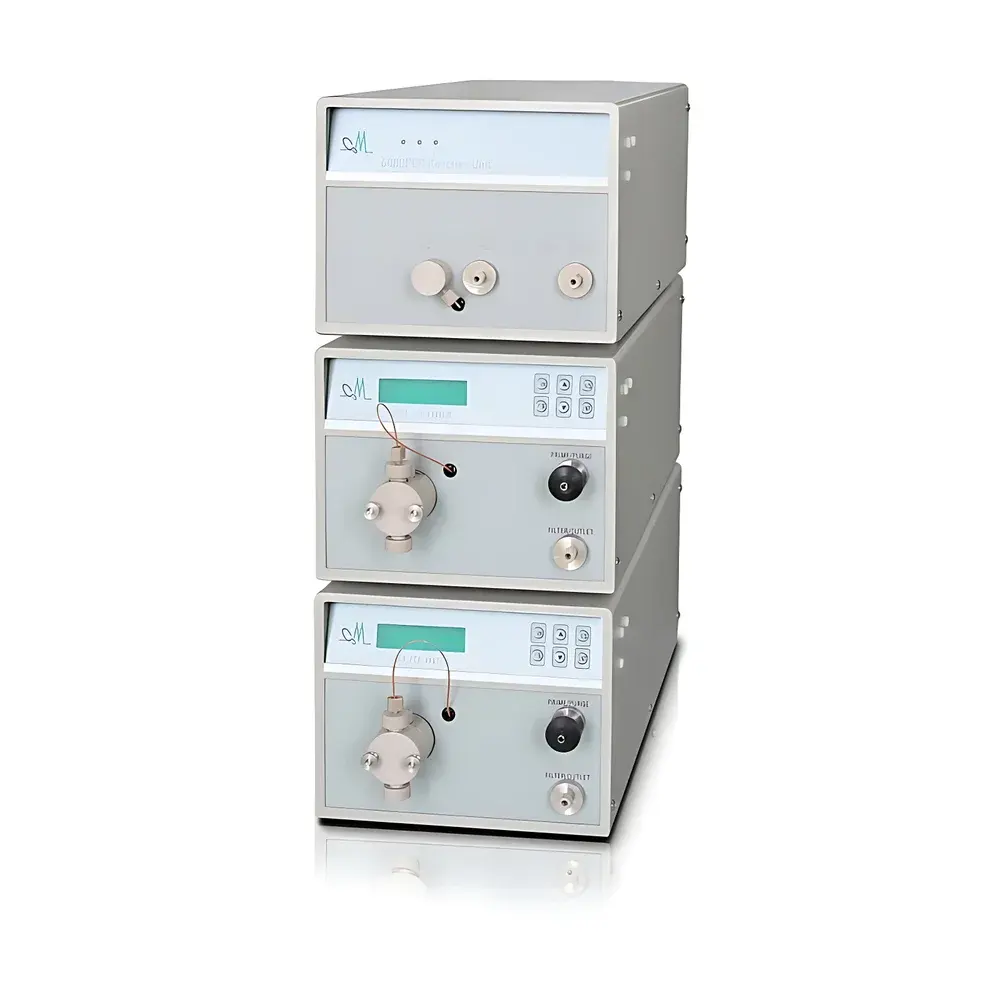
CoMetro Com6000 Post-Column Derivatization System for Carbamate Pesticide Residue Analysis
| Brand | CoMetro |
|---|---|
| Model | Com6000 Series |
| Temperature Range | Ambient +10 °C to 150 °C |
| Derivatization Reagent Flow Rate | 0.001–10 mL/min |
| Reaction Coil Material | PEEK |
| Reactor Volume Options | 0.15 / 0.5 / 1.5 mL |
| Temperature Accuracy | ±1 °C |
| Temperature Reproducibility | ±0.4 °C |
| Maximum Safety Cut-off | 160 °C |
| Pump Pressure Range | 0–4000 psi |
| Flow Accuracy | ±1% |
| Flow Precision | 0.2% RSD |
| System Fluidic Path | Full PEEK |
Overview
The CoMetro Com6000 Post-Column Derivatization System is an engineered solution for high-sensitivity, quantitative analysis of carbamate pesticides and other low-UV-absorbing analytes in complex matrices. Designed to integrate seamlessly with HPLC systems, the Com6000 enables on-line post-column derivatization—converting non-fluorescent or weakly fluorescent carbamates (e.g., carbaryl, methomyl, aldicarb, propoxur) into stable, highly detectable fluorescent derivatives via thermal or catalytic reaction with o-phthalaldehyde (OPA), naphthalene-2,3-dicarboxaldehyde (NDA), or other validated reagents. This system directly supports compliance with Chinese national standard GB 23200.112–2018 and agricultural industry standard NY/T 761–2008 for multi-residue analysis of carbamates in plant-derived food commodities. Its core architecture employs Couette-flow mixing within a thermally controlled, sealed reaction coil—ensuring rapid, reproducible derivatization kinetics while minimizing band broadening and backpressure fluctuations.
Key Features
- Modular dual-reaction capability: Supports simultaneous heated and ambient-temperature derivatization steps—enabling two-stage protocols (e.g., hydrolysis followed by condensation) without manual intervention.
- Front-panel digital interface: Real-time display of reactor temperature setpoint/actual value, derivatization pump flow rate, line pressure, and pressure limits—no software required for basic operation.
- Tool-free reactor cartridge exchange: Each PEEK reaction coil (0.15 / 0.5 / 1.5 mL options) installs with only two fittings—reducing dead volume, minimizing carryover, and preserving chromatographic resolution.
- Full PEEK fluidic path: Chemically inert, low-metal leaching construction compatible with aggressive derivatization reagents (e.g., sodium hydroxide, thiol buffers, borate solutions) and resistant to corrosion from halogenated solvents or acidic mobile phases.
- Integrated pump intelligence: Stepper-motor-driven derivatization pumps feature auto-purge cycles, built-in PEEK exhaust valves, and real-time pressure monitoring—extending seal life and ensuring long-term flow stability (0.2% RSD).
- Flexible control architecture: Local operation via front-panel keypad or remote command via RS232—supporting integration into LIMS-controlled labs and automated workflows compliant with 21 CFR Part 11 audit trail requirements.
Sample Compatibility & Compliance
The Com6000 system is validated for use with CoMetro’s dedicated carbamate-specific reversed-phase columns (e.g., Comatex C18-CB and C8-CB, 5 µm, 250 × 4.6 mm) and certified derivatization reagent kits (P/N: YS-CB-001). It meets analytical performance criteria outlined in GB 23200.112–2018 for detection limits ≤0.01 mg/kg across nine carbamate residues in fruits, vegetables, and grains. The system’s temperature stability (±0.4 °C reproducibility) and precise flow control (±1% accuracy) ensure method transferability between laboratories. All hardware components conform to ISO 9001 manufacturing standards; PEEK tubing and fittings comply with USP Class VI biocompatibility specifications. When deployed in GLP-regulated environments, the system supports electronic signature capture, event logging, and configuration change tracking when interfaced with validated chromatography data systems.
Software & Data Management
While fully functional as a standalone instrument, the Com6000 provides native RS232 serial communication for bidirectional control and status reporting. It accepts ASCII-based commands for temperature ramping, flow rate adjustment, and pressure threshold setting—enabling synchronization with third-party CDS platforms (e.g., Thermo Chromeleon, Waters Empower, Agilent OpenLab). Audit-ready operation is achievable through external software that records all parameter changes—including timestamps, operator IDs, and system state transitions—in accordance with FDA 21 CFR Part 11 requirements. No proprietary software installation is required; configuration files and calibration logs are stored externally by the host CDS.
Applications
Beyond carbamate pesticide quantification, the Com6000 supports diverse derivatization-based assays including: amino acid profiling (including taurine and γ-aminobutyric acid); mycotoxin analysis (aflatoxin B₁, deoxynivalenol, domoic acid); herbicide residue testing (glyphosate, paraquat, diquat); analysis of aminoglycoside and polyether antibiotics; pharmaceutical impurity screening (e.g., voglibose, erythromycin); clinical metabolic disorder diagnostics (phenylketonuria, maple syrup urine disease); and detection of biogenic amines, bromate, formaldehyde, hexavalent chromium, and guanidines. Its adaptability extends to environmental water monitoring, feed and food safety QA/QC, clinical toxicology, and pharmaceutical process validation.
FAQ
What regulatory methods does the Com6000 support?
It is specifically optimized for GB 23200.112–2018 and NY/T 761–2008, but its modular design allows method adaptation to AOAC 2007.01, EN 15662:2018, and EPA Method 531.1.
Can the Com6000 be used with UV or MS detection?
Yes—it is compatible with fluorescence, UV-Vis, and mass spectrometric detectors; however, fluorescence detection remains the primary recommended mode for carbamate analysis due to superior sensitivity post-derivatization.
Is PEEK the only wetted material in contact with reagents?
Yes—the entire fluid path—including pump heads, check valves, reaction coils, and interconnect tubing—is constructed exclusively from PEEK to prevent metal ion leaching and chemical degradation.
How is temperature stability verified during qualification?
Temperature accuracy (±1 °C) and reproducibility (±0.4 °C) are verified using NIST-traceable calibrated PT100 probes placed directly inside the reactor block during IQ/OQ protocol execution.
Does the system include validation documentation?
CoMetro supplies a Factory Acceptance Test (FAT) report and a comprehensive User Requirement Specification (URS)-aligned Installation Qualification (IQ) template; Operational Qualification (OQ) protocols are available upon request for GMP/GLP environments.




