
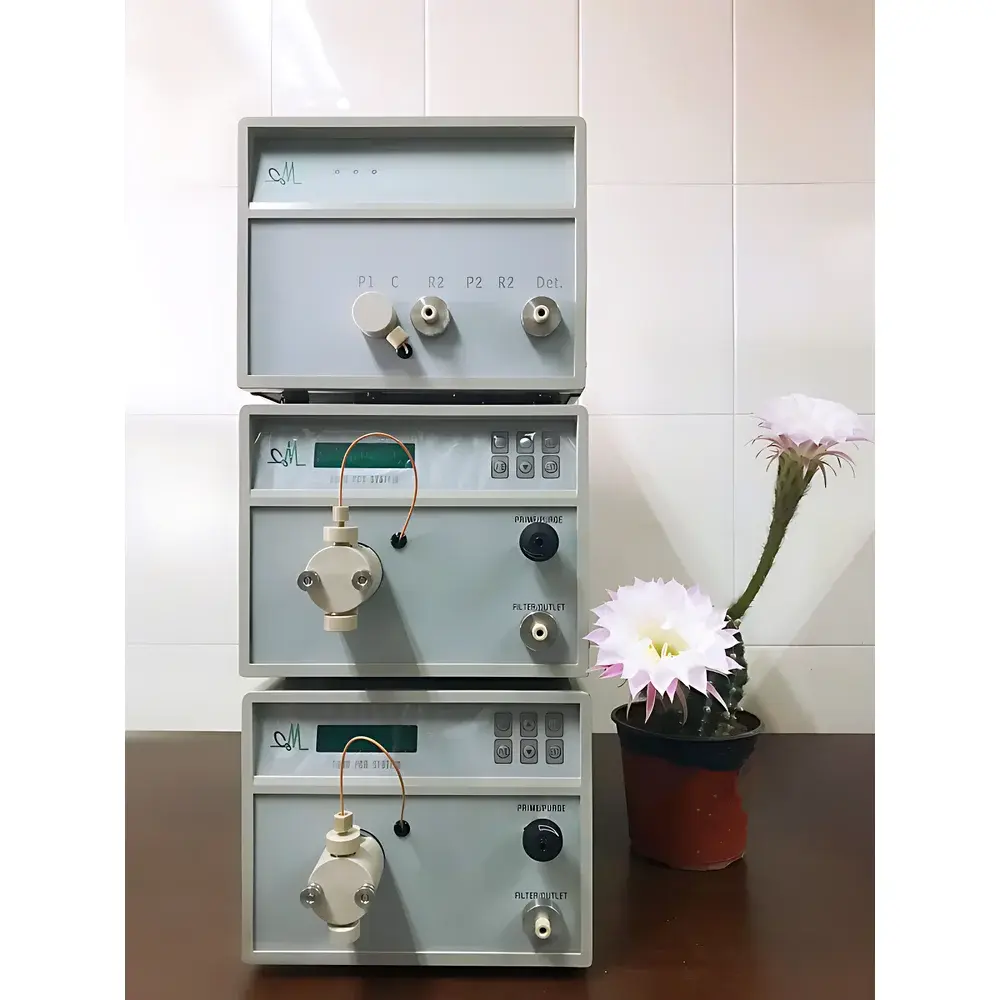
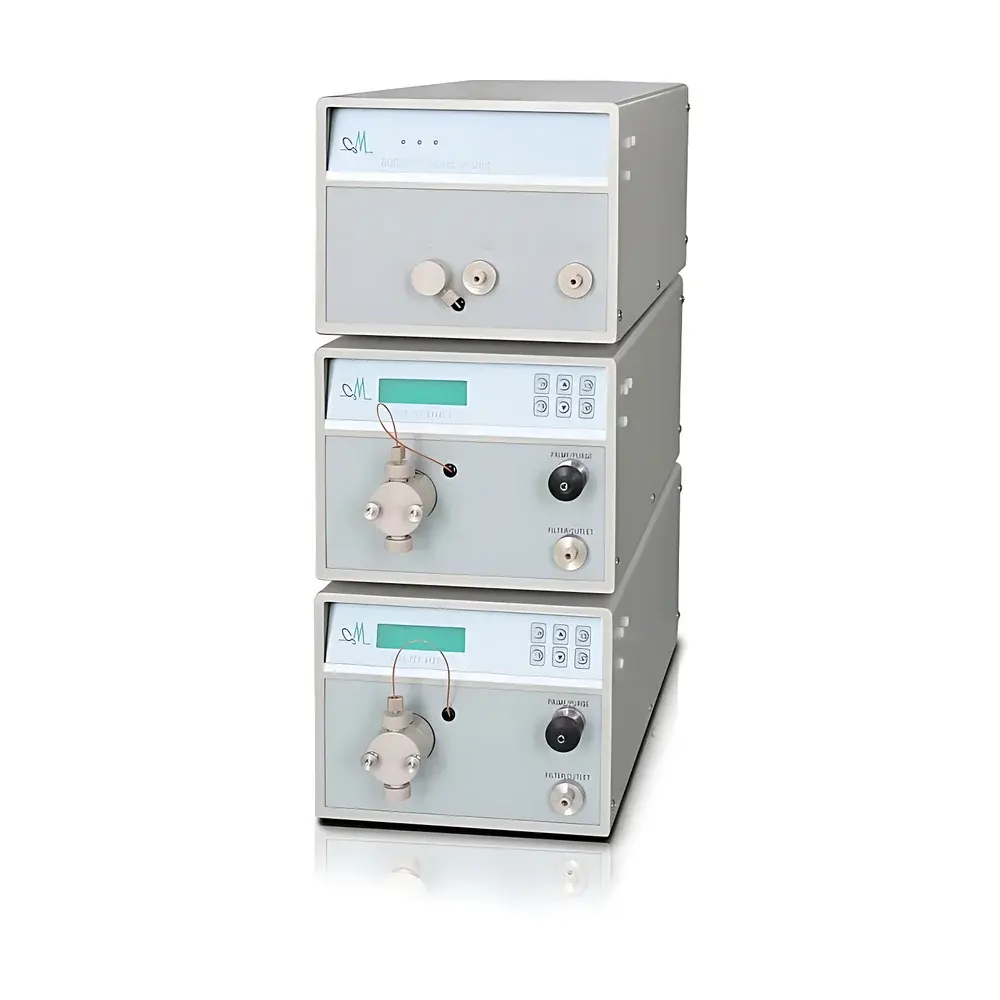
CoMetro Com6000 Series Post-Column Derivatization System
| Brand | CoMetro |
|---|---|
| Origin | Imported |
| Manufacturer Type | Authorized Distributor |
| Model | Com6000 Series |
| Temperature Range | Ambient +10 °C to 150 °C |
| Derivatization Reagent Flow Rate | 0.001–10 mL/min |
| Reaction Loop Material | Full PEEK fluidic path |
Overview
The CoMetro Com6000 Series Post-Column Derivatization System is an engineered solution for enhancing detection sensitivity and selectivity in high-performance liquid chromatography (HPLC) and ultra-high-performance liquid chromatography (UHPLC) applications. It operates on the principle of post-column chemical derivatization—introducing a reactive reagent downstream of the analytical column but upstream of the detector—to convert non-UV-absorbing or weakly fluorescent analytes into highly detectable derivatives. This system is widely deployed in regulated laboratories performing residue analysis, clinical biomarker quantification, and pharmaceutical impurity profiling where native analyte response is insufficient for meeting method detection limits (MDLs) or regulatory thresholds (e.g., EU MRLs, US EPA Method 548/549, FDA Guidance for Residue Chemistry Studies). Its architecture supports both thermal and ambient derivatization reactions, enabling compatibility with thermally labile reagents (e.g., o-phthalaldehyde for amino acids) and high-temperature protocols (e.g., ninhydrin or ortho-phthalaldehyde with iodide for primary amines, or sodium nitroprusside for hydrazides).
Key Features
- Modular reactor design with interchangeable reaction cores (0.15 mL, 0.5 mL, or 1.5 mL volume options), each featuring a sealed, continuous-loop geometry optimized for minimal band broadening and high mixing efficiency via multi-directional flow dynamics.
- Dual-zone temperature control: independent heating modules support simultaneous thermal derivatization (up to 150 °C, ±1 °C accuracy, ±0.4 °C reproducibility) and ambient reaction steps—enabling two-stage derivatization protocols such as those required for carbamate pesticide analysis per AOAC 2007.01 and ISO 11843-2.
- Full PEEK fluidic path—including pump heads, tubing, valves, and reactor loops—ensuring chemical inertness against aggressive reagents (e.g., sodium hypochlorite, potassium cyanide, or strong acid/base derivatives) and eliminating metal-induced catalytic degradation or adsorption losses.
- Integrated derivatization pumps with stepper-motor-driven precision metering (0.001–10 mL/min, ±1% flow accuracy, 0.2% RSD), built-in PEEK exhaust valves, automatic online seal-washing cycles, and real-time pressure monitoring (0–4000 psi).
- Front-panel digital interface with dedicated displays for reactor temperature setpoint/actual value, pump flow rate/pressure/pressure limits, and system readiness status—fully operable without external software.
- RS232 serial interface enables bidirectional communication for remote parameter control, event logging, and integration into LIMS or chromatography data systems (CDS) compliant with 21 CFR Part 11 audit trail requirements.
Sample Compatibility & Compliance
The Com6000 system is validated for use in methods aligned with international regulatory frameworks including ISO/IEC 17025-accredited testing, USDA AMS residue enforcement programs, and EU Regulation (EC) No 396/2005. It supports derivatization chemistries for diverse analyte classes: carbamate pesticides (e.g., carbaryl, methomyl) per GB 23200.112–2018 and NY/T 761–2008; glyphosate and AMPA using R300-02 reagent kits; aflatoxins (B1/B2/G1/G2) via bromination followed by fluorescence enhancement; ochratoxin A using iodine oxidation; and amino acids/taurine using OPA/thiol derivatization. All wetted materials comply with USP Class VI biocompatibility standards, and the system’s closed-loop reactor design meets GLP requirements for contamination control and method robustness.
Software & Data Management
While the Com6000 operates autonomously via its front panel, its RS232 port supports standardized ASCII command protocols for integration with third-party CDS platforms (e.g., Thermo Chromeleon, Waters Empower, Agilent OpenLab). Logged operational parameters—including temperature ramp profiles, pump flow histories, pressure excursions, and system error codes—are timestamped and exportable for audit-ready reporting. When deployed in 21 CFR Part 11 environments, optional electronic signature modules and role-based access control can be implemented at the host CDS level to satisfy electronic record integrity requirements.
Applications
- Food safety testing: Quantification of carbamate residues in fruits, vegetables, and cereals; glyphosate in soybeans and oats; mycotoxins in nuts and spices.
- Clinical diagnostics: Screening for phenylketonuria (PKU) and maple syrup urine disease (MSUD) via amino acid profiling in dried blood spots.
- Environmental monitoring: Detection of bromate in drinking water, hexavalent chromium in wastewater, and biogenic amines in seafood.
- Pharmaceutical QC: Assay of vildagliptin (voglibose analog), erythromycin, and gentamicin using fluorescence or electrochemical detection enhancement.
- Feed and nutrition analysis: Monitoring lysine bioavailability, taurine in pet food, and melamine adulteration in dairy-based ingredients.
FAQ
What derivatization reagents are compatible with the Com6000 system?
The system supports aqueous, organic, and mixed-phase reagents—including OPA, ninhydrin, sodium nitroprusside, iodine, potassium bromide, and chloramine-T—provided they are chemically stable within PEEK and do not exceed 4000 psi system pressure.
Can the Com6000 be integrated with UHPLC systems operating above 1000 bar?
Yes—the full-PEEK flow path and reinforced reactor core are rated for backpressures up to 4000 psi (≈275 bar), making it suitable for most UHPLC configurations when placed post-column but pre-detector.
Is method validation documentation available for regulatory submissions?
CoMetro provides instrument qualification protocols (IQ/OQ/PQ templates), material certifications (USP Class VI, RoHS), and technical notes supporting ICH Q2(R2) parameters—available upon request to authorized distributors.
How often does the reactor core require replacement?
Under normal operation with cleaned reagents, reactor cores exhibit >2-year service life; replacement requires only two fittings and takes <90 seconds due to the modular bayonet-mount design.
Does the system support gradient reagent delivery?
No—the Com6000 delivers isocratic reagent flow; gradient derivatization requires external binary pump integration via RS232-synchronized start/stop commands.




