
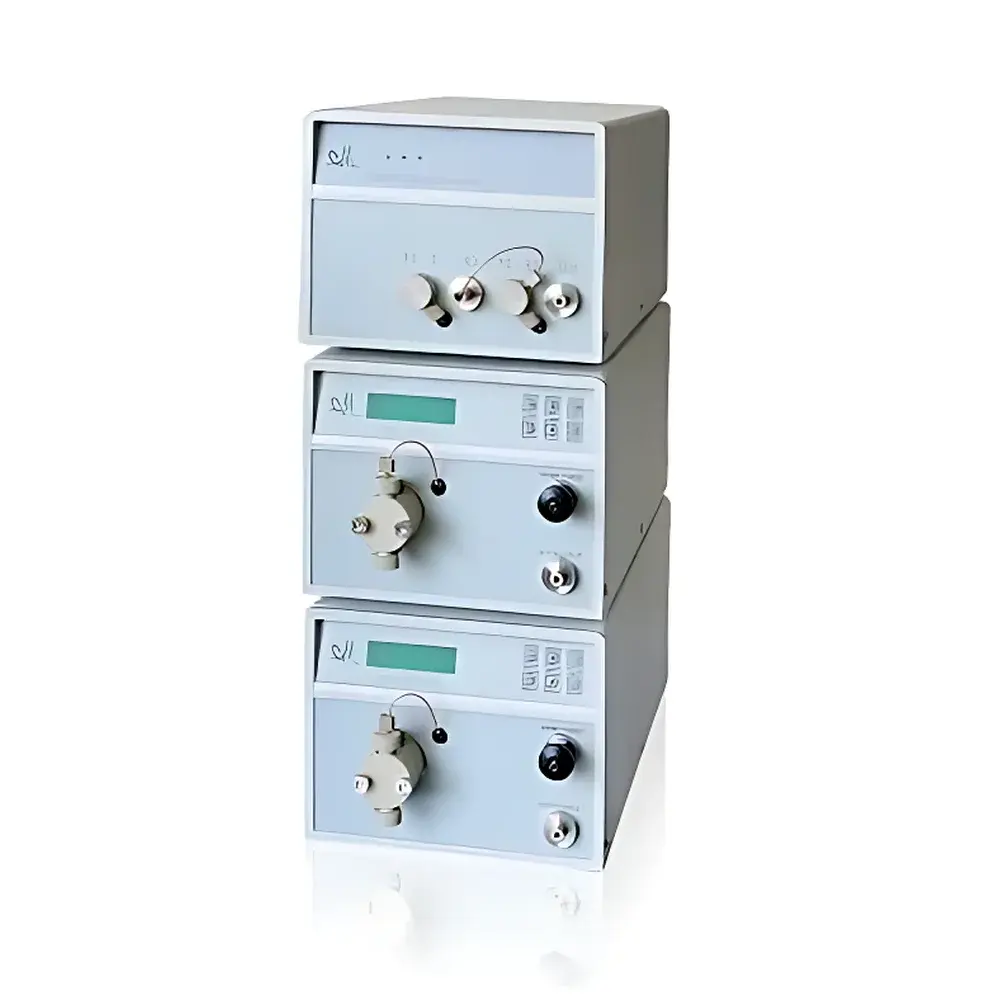
CoMetro Com6000 Series Post-Column Derivatization System
| Brand | CoMetro |
|---|---|
| Origin | Imported |
| Manufacturer Type | Authorized Distributor |
| Model | Com6000 Series |
| Temperature Range | 150 °C (max) |
| Derivatization Reagent Flow Rate | 0.001–10 mL/min |
| Reaction Coil Material | PEEK |
| Reaction Volume Options | 0.15 / 0.5 / 1.5 mL |
| Temperature Accuracy | ±1 °C |
| Temperature Reproducibility | ±0.4 °C |
| Pressure Range | 0–4000 psi |
| Flow Accuracy | ±1% |
| Flow Precision | 0.2% RSD |
Overview
The CoMetro Com6000 Series Post-Column Derivatization System is a precision-engineered, modular platform designed to enhance detection sensitivity and selectivity in high-performance liquid chromatography (HPLC) and ultra-high-performance liquid chromatography (UHPLC) workflows. It operates on the principle of post-column chemical derivatization—introducing a reactive reagent downstream of the analytical column but upstream of the detector—to convert non-chromophoric or weakly fluorescent analytes into stable, highly detectable derivatives. This system is optimized for applications requiring trace-level quantification under regulated laboratory conditions, including environmental monitoring, food safety testing, clinical diagnostics, and pharmaceutical quality control. Its architecture supports both thermal and ambient derivatization reactions, enabling sequential multi-step derivatization protocols without manual intervention or system reconfiguration.
Key Features
- Modular reaction core design with front-panel-accessible quick-connect fittings—only two connections required for full reaction coil replacement.
- Simultaneous dual-path capability: independent temperature-controlled and ambient-temperature reaction zones within a single chassis, supporting two-stage derivatization (e.g., hydrolysis followed by condensation).
- PEEK-only fluidic path from reagent inlet to detector outlet—including pump heads, tubing, valves, and reaction coils—ensuring chemical inertness, low metal leaching, and compatibility with aggressive reagents (e.g., o-phthalaldehyde, ninhydrin, ortho-diaminobenzene).
- Digital front-panel interface with real-time display of setpoint/actual temperature per reaction zone, reagent flow rate, system pressure, and pressure limits.
- Integrated derivatization pumps featuring stepper-motor-driven precision metering, automatic online seal cleaning cycles, and built-in PEEK exhaust valves to minimize bubble entrapment and baseline drift.
- RS232 serial interface for remote instrument control, parameter logging, and integration into LIMS or chromatography data systems (CDS) compliant with FDA 21 CFR Part 11 audit trail requirements.
- Thermally stabilized reaction coils with volumetric options (0.15 mL, 0.5 mL, 1.5 mL), calibrated to ±5% volume accuracy, and engineered for minimal band broadening via multidirectional laminar flow geometry.
Sample Compatibility & Compliance
The Com6000 system is validated for use in assays aligned with international regulatory standards, including AOAC Official Methods®, ISO 13843, USP , and EPA Method 548. It supports derivatization of primary and secondary amines (e.g., amino acids, taurine, biogenic amines), hydrazides (e.g., carbamate pesticides), aldehydes (e.g., formaldehyde), and specific heterocyclic toxins (e.g., aflatoxins, ochratoxin A, domoic acid). Its PEEK-based construction ensures compliance with GLP and GMP environments where extractables and leachables must be minimized. The system’s temperature cut-off at 160 °C and real-time pressure monitoring provide fail-safe operation during extended unattended runs—critical for overnight residue screening in food and feed laboratories.
Software & Data Management
While the Com6000 operates as a standalone hardware module, its RS232 interface enables bidirectional communication with third-party CDS platforms (e.g., Waters Empower, Thermo Chromeleon, Agilent OpenLab). All user-modifiable parameters—including temperature setpoints, flow rates, pressure thresholds, and derivatization timing—are timestamped and logged locally. When integrated into a validated workflow, the system supports electronic signatures, user access levels, and immutable audit trails meeting FDA 21 CFR Part 11 and EU Annex 11 requirements. No proprietary software installation is required; configuration is performed via ASCII command protocol documented in the IEC 62443-aligned technical manual.
Applications
- Amino acid profiling in clinical serum/plasma (e.g., phenylketonuria and maple syrup urine disease screening)
- Quantitative analysis of glyphosate, glufosinate, paraquat, and diquat in water, soil, and plant matrices
- Detection of mycotoxins (aflatoxin B1/B2/G1/G2, deoxynivalenol, fumonisins) in cereals and animal feed
- Residue monitoring of aminoglycoside and polyether antibiotics in milk and honey
- Pharmaceutical impurity profiling (e.g., voglibose, erythromycin degradation products)
- Chromium(VI) speciation in drinking water using diphenylcarbazide derivatization
- Bromate determination in ozonated bottled water via post-column iodide oxidation
FAQ
What types of detectors are compatible with the Com6000 system?
The system is optimized for fluorescence (FLD), UV-Vis absorbance (including diode array), and electrochemical (ECD) detection. It is not intended for coupling with mass spectrometry due to solvent incompatibility with common derivatization reagents.
Can the Com6000 perform cold derivatization without heating?
Yes—its modular reactor design allows one or more reaction zones to operate at ambient temperature while others are heated, enabling hybrid protocols such as room-temperature OPA derivatization followed by thermally accelerated naphthalene-2,3-dicarboxaldehyde (NDA) reaction.
Is method transfer supported between different Com6000 units?
Yes—calibrated reaction volumes, temperature profiles, and flow parameters are reproducible across units when operated within specified environmental conditions (20–25 °C ambient, <60% RH), supporting inter-laboratory method validation per ICH Q2(R2).
How often does the PEEK reaction coil require replacement?
Under typical usage (≤10 mL/min, ≤150 °C, non-corrosive reagents), the coil exhibits service life exceeding 2,000 injections; replacement is recommended only upon observed peak broadening or pressure instability confirmed by system suitability testing.
Does the system support gradient-compatible derivatization?
Yes—the flow-stable pump design maintains consistent reagent delivery across HPLC gradients, and the low-dead-volume reactor minimizes dwell time effects, preserving chromatographic resolution during method development.
Related Products





