
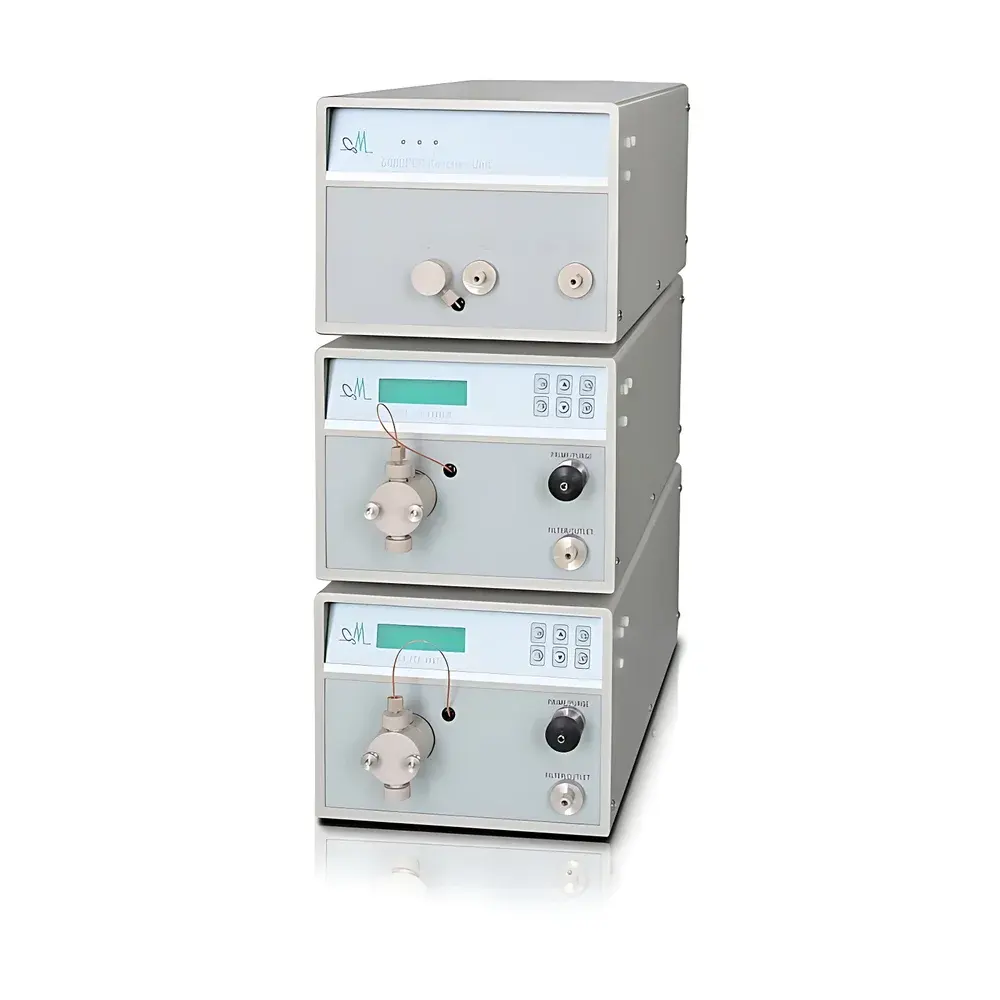
CoMetro Com6000 Series Post-Column Derivatization System for Glyphosate Analysis
| Brand | CoMetro |
|---|---|
| Origin | Imported |
| Manufacturer Type | Authorized Distributor |
| Model | Com6000 Series |
| Temperature Range | RT+10°C to 150°C (Ready Indicator Activated Within 30 min at 150°C) |
| Derivatization Reagent Flow Rate | 0.001–10 mL/min |
| Reaction Coil Material | Full PEEK |
| Reaction Volume Options | 0.15 / 0.5 / 1.5 mL |
| Temperature Accuracy | ±1°C |
| Temperature Reproducibility | ±0.4°C |
| Max Safety Cut-off | 160°C |
| Flow Accuracy | ±1% |
| Flow Precision | 0.2% RSD |
| Pressure Range | 0–4000 PSI |
| Control Interface | Front-panel keypad + RS232 |
Overview
The CoMetro Com6000 Series Post-Column Derivatization System is an engineered solution for enhancing detection sensitivity and selectivity in high-performance liquid chromatography (HPLC) applications requiring post-separation chemical derivatization. Designed specifically for trace-level analysis of primary amines and hydrazide-reactive analytes—including glyphosate, glufosinate, aminomethylphosphonic acid (AMPA), and other polar herbicides—the system integrates thermally controlled reaction modules with precision reagent delivery to enable reproducible, on-line derivatization immediately following column elution. Its operation relies on the controlled mixing of column effluent with derivatizing reagents (e.g., o-phthalaldehyde/mercaptoethanol or fluorenylmethyloxycarbonyl chloride) under precisely regulated temperature and residence time conditions—critical parameters for quantitative stability and peak integrity in regulated residue testing workflows.
Key Features
- Modular reactor architecture supporting single- or dual-core configurations for sequential or parallel derivatization steps (e.g., heating + ambient-stage reactions)
- Front-panel digital interface with real-time display of setpoint/actual temperature per reactor core, reagent flow rate, system pressure, and pressure limits
- Thermally optimized reaction coils (0.15 / 0.5 / 1.5 mL volume options) fabricated entirely from PEEK for chemical inertness, low metal leaching, and compatibility with aggressive reagents (e.g., sodium hydroxide, iodine, ninhydrin)
- Integrated derivatization pumps featuring stepper-motor-driven precision metering, automatic online seal-washing, PEEK-built-in vent valves, and built-in pressure transducers
- RS232 serial interface enabling remote control, parameter logging, and synchronization with HPLC data systems for GLP-compliant audit trails
- Minimalist fluidic layout with all fittings located on the front panel—reducing dead volume, connection points, and potential leakage pathways
- Rapid thermal stabilization: reaches and maintains 150°C within ≤30 minutes; safety cutoff at 160°C prevents overheating-induced degradation of reagents or tubing
Sample Compatibility & Compliance
The Com6000 Series supports derivatization of structurally diverse analytes across environmental, food safety, clinical, and pharmaceutical domains. Validated applications include glyphosate and AMPA in drinking water (per EPA Method 547.1), amino acids and taurine in biological fluids, carbamate pesticides (e.g., carbaryl, aldicarb) in produce extracts, mycotoxins (aflatoxin B1, deoxynivalenol), and antibiotics such as gentamicin and monensin. The system’s full-PEEK fluid path ensures compliance with ISO 17025 requirements for trace-metal-free analysis and meets material compatibility expectations outlined in USP , ICH Q2(R2), and FDA 21 CFR Part 11 when integrated into validated LC-FLD or LC-UV workflows. Reaction volume accuracy (±5%) and thermal reproducibility (±0.4°C) support method transfer between laboratories operating under GMP or GLP frameworks.
Software & Data Management
While the Com6000 operates as a standalone hardware module, its RS232 interface allows bidirectional communication with third-party chromatography data systems (CDS) including Thermo Chromeleon, Agilent OpenLab CDS, and Waters Empower. Users can log temperature profiles, pump status, pressure events, and alarm timestamps directly into the CDS audit trail. Optional firmware updates provide enhanced error-handling protocols and extended diagnostic reporting—supporting routine IQ/OQ/PQ verification and facilitating regulatory submissions where instrument qualification documentation is required. All parameter changes are timestamped and user-ID tagged when enabled via external software control.
Applications
- Environmental monitoring: Glyphosate, AMPA, and metabolites in surface water, groundwater, and wastewater per ISO 11881 and EN 15929
- Food safety testing: Residues of paraquat, diquat, and glyphosate in cereals, fruits, and infant formula per EU Regulation (EC) No 396/2005
- Clinical diagnostics: Quantification of phenylalanine, tyrosine, and branched-chain amino acids in neonatal screening for PKU and MSUD
- Pharmaceutical QC: Assay of vildagliptin-related impurities, erythromycin degradation products, and polymyxin B components
- Toxicology: Detection of biogenic amines (histamine, putrescine), bromate in bottled water, Cr(VI) in industrial effluents, and formaldehyde in disinfectant formulations
FAQ
What derivatization reagents are compatible with the Com6000 Series?
The system accommodates aqueous and organic-soluble reagents including OPA/3-MPA, FMOC-Cl, ninhydrin, and acidic iodine solutions—provided they are chemically stable below 150°C and compatible with PEEK wetted materials.
Can the Com6000 be used with UHPLC systems?
Yes, when configured with low-volume reaction coils (0.15 mL) and optimized dwell volume management, it maintains peak sharpness and resolution up to 1000 bar backpressure.
Is the system compliant with 21 CFR Part 11?
The hardware itself is Part 11–capable when integrated with a validated CDS that enforces electronic signatures, audit trails, and role-based access control.
How often does the reaction coil require replacement?
Under normal use with non-corrosive reagents, PEEK coils exhibit service life exceeding 2 years; replacement is recommended after exposure to strong oxidizers (e.g., hypochlorite) or repeated thermal cycling above 130°C.
Does CoMetro provide application notes for glyphosate analysis?
Yes—validated HPLC-FLD methods using Comatex SAX/SCX columns (P/N A72545/B72545) and R300-02 derivatization kits are available upon request for method development support.



