
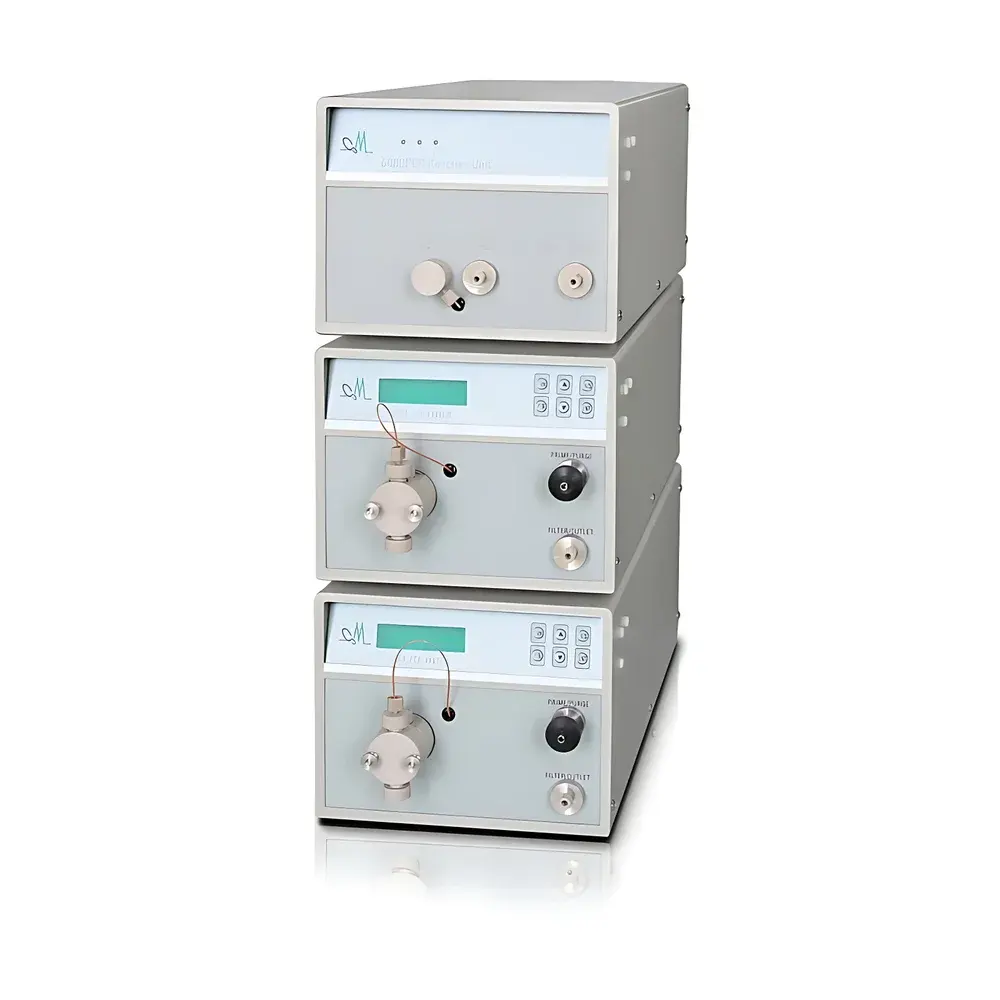
CoMetro CoMetro6000 Post-Column Derivatization System
| Brand | CoMetro |
|---|---|
| Origin | Imported |
| Manufacturer Type | Authorized Distributor |
| Model | CoMetro6000 |
| Temperature Range | Ambient +10 °C to 150 °C |
| Derivatization Reagent Flow Rate | 0.001–10 mL/min |
| Reaction Coil Material | Stainless Steel |
| Flow Path Material | PEEK |
| Temperature Accuracy | ±1 °C |
| Temperature Reproducibility | ±0.4 °C |
| Reaction Volume Options | 0.15 / 0.5 / 1.5 mL |
| Pressure Range | 0–4000 psi |
| Flow Accuracy | ±1% |
| Flow Precision | 0.2% RSD |
| Safety Cutoff Temperature | 160 °C |
| Warm-up Time to 150 °C | ≤30 min |
Overview
The CoMetro CoMetro6000 Post-Column Derivatization System is an engineered solution for enhancing detection sensitivity and selectivity in high-performance liquid chromatography (HPLC) and ultra-high-performance liquid chromatography (UHPLC) workflows. Designed for integration downstream of the analytical column and upstream of the detector—typically fluorescence (FLD), ultraviolet (UV), or mass spectrometry (MS) detectors—the system enables real-time chemical derivatization of analytes that lack native chromophores or fluorophores. It operates on the principle of controlled, temperature-regulated, continuous-flow reaction kinetics, where post-separation analytes mix with derivatizing reagents under precisely defined thermal and residence time conditions. This ensures stoichiometric conversion, minimized band broadening, and high reproducibility—critical for quantitative compliance with regulatory methods such as AOAC, ISO 18362 (amino acids), EPA Method 548/549 (pesticides), and USP for analytical instrument qualification.
Key Features
- Modular dual-core reactor architecture supporting simultaneous heated and ambient-temperature derivatization steps—ideal for multi-step protocols such as o-phthalaldehyde (OPA) followed by fluorenylmethyloxycarbonyl chloride (FMOC) derivatization of amino acids.
- Front-panel digital interface with independent temperature setpoint and real-time monitoring for each reactor core; pressure, flow rate, and pressure limit display for each derivatization pump.
- Stainless steel reaction coils with optional volumes (0.15 mL, 0.5 mL, 1.5 mL) engineered for minimal peak dispersion and optimized residence time control; volume accuracy ±5%.
- Full PEEK fluidic path from reagent reservoir to detector interface—chemically inert, low metal leaching, compatible with aggressive reagents (e.g., ortho-phthalaldehyde in borate buffer, ninhydrin in lithium citrate, or triphosgene-based derivatization agents).
- Derivatization pumps featuring stepper-motor-driven precision metering, integrated PEEK exhaust valves, automatic online seal-washing cycles, and built-in pressure transducers for real-time overpressure detection and shutdown.
- RS232 serial interface enabling full remote control and monitoring via LIMS or chromatography data systems (CDS); supports automated method synchronization with HPLC gradient timing and detector acquisition triggers.
- Front-accessible quick-connect fittings—only two unions required for reactor core replacement—reducing downtime and operator-induced variability during maintenance.
Sample Compatibility & Compliance
The CoMetro6000 is validated for use in regulated environments requiring audit-ready operation. Its temperature control (±0.4 °C reproducibility, ±1 °C accuracy) and flow delivery (0.2% RSD, ±1% absolute accuracy) meet performance criteria outlined in ICH Q2(R2) for analytical method validation. The system supports derivatization protocols referenced in pharmacopoeial monographs including USP , EP 2.2.46, and JP 6.07, particularly for amino acid analysis (e.g., taurine, lysine), carbamate pesticide residues (e.g., carbaryl, aldicarb), glyphosate and its metabolite AMPA, mycotoxins (aflatoxin B1, deoxynivalenol), aminoglycoside antibiotics (gentamicin, neomycin), and clinical biomarkers (phenylalanine for PKU screening, branched-chain amino acids for MSUD). All wetted materials comply with USP Class VI biocompatibility and FDA 21 CFR Part 11 requirements when operated with compliant CDS software—supporting electronic signatures, audit trails, and user access controls.
Software & Data Management
While the CoMetro6000 operates as a standalone hardware module, its RS232 interface provides bidirectional communication with third-party chromatography data systems (e.g., Thermo Chromeleon, Waters Empower, Agilent OpenLab). Commands include temperature ramp initiation, flow rate adjustment, pressure threshold configuration, and status polling (ready/idle/error). All parameter changes are timestamped and logged locally on the instrument’s non-volatile memory. When integrated into a 21 CFR Part 11–compliant laboratory infrastructure, the system contributes to ALCOA+ data integrity principles—ensuring data is Attributable, Legible, Contemporaneous, Original, Accurate, and Complete. Optional firmware updates deliver enhanced diagnostics, including predictive seal life estimation and pressure transient anomaly detection.
Applications
The CoMetro6000 serves laboratories across food safety, environmental monitoring, pharmaceutical QC/QA, clinical diagnostics, and agrochemical R&D. It is routinely deployed in accredited testing facilities performing residue analysis per EU Regulation (EC) No 396/2005, drinking water testing per EPA Method 544 (microcystins), veterinary drug residue quantification per CAP guidelines, and newborn screening programs for inborn errors of metabolism. Its flexibility accommodates both single-reagent (e.g., ninhydrin for primary amines) and sequential dual-reagent chemistries (e.g., OPA/FMOC for primary/secondary amine differentiation), making it suitable for complex matrices such as infant formula, animal feed, plasma, urine, soil extracts, and wastewater influents.
FAQ
What types of detectors are compatible with the CoMetro6000?
The system interfaces seamlessly with fluorescence detectors (FLD), UV-Vis absorbance detectors, and electrospray ionization (ESI) sources for LC-MS/MS—provided appropriate solvent compatibility and post-derivatization flow splitting is implemented.
Can the CoMetro6000 be used for GMP-regulated manufacturing release testing?
Yes—when operated within a validated method, with documented IQ/OQ/PQ, and integrated into a Part 11–compliant CDS, the CoMetro6000 meets GMP requirements for instrument qualification and data integrity.
Is tubing replacement required after each derivatization reagent change?
No—full PEEK fluidic construction and integrated auto-purge functionality allow safe reagent switching without manual line flushing or tubing replacement, minimizing carryover and maintenance overhead.
How is temperature stability verified during routine operation?
Built-in NIST-traceable RTD sensors provide continuous feedback; users may perform periodic verification using calibrated external thermocouple probes inserted into auxiliary ports—procedures aligned with ASTM E2582 and ISO/IEC 17025 calibration guidelines.
Does the system support gradient-compatible derivatization?
Yes—RS232-triggered temperature and flow modulation allows dynamic adjustment synchronized with HPLC gradient profiles, essential for optimizing derivatization efficiency across elution windows with varying solvent composition.
Related Products





