
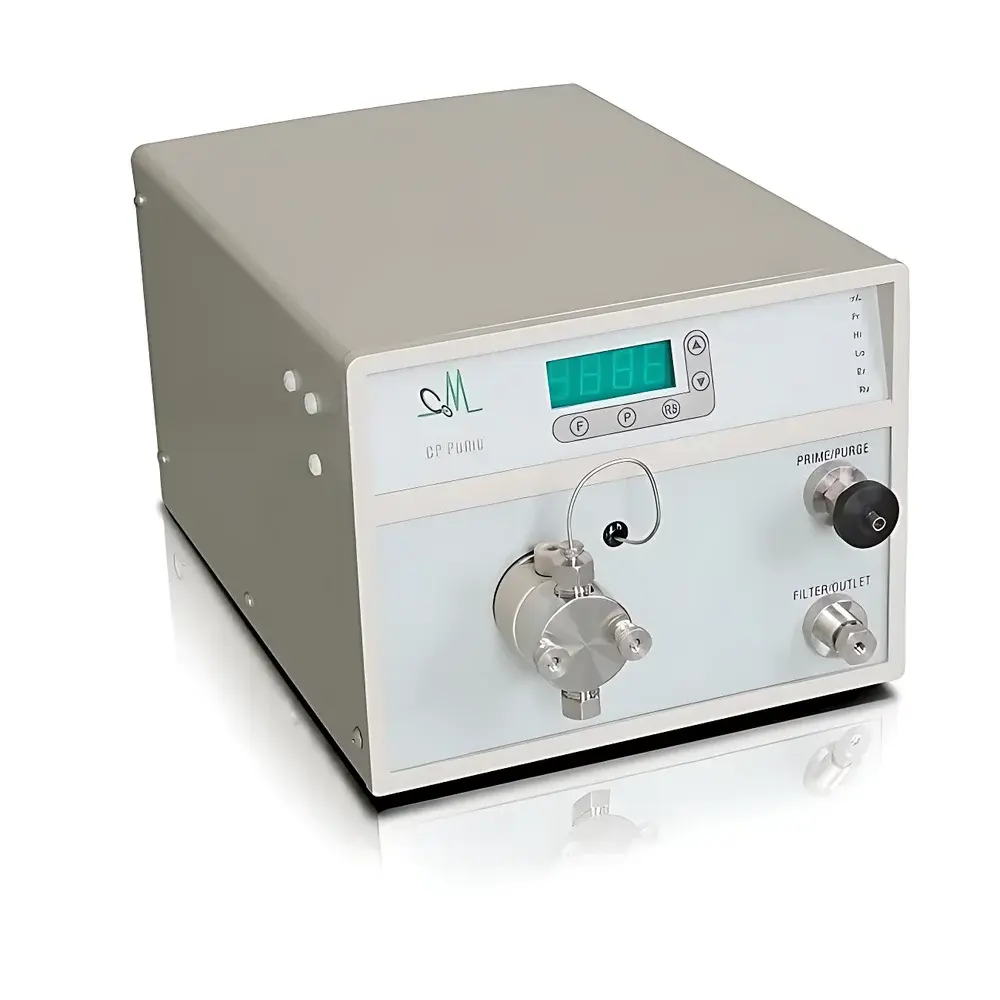
CoMetro CP-M250 High-Pressure Metering Plunger Pump for HPLC and Chemical Process Applications
| Brand | CoMetro |
|---|---|
| Model | CP-M250 |
| Instrument Type | Binary Pump |
| Max Operating Pressure | 1500 psi |
| Flow Rate Range | 0.1–50 mL/min |
| Flow Accuracy | ±1% |
| Flow Precision | 0.2% RSD |
| Dimensions | 175(H) × 225(W) × 305(D) mm |
| Weight | 11 kg |
| Power Supply | 230 V / 115 V, 50 / 60 Hz |
| Fluid Path Materials | 316 Stainless Steel (standard) or PEEK (optional) |
| Control Interface | Keypad + RS232 digital communication |
| Remote Analog Input | 0–5 V or 4–20 mA |
| Compliance | Designed for GLP/GMP-aligned lab environments |
Overview
The CoMetro CP-M250 is a high-precision, electronically controlled high-pressure metering plunger pump engineered for demanding applications in analytical chemistry, process development, and laboratory-scale chemical synthesis. Unlike conventional reciprocating pumps relying solely on mechanical check valves and passive dampening, the CP-M250 integrates an active electronic compensation system coupled with a low-volume pulsation-dampening accumulator and non-contact pressure transduction. Its operational principle is based on closed-loop servo control of a brushless DC motor driving a precision-ground plunger assembly. Real-time flow feedback—derived from motor torque profiling, volumetric displacement calibration, and dynamic load compensation—enables continuous adjustment to maintain constant volumetric delivery across variable backpressure conditions up to 1500 psi. This architecture delivers true pulse-free flow profiles essential for gradient elution in binary HPLC systems, solvent delivery in flow chemistry reactors, and reproducible reagent metering in kinetic studies.
Key Features
- Electronically compensated drive system with adaptive motor torque regulation for consistent volumetric output under changing system resistance
- Low internal-volume accumulator design minimizing compressibility-induced flow lag and improving transient response
- Non-contact pressure sensing technology eliminating diaphragm fatigue and drift over extended operation
- Modular fluid path construction with standard 316 stainless steel wetted parts; optional PEEK components available for enhanced chemical compatibility with aggressive solvents or biological buffers
- Integrated bypass valve and self-cleaning module enabling automatic line purging and reduced maintenance downtime
- Dual-mode control interface: intuitive front-panel keypad with real-time parameter display and full RS232 protocol support for remote automation via LabVIEW, Python, or third-party chromatography data systems (CDS)
- Configurable analog input (0–5 V or 4–20 mA) for external flow setpoint modulation in synchronized multi-pump or reactor control configurations
Sample Compatibility & Compliance
The CP-M250 is validated for use with a broad spectrum of HPLC-grade organic solvents (e.g., acetonitrile, methanol, THF), aqueous buffers (pH 2–12), and mildly corrosive reagents common in catalysis and polymerization research. Its chemically inert fluid path options ensure compatibility with halogenated solvents, strong acids (e.g., TFA), and base-sensitive compounds. The pump’s mechanical architecture and firmware logic are designed to meet core requirements of ISO/IEC 17025-accredited testing laboratories. When deployed with compliant data acquisition software, it supports ALCOA+ data integrity principles and facilitates traceable audit trails required under FDA 21 CFR Part 11 and EU Annex 11. Its stable flow performance aligns with ASTM D3590 (for liquid delivery accuracy in analytical instrumentation) and USP recommendations for pump consistency in pharmaceutical method development.
Software & Data Management
The CP-M250 communicates via industry-standard RS232 serial protocol using ASCII command syntax, enabling seamless integration into automated workflows without proprietary drivers. Firmware supports timestamped event logging—including flow start/stop, pressure threshold alarms, and error codes—for post-run forensic analysis. Optional firmware upgrade enables configurable data streaming at user-defined intervals (1–10 Hz), allowing real-time synchronization with mass spectrometers, UV-Vis detectors, or reactor temperature controllers. All configuration parameters—including flow setpoint, pressure limits, ramp rates, and alarm thresholds—are stored in non-volatile memory with write-protection options to prevent accidental modification during routine operation. Remote control scripts can be scheduled through Windows-based terminal emulators or embedded in Python-based orchestration frameworks using PySerial libraries.
Applications
- HPLC and UHPLC system integration as a binary solvent delivery module for gradient separation of complex petrochemical fractions
- Controlled reagent addition in microreactor and flow chemistry platforms requiring precise stoichiometric dosing at elevated pressures
- Calibration and verification of inline flow sensors and Coriolis meters in pilot-scale process validation
- Long-duration stability testing of catalysts under continuous liquid-phase feed conditions
- Teaching laboratories for demonstrating fundamental principles of positive displacement pumping, fluid compressibility, and closed-loop control theory
- QC/QA labs performing method transfer studies where inter-instrument flow reproducibility must meet ≤0.2% RSD specifications
FAQ
What is the maximum allowable backpressure for continuous operation?
The CP-M250 is rated for continuous operation up to 1500 psi (103 bar) at all flow rates within its specified range. Short-term excursions beyond this limit are not recommended and may trigger automatic shutdown if equipped with optional pressure-limiting firmware.
Can the pump handle viscous solvents such as glycerol or ethylene glycol?
Yes—within viscosity limits of 20 cP at 25 °C. For higher-viscosity fluids, flow rate should be reduced proportionally to maintain mechanical longevity and avoid cavitation during suction stroke.
Is the RS232 interface compatible with modern USB-to-serial adapters?
Yes, provided the adapter uses FTDI or Silicon Labs chipsets and is configured for 9600 baud, 8N1, no hardware handshaking.
How often does the pump require recalibration?
Factory calibration is traceable to NIST standards and remains valid for 12 months under normal operating conditions. Annual verification using gravimetric flow measurement per ISO 5167 is recommended for GLP-compliant environments.
Does the CP-M250 support gradient mixing internally?
No—it functions as a high-accuracy binary pump and requires external low-dead-volume mixing tees or a dedicated mixing module for gradient formation.




