
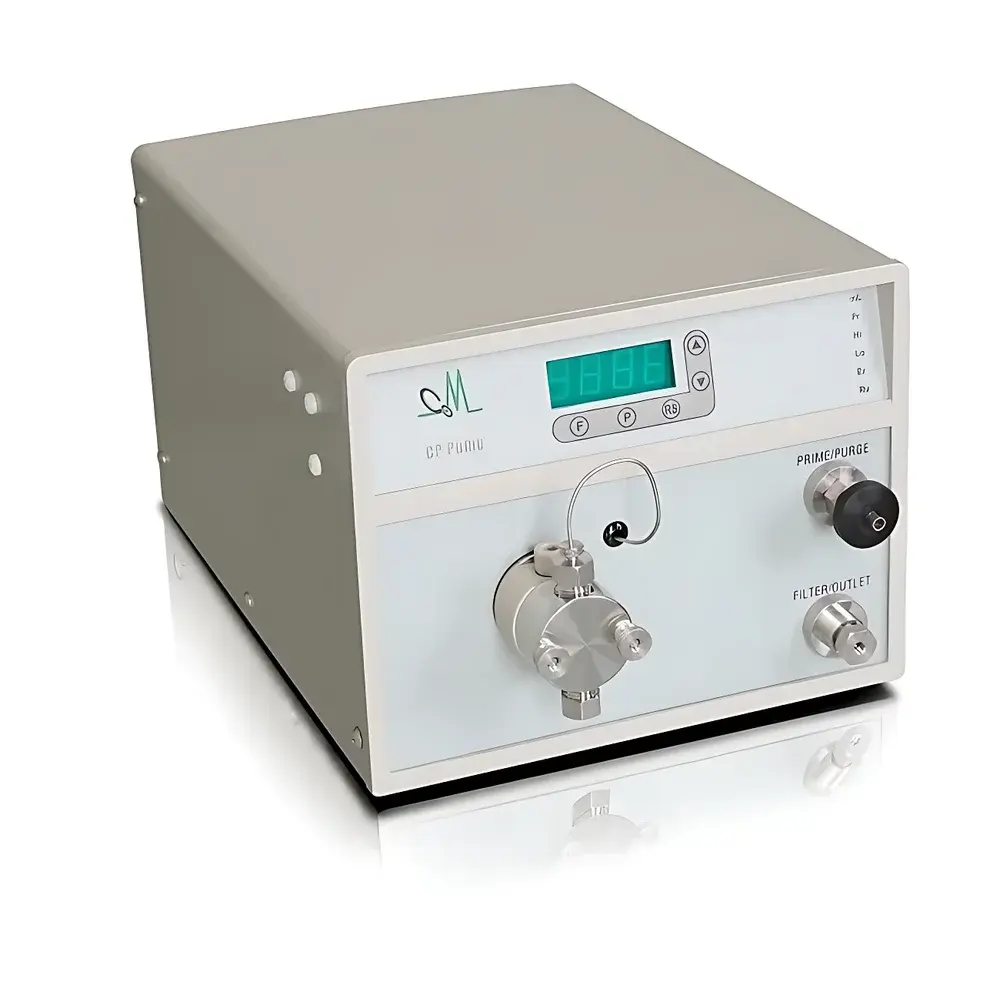
CoMetro CP-M350 High-Pressure Constant Flow Pump for Chemical Process Systems
| Brand | CoMetro |
|---|---|
| Model | CP-M350 |
| Flow Rate | 0.1–50 mL/min |
| Maximum Pressure | 1500 psi |
| Accuracy | ±2% |
| Precision (RSD) | ≤0.2% |
| Dimensions | 175(H) × 225(W) × 305(D) mm |
| Weight | 11 kg |
| Power Supply | 115/230 V, 50/60 Hz |
| Fluid Path Materials | 316 Stainless Steel (standard) or PEEK (optional) |
| Control Interface | Keypad + RS232 digital communication |
| Pressure Monitoring | Real-time display with high/low limit setting and alarm |
| Compliance | Designed for GLP/GMP-aligned lab environments |
Overview
The CoMetro CP-M350 High-Pressure Constant Flow Pump is an engineered solution for precise, pulse-free liquid delivery in chemical process development, continuous flow synthesis, and analytical sample introduction systems. Based on a dual-stage electronic compensation architecture—comprising a brushless DC motor, non-contact pressure transduction, and a low-volume inertial accumulator—the CP-M350 eliminates flow pulsation inherent in conventional reciprocating piston designs. Its operation follows positive displacement principles with real-time closed-loop feedback: the motor dynamically adjusts torque and stroke timing in response to upstream pressure fluctuations and viscosity-induced load changes, ensuring stable volumetric output across variable backpressures up to 1500 psi (103 bar). This makes it particularly suitable for applications demanding reproducible reagent dosing in catalytic reactions, solvent delivery in high-pressure HPLC-like manifolds, and controlled feed in microreactor platforms.
Key Features
- Zero-pulse flow delivery enabled by low-inner-volume accumulator and fast-response electronic compensation control
- Integrated non-contact pressure sensing system with real-time digital readout and programmable high/low pressure limits
- Dual-mode operation: local keypad control and remote RS232 interface for integration into automated lab workflows
- Modular fluid path options—standard 316 stainless steel or biocompatible PEEK—for compatibility with aggressive solvents, acids, bases, and halogenated media
- Built-in bypass valve and self-cleaning cycle to minimize carryover and extend service intervals between maintenance
- Robust mechanical architecture with suspended pump head design reducing vibration transmission and improving long-term seal integrity
- Compliance-ready firmware architecture supporting time-stamped event logging and user-access-level controls aligned with 21 CFR Part 11 data integrity expectations
Sample Compatibility & Compliance
The CP-M350 accommodates a broad range of process-relevant fluids—including organic solvents (e.g., THF, DMF, acetonitrile), aqueous electrolytes, corrosive reagents (e.g., HCl, HNO₃ up to 30%), and suspensions containing particles <5 µm—when configured with appropriate wetted materials. All standard configurations meet CE marking requirements for electromagnetic compatibility (EMC Directive 2014/30/EU) and low-voltage safety (LVD Directive 2014/35/EU). When deployed in regulated environments (e.g., pharmaceutical process R&D or contract manufacturing), the pump’s digital interface supports traceable parameter logging and user authentication protocols compatible with laboratory information management systems (LIMS) and electronic lab notebooks (ELN). It is routinely validated per ASTM E2500 and ISO/IEC 17025 guidelines for equipment qualification in method development laboratories.
Software & Data Management
The CP-M350 operates natively via its embedded microcontroller with intuitive menu navigation and real-time status indicators (flow rate, pressure, alarm state, motor load). For system-level integration, the RS232 port enables bidirectional communication using ASCII-based command protocol—supporting remote start/stop, flow setpoint adjustment, pressure threshold configuration, and query of operational diagnostics. Third-party software packages—including LabVIEW drivers, Python PySerial libraries, and MATLAB Instrument Control Toolbox—can be deployed for custom automation sequences. Audit trail functionality records all parameter changes with timestamp, operator ID, and reason-for-change metadata when connected to compliant host software, fulfilling ALCOA+ (Attributable, Legible, Contemporaneous, Original, Accurate, Complete, Consistent, Enduring, Available) data governance criteria.
Applications
- Continuous-flow chemical synthesis requiring stoichiometric accuracy under elevated backpressure
- Feed control in packed-bed and trickle-bed reactors for kinetic studies and catalyst evaluation
- Calibration fluid delivery in online process analyzers (e.g., NIR, UV-Vis flow cells)
- High-pressure liquid chromatography (HPLC) method scouting and preparative-scale fraction collection support
- Teaching laboratories demonstrating mass transport phenomena, residence time distribution, and pump hydraulics
- QC/QA testing of fluid-handling components where reproducibility and pressure stability are critical acceptance criteria
FAQ
Does the CP-M350 support pressure-controlled flow regulation?
No—it operates as a constant-flow device with pressure monitoring capability. Flow rate is the primary controlled variable; pressure is measured and reported but not used as a feedback signal to modulate flow.
Can the pump handle abrasive slurries or particulates?
It is rated for liquids with suspended solids <5 µm in diameter. For higher particulate loads, optional sapphire-tipped check valves and hardened stainless-steel pump heads are available upon request.
Is validation documentation provided with the instrument?
Yes—a Factory Acceptance Test (FAT) report including flow accuracy verification at three points (0.1, 5, and 50 mL/min) against NIST-traceable gravimetric standards is supplied. IQ/OQ templates compliant with GAMP5 are available separately.
What is the recommended maintenance interval?
Under typical laboratory use (8 h/day, moderate solvent exposure), preventive maintenance—including seal inspection, accumulator calibration, and motor brush assessment—is advised every 6 months or after 2000 operating hours.
How does the self-cleaning function operate?
Upon activation, the pump reverses flow direction while opening the internal bypass valve, flushing residual fluid from the check valves and accumulator chamber using a pre-set volume of clean solvent—minimizing cross-contamination between sequential runs.



