
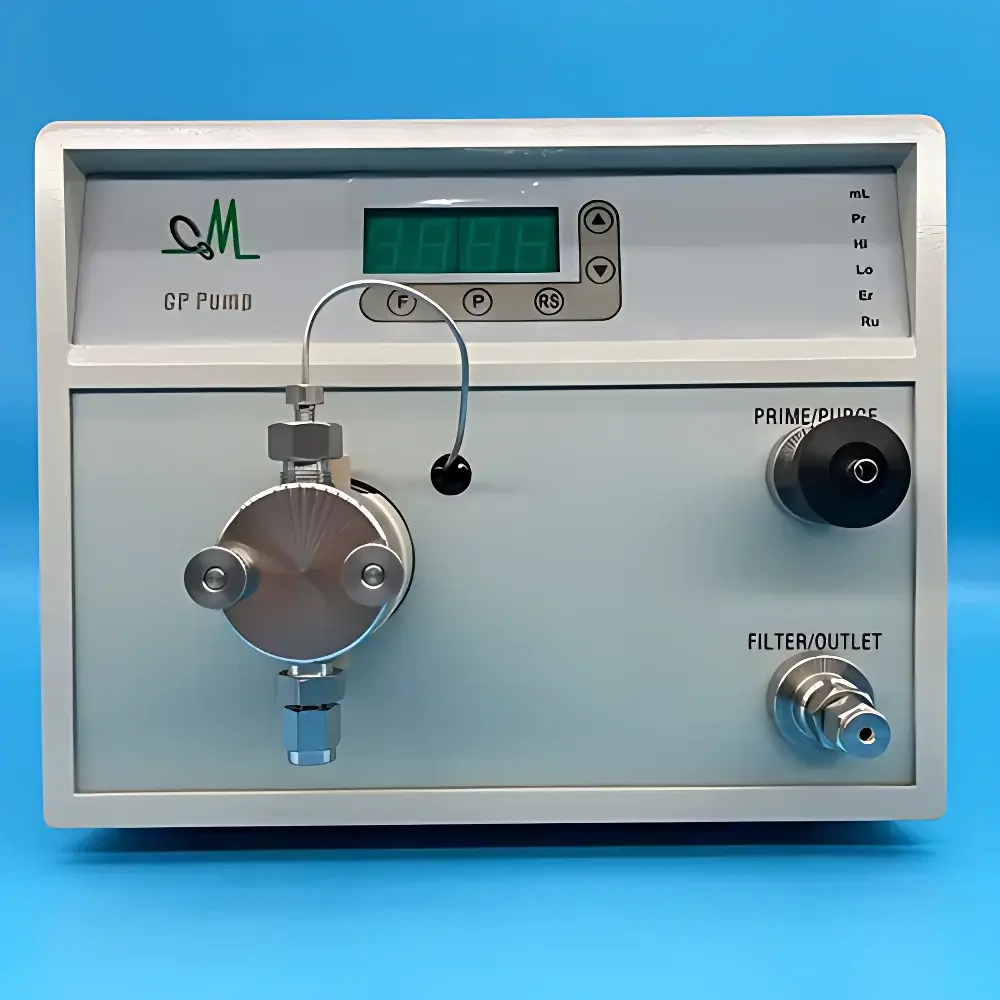
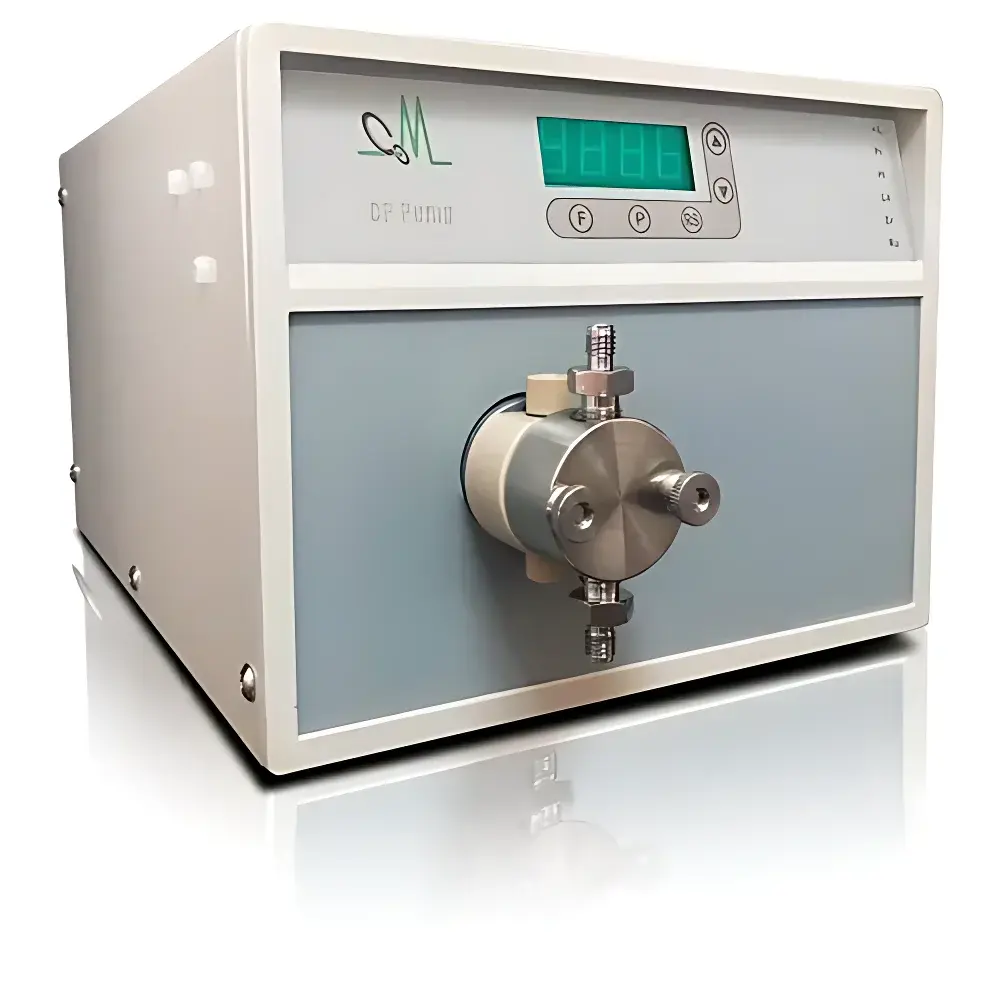
Cometro CP-M SL Series Microchannel Continuous-Flow Reactor Precision Metering Pump
| Brand | Cometro |
|---|---|
| Origin | Imported |
| Manufacturer Type | Authorized Distributor |
| Model | CP-M SL |
| Drive Type | Electric Motor |
| Max Speed | 500 rpm |
| Flow Range | 0.01–10 mL/min |
| Max Pressure | 6000 psi |
| Accuracy | ±2% |
| Precision (RSD) | ≤0.2% |
| Dimensions (H×W×D) | 175 × 225 × 305 mm |
| Weight | 11 kg |
| Power Supply | 115/230 V, 50/60 Hz |
| Fluid Path Materials | PEEK or 316 Stainless Steel |
| Control Interface | Keypad + RS232 Digital Communication |
| Built-in Features | Bypass Valve, Auto-Cleaning Module, Non-Contact Pressure Sensing, Electronic Flow Compensation |
Overview
The Cometro CP-M SL Series is a high-precision, low-pulsation metering pump engineered specifically for integration into microchannel continuous-flow reactor systems. It operates on a positive displacement principle using an electronically compensated fill-and-displace mechanism, coupled with a low internal-volume pulsation dampener (energy storage equalizer) and precision-machined check valves. This architecture eliminates flow pulsation across the full operational range—critical for maintaining laminar flow profiles, precise residence time control, and reproducible reaction kinetics in microfluidic synthesis, catalytic screening, and photochemical transformations. With a maximum pressure rating of 6000 psi (414 bar), the CP-M SL supports demanding applications including supercritical fluid processing, high-pressure hydrogenation, and dense-phase polymerization—where both pressure integrity and volumetric accuracy are non-negotiable. Its compact footprint (175 × 225 × 305 mm) and modular mounting design facilitate seamless integration into automated lab-scale flow chemistry platforms.
Key Features
- Ultra-stable flow delivery: <0.2% RSD across 0.01–10 mL/min range, enabled by real-time electronic compensation and non-contact pressure feedback
- High-pressure capability: Dual-rated configurations up to 6000 psi (414 bar) with chemically resistant fluid paths in PEEK or electropolished 316 stainless steel
- Intelligent drive architecture: Brushless DC motor with closed-loop speed control, integrated bypass valve, and auto-cleaning cycle to prevent crystallization or particulate clogging
- Multi-mode operation: Local keypad control with intuitive menu navigation; remote operation via RS232 serial interface supporting TTL-level frequency/voltage analog inputs
- Comprehensive safety monitoring: Real-time display of flow rate, system pressure, upper/lower pressure limits, operational status, and fault alerts (e.g., occlusion, dry-run, overpressure)
- GLP-ready firmware: Audit-trail capable logging (via external host), configurable alarm thresholds, and user-access level management for regulated environments
Sample Compatibility & Compliance
The CP-M SL accommodates a broad spectrum of process fluids—including corrosive organometallics, viscous polymer precursors, aqueous biological buffers, and supercritical CO₂—with material compatibility validated per ASTM F2080 (PEEK) and ASTM A276 (316 SS). Its design conforms to ISO 8536-4 for infusion pump performance standards and meets mechanical safety requirements under IEC 61010-1 for laboratory equipment. When deployed in pharmaceutical development workflows, the pump supports 21 CFR Part 11 compliance through traceable parameter logging, electronic signatures (when paired with validated host software), and immutable event records—making it suitable for GMP-aligned process validation studies and DOE-driven reaction optimization.
Software & Data Management
While the CP-M SL operates autonomously via front-panel controls, its RS232 interface enables bidirectional communication with third-party SCADA systems, LabVIEW-based automation suites, or custom Python-controlled flow platforms. Host software can configure setpoints, initiate calibration routines, retrieve real-time telemetry (flow, pressure, temperature if externally sensed), and export timestamped CSV logs for statistical process control (SPC) analysis. Firmware supports programmable ramp profiles, multi-step sequencing, and conditional triggers (e.g., pause on pressure deviation >5%), facilitating unattended overnight experiments. All configuration changes are logged with operator ID, timestamp, and pre-/post-value deltas—ensuring full traceability for internal QA audits or regulatory submissions.
Applications
- Continuous-flow synthesis of APIs and fine chemicals under controlled residence time and thermal gradients
- Catalyst screening in high-throughput microreactor arrays with precise stoichiometric reagent dosing
- Supercritical fluid extraction (SFE) and fractionation requiring stable co-solvent delivery at elevated pressures
- Microfluidic cell culture perfusion systems demanding biocompatible, pulseless nutrient supply
- Hyphenated techniques: Coupling with inline FTIR, UV-Vis, or mass spectrometry for real-time reaction monitoring
- Academic research in green chemistry, electrochemical synthesis, and photoredox catalysis where reproducibility at sub-mL/min scales is essential
FAQ
What is the minimum programmable flow rate and corresponding resolution?
The CP-M SL achieves a minimum flow rate of 0.01 mL/min with 0.001 mL/min resolution when operating in its standard 0.01–10 mL/min configuration (model CP-M310CP). Resolution is maintained across the full range via microstepping motor control and calibrated volumetric displacement per revolution.
Can the pump be used with aggressive solvents such as concentrated HF or molten salts?
No. While PEEK and 316 stainless steel offer broad chemical resistance, neither material is compatible with hydrofluoric acid, hot chlorinated solvents, or molten alkali metals. Compatibility must be verified against the manufacturer’s chemical resistance chart prior to deployment.
Is pressure transducer output available as an analog signal?
Yes—models equipped with pressure sensing (e.g., CP-M3xxCP variants) provide isolated 0–5 V or 4–20 mA analog outputs for integration with PLCs or data acquisition systems.
Does the pump support gradient elution protocols similar to HPLC systems?
It does not natively generate gradients, but multi-pump synchronization via RS232 allows coordinated flow modulation between two or more CP-M SL units to emulate binary or ternary solvent gradients in flow chemistry applications.
What maintenance intervals are recommended for long-term reliability?
Routine inspection of check valves and seals every 500 operating hours is advised; full recalibration and seal replacement are recommended annually or after 2000 hours—whichever occurs first—under typical laboratory usage conditions.
Related Products



