
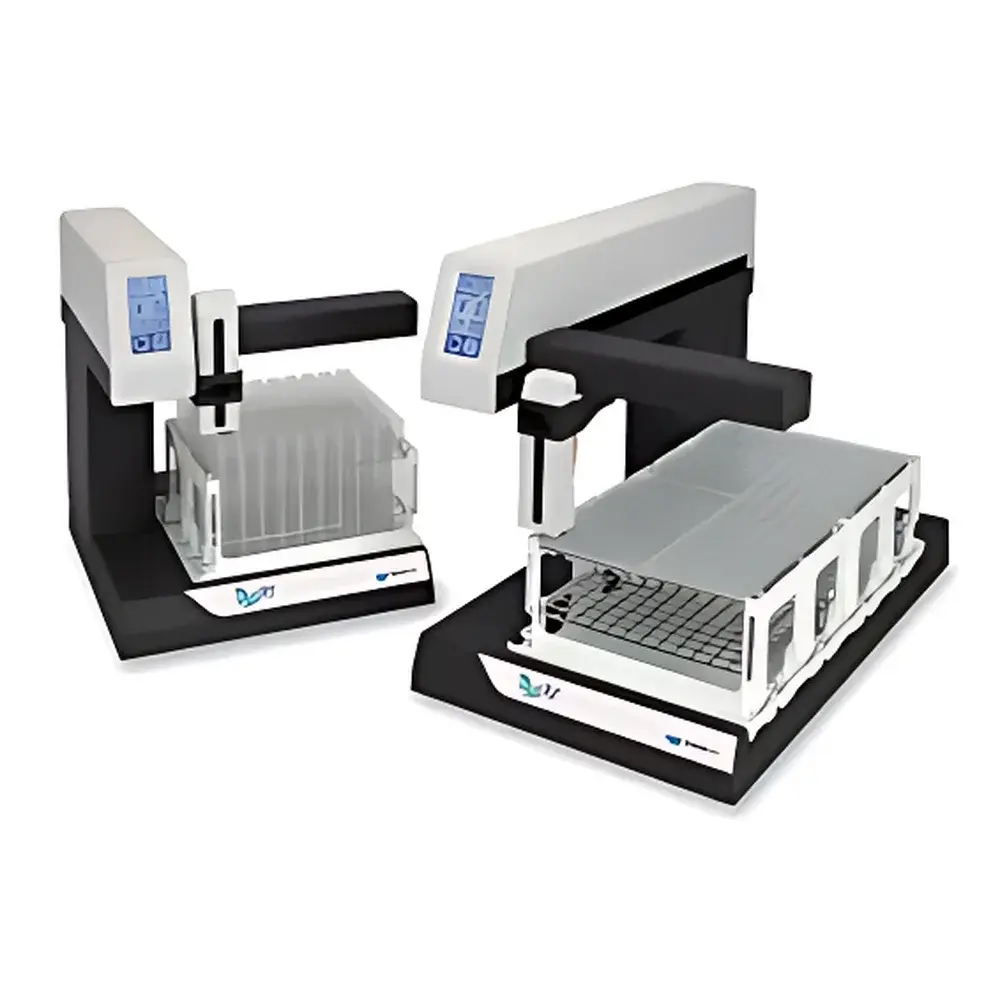
CoMetro R1/R2 Fraction Collector
| Brand | CoMetro |
|---|---|
| Model | R1/R2 Fraction Collector |
| Type | Stepwise (Programmable) Fraction Collector |
| Collection Modes | Time-based, Drop-counting, Volume-based, Peak-triggered |
| Max Flow Rate | 100 mL/min |
| Dimensions (R1) | 31 × 33 × 35.5 cm |
| Dimensions (R2) | 31 × 53 × 38 cm |
| Weight (R1, w/o rack) | 7.7 kg |
| Weight (R2, w/o rack) | 10.6 kg |
| Power Supply | 115 VAC or 230 VAC, 50/60 Hz |
| Tube Rack Options | 144-12, 144-13, 100-16, 72-18, 36-25, 60-1.5, 36-50, 96-well plate compatible |
| Safety Features | Leak-proof design, electrical insulation protection |
| Mounting | Optional instrument stand for space optimization |
| Compliance | Designed for GLP-compliant laboratory environments |
Overview
The CoMetro R1/R2 Fraction Collector is a programmable, stepwise fraction collection system engineered for integration with preparative liquid chromatography (prep-LC), flash chromatography, and gravity-fed or pump-driven column chromatography workflows. It operates on a dual-valve switching architecture that directs eluent flow into discrete receptacles—tubes, vials, or microplates—based on user-defined criteria including elapsed time, cumulative drop count, delivered volume, or real-time signal threshold detection (e.g., UV absorbance peak onset). Unlike continuous or analog-triggered collectors, the R1/R2 implements deterministic, low-latency valve actuation to minimize dead volume carryover and ensure high-fidelity fraction isolation—critical for downstream purification, structural characterization, or biological activity screening. Its modular mechanical design supports both benchtop and stacked configurations, and its firmware architecture accommodates method storage for up to 16 independent collection protocols, enabling rapid reconfiguration between analytical campaigns without manual recalibration.
Key Features
- Three primary collection modes: time-scheduled (programmable interval from 0.1 s to 999 min), drop-counting (adjustable sensitivity per channel), and volumetric (calibrated via pump flow rate input); optional peak-triggered mode interfaces with analog output signals from UV-Vis, conductivity, or refractive index detectors.
- Dual-position switching valve with <100 ms actuation latency and <50 µL internal dead volume ensures minimal sample dispersion and maximizes recovery of narrow peaks in gradient elution.
- Modular tube rack system supports standardized formats: 144 × 12 mm or 13 mm tubes (R1 standard; R2 includes two racks), 100 × 16 mm, 72 × 18 mm, 36 × 25 mm, 60 × 1.5 mL microcentrifuge tubes, 36 × 50 mL conical tubes, and 96-well plates—enabling seamless transition across analytical scale and sample matrix requirements.
- Low-noise DC motor drive (<45 dB(A)) and reinforced polymer housing provide stable operation in shared lab environments; all electrical components meet IEC 61010-1 safety standards for laboratory equipment.
- Integrated leak-detection circuitry monitors fluid path integrity during collection; automatic valve shutoff activates upon pressure anomaly or power interruption to prevent overflow or cross-contamination.
- Front-panel LCD interface with rotary encoder allows intuitive navigation and real-time status monitoring—including remaining fractions, elapsed time, current mode, and active rack position—without requiring external software.
Sample Compatibility & Compliance
The R1/R2 collector accepts aqueous, organic, and mixed-solvent mobile phases commonly used in reversed-phase, normal-phase, ion-exchange, and size-exclusion chromatography. All wetted surfaces are constructed from chemically resistant PTFE, PEEK, and stainless steel (316 SS), ensuring compatibility with 0.1% TFA, 1 M NaOH, acetonitrile, THF, and chloroform-based eluents. The device complies with ISO/IEC 17025 documentation requirements for method validation when paired with traceable flow calibration and time-stamped collection logs. Its analog/digital I/O ports support audit-trail generation under FDA 21 CFR Part 11 when connected to validated chromatography data systems (CDS), fulfilling GLP and GMP documentation mandates for pharmaceutical process development and natural product isolation.
Software & Data Management
While fully functional as a standalone unit, the R1/R2 supports bidirectional communication via RS-232 or opto-isolated digital I/O for synchronization with third-party pumps, detectors, and CDS platforms—including Agilent OpenLab, Waters Empower, and Shimadzu LabSolutions. Method files (.frx) store collection parameters, rack geometry definitions, and trigger thresholds, and can be exported/imported via USB memory stick. All collection events—including start/stop timestamps, valve actuation logs, and error codes—are recorded in non-volatile memory with UTC time stamping, supporting retrospective review during regulatory audits. Firmware updates are delivered via signed binary packages to maintain cryptographic integrity.
Applications
- Preparative HPLC fractionation of synthetic intermediates and chiral compounds where high-purity isolation (>95% ee) demands precise peak slicing.
- Flash chromatography purification of natural product extracts, enabling parallel collection of bioactive subfractions for HTS assays.
- Protein purification workflows using FPLC systems, where pH- or conductivity-triggered collection preserves native conformation.
- Automated solvent exchange protocols in peptide synthesis, integrating with lyophilization-ready vial formats.
- Method development studies requiring comparative fraction analysis across multiple column chemistries or gradient slopes.
FAQ
What is the minimum detectable drop volume for drop-counting mode?
Drop sensitivity is configurable between 1–10 drops per collection event, with optimal resolution achieved at ≥20 µL per drop using standard 13 mm glass tubes.
Can the R1/R2 be used with high-pressure prep-LC systems (>100 bar)?
Yes—the switching valve is rated to 200 bar static pressure; however, dynamic pulsation above 100 bar requires upstream dampening or flow splitting to maintain timing accuracy.
Is remote control possible via Ethernet or Wi-Fi?
No native Ethernet/Wi-Fi module is included; remote operation requires RS-232-to-TCP/IP bridge hardware or integration through host CDS software.
How is calibration performed for volumetric collection?
Volumetric mode relies on externally calibrated pump flow rate input; no onboard flow sensor is present—users must enter verified flow values (e.g., from gravimetric measurement) into the method editor.
Are replacement racks available for non-standard tube geometries?
Yes—custom rack designs (e.g., for 384-well plates or custom vial arrays) are available under CoMetro’s OEM engineering services program with lead time of 6–8 weeks.





