
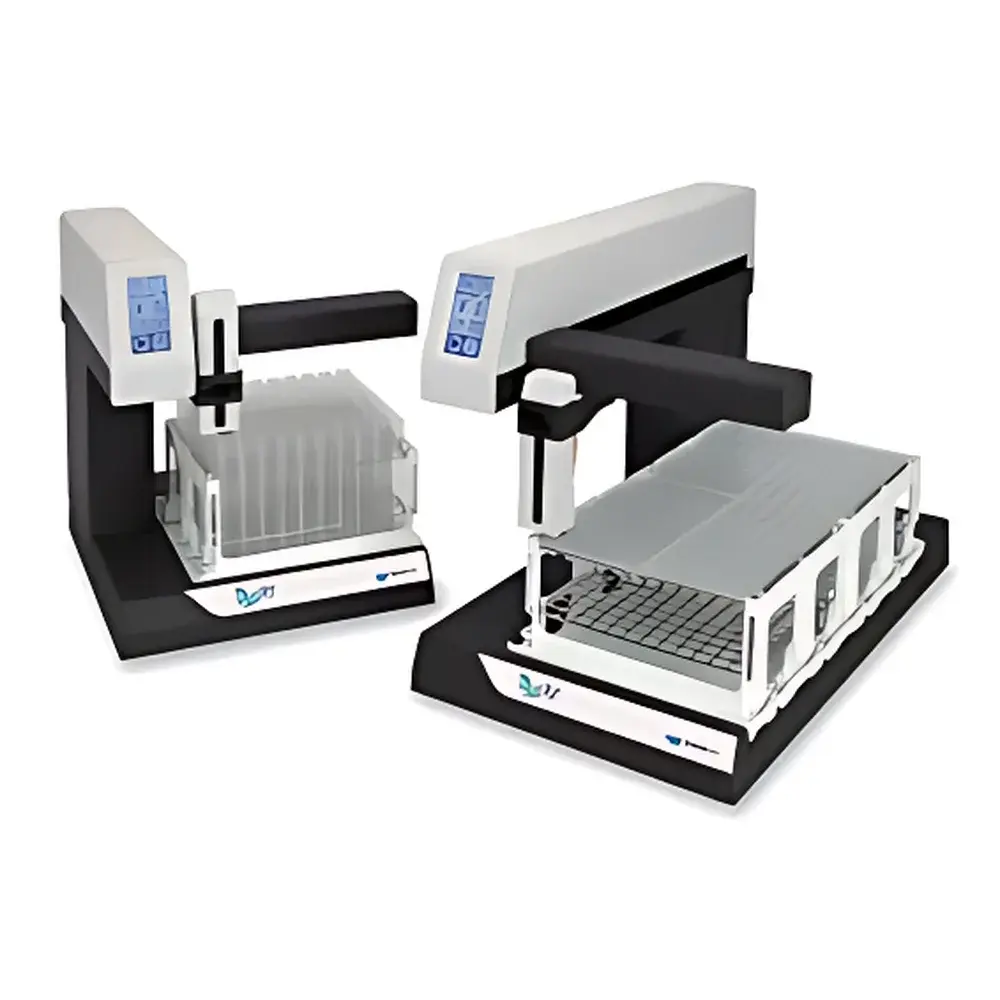
CoMetro R1/R2 Fraction Collector
| Brand | CoMetro |
|---|---|
| Model | R1 / R2 |
| Type | Programmable Volume-Based Fraction Collector |
| Collection Modes | Time-, Drop-, Volume-, and Peak-Triggered |
| Max Flow Rate | 100 mL/min |
| Dimensions (R1) | 31 × 33 × 35.5 cm |
| Dimensions (R2) | 31 × 53 × 38 cm |
| Weight (R1, excl. rack) | 7.7 kg |
| Weight (R2, excl. rack) | 10.6 kg |
| Power Supply | 115 VAC or 230 VAC, 50/60 Hz |
| Tube Capacity Options | 36–144 positions (1.5 mL to 50 mL tubes, vials, or custom vessels) |
| Compliance | CE-marked, designed for GLP-compliant laboratory environments |
Overview
The CoMetro R1/R2 Fraction Collector is a programmable, volume-driven fraction collection system engineered for integration with preparative liquid chromatography (prep-LC), flash chromatography, and gravity-fed column chromatography systems. It operates on precise volumetric displacement sensing combined with real-time flow monitoring, enabling accurate, repeatable fraction isolation based on user-defined thresholds—whether volume, time, drop count, or detector peak signal. Unlike fixed-interval collectors, the R1/R2 employs a high-reproducibility peristaltic or valve-based fluid path switching mechanism, minimizing carryover and ensuring integrity of collected fractions during multi-step purification workflows. Its modular architecture supports both standalone operation and seamless synchronization with third-party UV/Vis, conductivity, or mass spectrometric detectors via TTL or analog output triggers—making it suitable for method development, natural product isolation, peptide purification, and pharmaceutical intermediate recovery.
Key Features
- Multi-mode triggering: Independent selection of volume-based (mL), time-based (s/min), drop-count-based (programmable drop volume calibration), or peak-triggered (TTL/analog input from external detector) collection logic.
- Configurable collection patterns: Left-to-right linear sequencing or serpentine (Z-pattern) tube traversal—both optimized for minimal dead-volume transfer and rapid valve actuation (< 300 ms switch time).
- Modular tube rack compatibility: Supports standardized and custom tube formats—including 1.5 mL microcentrifuge tubes, 13 mm and 16 mm round-bottom test tubes, 18 mm and 25 mm culture tubes, 36 × 50 mL conical tubes, and 96-well microplates—via interchangeable, tool-free rack inserts.
- Low-noise, maintenance-optimized drive system: Brushless DC motor control ensures consistent positioning accuracy (±0.2 mm) and operational longevity (> 50,000 cycle rating) with acoustic emission < 45 dB(A) at 1 m distance.
- Integrated safety architecture: Dual redundant leak detection circuitry (capacitive + optical), isolated power supply with reinforced insulation (IEC 61010-1), and automatic flow-stop upon pressure anomaly or rack misalignment.
- Expandable footprint: R1 model accommodates one rack (up to 144 × 13 mm tubes); R2 adds second rack position plus extended horizontal travel for dual-rack parallel collection or staggered sequential filling.
Sample Compatibility & Compliance
The R1/R2 is compatible with aqueous, organic, and mixed-solvent mobile phases commonly used in reversed-phase, normal-phase, ion-exchange, and size-exclusion chromatography. All wetted components—including tubing, valves, and collection vessel interfaces—are constructed from chemically resistant materials (e.g., PTFE, PEEK, borosilicate glass-compatible seals) rated for continuous exposure to acetonitrile, methanol, THF, chloroform, and dilute acids/bases. The system conforms to IEC 61010-1 for electrical safety and carries CE marking for use within the European Economic Area. While not FDA 21 CFR Part 11–certified out-of-the-box, its firmware supports audit-trail-enabling configurations when deployed with compliant LIMS or CDS platforms—facilitating alignment with GLP and GMP documentation requirements for regulated analytical laboratories.
Software & Data Management
The R1/R2 operates via an embedded 32-bit ARM Cortex-M7 controller with non-volatile memory for storing up to 99 user-defined methods—including gradient-aware volume thresholds, inter-fraction delay times, and conditional logic branching (e.g., “collect only if absorbance > 200 mAU”). Method recall is accessible through a backlit 4.3-inch resistive touchscreen interface with tactile feedback. Optional USB-C host port enables direct export of collection logs (CSV format) containing timestamp, fraction number, cumulative volume, trigger type, and system status flags. No proprietary software installation is required; however, ASCII command protocol (RS-232 or USB virtual COM) allows full remote control and synchronization with third-party chromatography data systems (CDS) such as Chromeleon, Empower, or OpenLab.
Applications
- Preparative HPLC fractionation of synthetic intermediates and chiral compounds
- Flash chromatography purification of natural product extracts (e.g., alkaloids, flavonoids)
- Desalting and buffer exchange of protein samples using size-exclusion columns
- Automated collection of elution peaks in affinity chromatography workflows
- Method scouting for solvent system optimization in orthogonal separation schemes
- High-throughput sample archiving in metabolomics and environmental analysis pipelines
FAQ
What is the minimum programmable volume increment?
The system supports volume-based triggering in 0.01 mL increments, calibrated against gravimetric standards traceable to NIST SRM 2197.
Can the R1/R2 be synchronized with a UV detector that lacks TTL output?
Yes—via optional analog-to-digital converter module (CoMetro AD-1), which converts 0–10 V detector signals into programmable peak thresholds.
Is rack auto-detection supported?
No—rack type must be manually selected prior to method execution to ensure correct X/Y coordinate mapping and valve timing.
Does the system support fractional collection during gradient elution?
Yes—volume thresholds remain valid across changing flow rates; users may also define dynamic volume windows tied to pump stroke count or elapsed time intervals.
What maintenance is required for long-term reliability?
Annual verification of valve seal integrity and flow sensor linearity is recommended; no routine lubrication or consumable replacement is needed under standard operating conditions.
Related Products




