
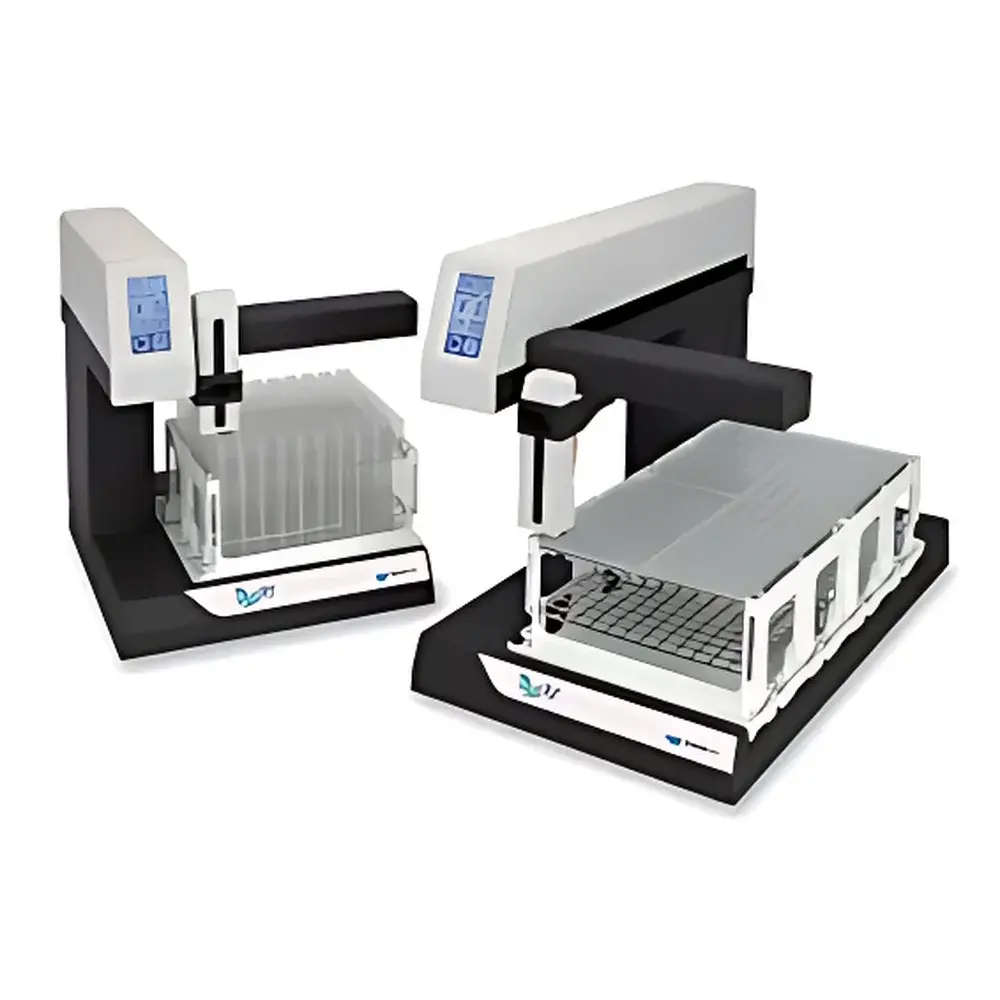
CoMetro R2 Liquid Phase Fraction Collector
| Brand | CoMetro |
|---|---|
| Model | R2 |
| Instrument Type | Liquid Phase Fraction Collector |
| Collection Mode | Volume-Based |
| Max Flow Rate | 100 mL/min |
| Dimensions (W×D×H) | 31 × 53 × 38 cm |
| Weight (excl. racks) | 10.6 kg |
| Power Supply | 115 VAC or 230 VAC, 50/60 Hz |
| Tube Rack Compatibility | Up to 144 × 13 mm tubes (standard), plus optional racks for 12 mm, 16 mm, 18 mm, 25 mm tubes, 1.5 mL & 50 mL centrifuge tubes, and 96-well microplates |
| Safety Features | Leak-proof design, electrical insulation protection |
| Compliance | Designed for GLP/GMP-aligned chromatographic workflows |
Overview
The CoMetro R2 Liquid Phase Fraction Collector is an engineered solution for precise, automated fractionation in preparative liquid chromatography (prep-LC) and open-column chromatography systems. It operates on a volume-triggered collection principle—integrating high-accuracy peristaltic or syringe-pump-compatible flow monitoring with real-time valve actuation—to deliver reproducible, time-stable fraction boundaries under dynamic elution conditions. Unlike fixed-time collectors, the R2 dynamically calculates cumulative volume using calibrated flow rate input and pulse-counting integration, enabling robust performance across variable gradient methods and multi-solvent systems. Its modular architecture supports seamless integration into both standalone purification setups and OEM-configured chromatography platforms—including those equipped with UV-Vis, conductivity, or mass spectrometric detectors—without requiring proprietary communication protocols.
Key Features
- Three programmable collection modes: volume-based (primary), time-based, and drop-counting—each independently configurable with user-defined thresholds and delay offsets.
- Dual rack support (standard configuration) allows simultaneous use of two independently indexed tube arrays—enabling parallel collection strategies or internal method validation without hardware reconfiguration.
- Sub-100 ms valve switching latency ensures minimal band broadening during fraction transitions, preserving chromatographic resolution and maximizing recovery of target analytes.
- Leak-detection circuitry monitors fluid path integrity at the collection interface; integrated ground-fault interruption safeguards against electrical hazards in wet-lab environments.
- Front-panel LCD with tactile keypad enables offline method storage (up to 20 user-defined protocols), including nested parameters such as pre-collection delay, post-switch flush volume, and rack rotation logic.
- Low-noise brushless motor drive system (<42 dB(A)) minimizes acoustic interference in shared analytical laboratories and supports unattended overnight operation.
Sample Compatibility & Compliance
The R2 accommodates a wide range of primary and secondary containment formats—including standard 13 mm round-bottom test tubes (144-position rack), 16 mm and 18 mm culture tubes, 25 mm scintillation vials, 1.5 mL and 50 mL conical centrifuge tubes, and ANSI/SLAS-compliant 96-well microplates. All tube rack interfaces are mechanically registered and auto-detected via optical encoding to prevent misalignment-induced overflow. The system complies with IEC 61010-1:2010 for laboratory electrical equipment safety and meets electromagnetic compatibility requirements per EN 61326-1:2013. When deployed in regulated environments, its deterministic collection logic and non-volatile method storage support audit-ready documentation per FDA 21 CFR Part 11 when paired with compliant LIMS or CDS software.
Software & Data Management
While the R2 operates autonomously via embedded firmware, it provides RS-232 and USB-B serial interfaces for bidirectional command exchange with external chromatography data systems (CDS) or custom SCADA environments. Supported ASCII command sets enable synchronization with detector peak detection events—allowing “collect-on-peak” logic where fraction initiation is triggered by analog threshold crossing or digital TTL pulses. Method files export in plain-text CSV format for version control and electronic lab notebook (ELN) ingestion. No proprietary drivers or cloud dependencies are required; all configuration and diagnostics are accessible through local terminal emulation or vendor-neutral terminal software.
Applications
- Preparative purification of natural products, synthetic intermediates, and oligonucleotides using medium-pressure liquid chromatography (MPLC) and flash systems.
- Desalting and buffer exchange in protein purification workflows employing size-exclusion or ion-exchange chromatography.
- Fraction-guided bioassay fractionation—where collected eluates undergo immediate downstream screening without intermediate lyophilization.
- Method development support for analytical-to-preparative scale-up, leveraging consistent retention-time-to-volume mapping across instruments.
- Automated solvent recycling loops in green chemistry applications, where discrete fractions are diverted based on UV cutoff thresholds.
FAQ
What is the minimum programmable collection volume increment?
The R2 accepts volume setpoints in 0.01 mL increments, with collection accuracy validated to ±1.5% of set volume across the 0.1–100 mL/min flow range.
Can the R2 be synchronized with third-party detectors that lack digital output?
Yes—using analog voltage threshold triggering (0–10 V input range) or external TTL pulse input, the R2 can initiate collection without native detector protocol support.
Is firmware upgradable in the field?
Yes—firmware updates are delivered as signed binary files via USB stick and installed through the front-panel menu without service intervention.
Does the R2 support GLP audit trails?
The device logs all method changes, collection start/stop timestamps, and rack position events to internal memory; exportable logs meet ALCOA+ principles when integrated with compliant CDS platforms.
What maintenance is required for long-term reliability?
No scheduled preventive maintenance is specified; routine cleaning of valve manifolds and tube rack guides every 6 months is recommended to maintain positional repeatability and fluid path hygiene.




