
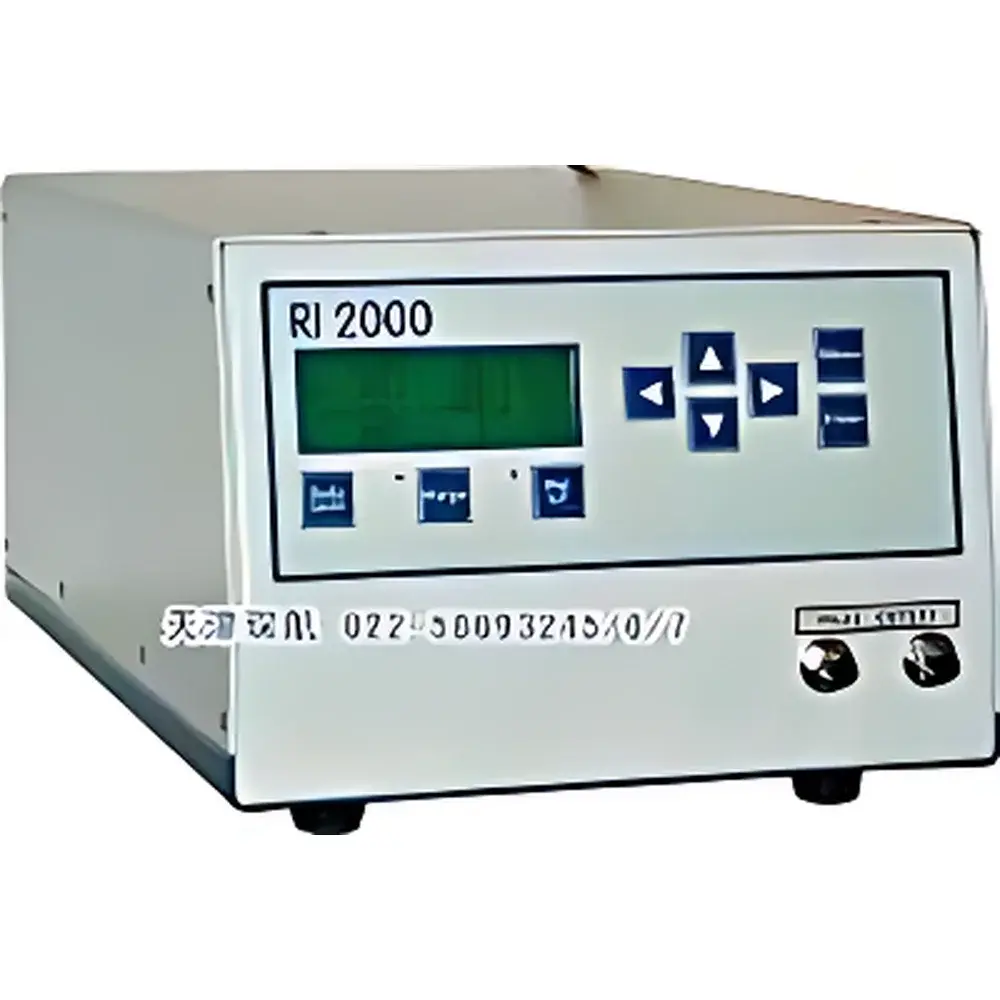
CoMetro RI-2000 Refractive Index Detector
| Brand | CoMetro |
|---|---|
| Model | RI-2000 |
| Detector Type | Refractive Index Detector (RID) |
| Compatible System | Liquid Chromatography (HPLC/UHPLC) |
| Refractive Index Range | 1.00–1.75 |
| Flow Rate Range | 0.2–3.0 mL/min |
| Linear Range | 80 × 10⁻⁵ RIU |
| Noise Level | 5 × 10⁻¹⁰ RIU |
| Auto-Zero Range | 40 × 10⁻⁵ RIU |
| Auto-Zero Resolution | 5 × 10⁻¹⁰ RIU |
| Integrator Output | ±1 V |
| Recorder Output | ±10 V |
| Analog Input/Output | ±5 VDC (TTL/12 VDC compatible) |
| Cell Volume | 9 µL |
| Maximum Cell Pressure | 6 kg/cm² (≈0.6 MPa) |
| Temperature Control Options | Ambient, 35°C, or 55°C (microprocessor-controlled) |
| Dimensions | 58.4 × 45.7 × 21.3 cm (W × D × H) |
| Weight | 16 kg |
| Power Supply | 220 V, 50/60 Hz, 80 VA |
Overview
The CoMetro RI-2000 Refractive Index Detector is a high-stability, low-noise universal detector engineered for integration into liquid chromatography (LC) systems—particularly where analytes lack chromophores, UV absorbance, or electrochemical activity. Operating on the principle of differential refractometry, the RI-2000 measures minute changes in the refractive index of the mobile phase as solutes elute from the column. This optical detection method relies on precise measurement of light deflection through a dual-beam flow cell configuration: one channel carries the analyte-laden eluent; the other serves as a reference stream. The resulting phase shift is converted into an analog voltage proportional to the concentration gradient, enabling quantitative analysis of carbohydrates, polymers, lipids, surfactants, and other non-UV-active compounds.
Key Features
- Optimized optical-mechanical architecture with thermally stabilized flow cell and precision-machined prism assembly ensures exceptional baseline stability (<5 × 10⁻¹⁰ RIU noise) over extended run times—critical for gradient-elution LC and preparative-scale separations.
- Full digital circuitry enables dual functionality: operation as a standalone refractive index detector and as an analog-to-digital interface module for legacy detectors (e.g., UV-Vis, fluorescence), supporting system-wide signal synchronization and centralized data acquisition.
- Integrated monochrome graphical LCD display provides real-time visualization of detector status—including temperature setpoint, auto-zero progress, signal output level, and error codes—without requiring external software or host PC connection.
- Built-in data buffer (non-volatile memory) retains up to 16 KB of chromatographic trace history, allowing local review, manual peak annotation, and recovery of transient signals during communication interruptions.
- Flexible thermal management: user-selectable fixed-point temperature control at ambient, 35°C, or 55°C via microprocessor-based PID regulation—minimizing thermal drift and enhancing reproducibility across varying laboratory environments.
Sample Compatibility & Compliance
The RI-2000 is compatible with standard HPLC-compatible solvents (e.g., water, acetonitrile, THF, chloroform, ethyl acetate) and supports flow rates from 0.2 to 3.0 mL/min—making it suitable for analytical, semi-preparative, and GPC/SEC applications. Its 9 µL fused-silica flow cell accommodates narrow-bore and standard 4.6 mm ID columns while maintaining pressure tolerance up to 0.6 MPa (6 kg/cm²). While refractive index detection is inherently non-destructive and universal, users must ensure mobile phase compatibility with the detector’s wetted materials (stainless steel, sapphire windows, PTFE seals). The instrument complies with IEC 61010-1 safety standards for laboratory electrical equipment and meets electromagnetic compatibility (EMC) requirements per EN 61326-1. For regulated environments, its analog/digital outputs support integration into 21 CFR Part 11-compliant data systems when paired with validated acquisition software and audit-trail-enabled controllers.
Software & Data Management
The RI-2000 features native analog output interfaces (±1 V integrator, ±10 V recorder, ±5 V TTL/12 V DC logic signals) for seamless integration with third-party chromatography data systems (CDS), including Waters Empower, Agilent OpenLab, and Shimadzu LabSolutions. Optional Windows-compatible data acquisition software (supporting Windows 3.x through Windows NT) provides real-time plotting, peak integration, calibration curve generation, and export to CSV or ASCII formats. All digital I/O lines—including marker pulses, solvent recirculation triggers, polarity inversion, and temperature feedback—are programmable via front-panel menu or remote command set, enabling synchronized operation in multi-detector LC configurations. Internal buffering allows offline trace recall and manual zero-correction without interrupting ongoing runs.
Applications
- Carbohydrate analysis in food, beverage, and pharmaceutical QC (e.g., glucose, fructose, sucrose, maltodextrins)
- Gel permeation chromatography (GPC) and size-exclusion chromatography (SEC) for polymer molecular weight distribution (MWD) determination
- Surfactant quantification in detergents and personal care formulations
- Lipid profiling in bio-oils and biodiesel feedstocks
- Quality control of excipients (e.g., PEGs, polysorbates) in parenteral drug products
- Method development for non-UV-absorbing impurities in synthetic intermediates
FAQ
Is the RI-2000 compatible with UHPLC systems?
Yes—the detector supports flow rates down to 0.2 mL/min and features low-volume (9 µL) flow cell geometry suitable for UHPLC, though dwell volume considerations require careful system band-broadening assessment.
Can the RI-2000 perform automatic solvent compensation?
No—it does not feature dynamic solvent compensation algorithms; users must rely on stable mobile phase composition and temperature control to minimize baseline drift during gradient elution.
What maintenance is required for long-term baseline stability?
Annual verification of optical alignment and prism cleanliness is recommended; routine flushing with compatible solvents after each use prevents residue buildup. No lamp replacement or fluid refills are required—unlike UV detectors.
Does the RI-2000 support GLP/GMP-compliant data handling?
When integrated with validated CDS platforms that enforce electronic signatures, audit trails, and secure data storage, the RI-2000’s analog and digital outputs meet foundational requirements for GLP and GMP documentation integrity.
Is a solvent recirculation unit included by default?
No—the solvent recirculation module is an optional upgrade kit, designed to reduce solvent consumption and waste generation during prolonged isocratic runs, particularly in carbohydrate or polymer analysis workflows.





