
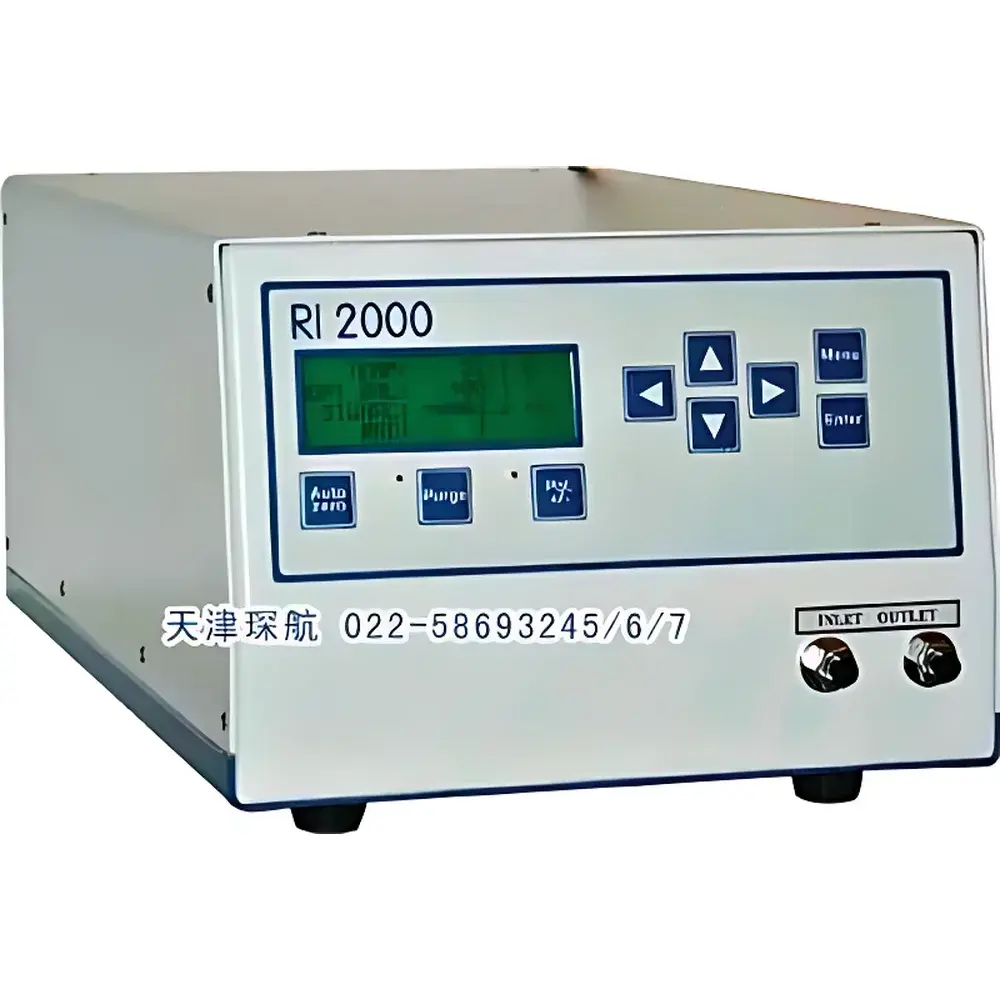
CoMetro RI2000 Differential Refractometer Detector
| Brand | CoMetro |
|---|---|
| Model | RI2000 |
| Detection Principle | Differential Refractometry |
| Refractive Index Range | 1.00–1.75 |
| Flow Rate Range | 0.2–3.0 mL/min |
| Linear Range | 0–1000 µRIU (80 × 10⁻⁵ RIU) |
| Noise Level | 5 × 10⁻¹⁰ RIU (typical) |
| Auto-Zero Range | ±40 × 10⁻⁵ RIU |
| Auto-Zero Resolution | 5 × 10⁻¹⁰ RIU |
| Cell Volume | 9 µL |
| Maximum Cell Pressure | 6 kg/cm² (≈0.6 MPa) |
| Temperature Control | Ambient, 35 °C or 55 °C (microprocessor-regulated) |
| Analog Outputs | ±1 V (integrator), ±10 V (recorder) |
| selectable gains | 10 mV, 100 mV, 1 V |
| Digital I/O | TTL-compatible inputs/outputs (5 Vdc or 12 Vdc) for marker, polarity, wash, auto-zero, temperature, solvent recirculator |
| Power Supply | 220 V AC, 50/60 Hz, 80 VA |
| Dimensions | 58.4 cm (W) × ? cm (D) × ? cm (H) |
| Weight | 16 kg (35 lbs) |
Overview
The CoMetro RI2000 Differential Refractometer Detector is a precision optical detector engineered for universal detection in high-performance liquid chromatography (HPLC) and preparative LC systems. It operates on the principle of differential refractometry—measuring minute changes in the refractive index (RI) of the eluent stream relative to a reference solvent flow. Unlike UV-Vis or fluorescence detectors, the RI2000 responds to virtually all solutes lacking chromophores or native fluorescence, including carbohydrates, polymers, lipids, organic acids, alcohols, and inorganic salts—making it indispensable for non-destructive, label-free quantification where compound-specific standards are unavailable or unstable.
Its optical design employs a dual-beam configuration with matched flow cells and thermally stabilized optics to minimize thermal drift and enhance baseline stability. The detector integrates microprocessor-based temperature control (with selectable setpoints at ambient, 35 °C, or 55 °C), ensuring consistent refractive index calibration across varying mobile phase compositions and ambient conditions. With a cell volume of only 9 µL and maximum pressure tolerance up to 0.6 MPa, the RI2000 maintains compatibility with standard HPLC systems while preserving column efficiency and resolution.
Key Features
- High-sensitivity optical path with noise performance of ≤5 × 10⁻¹⁰ RIU (RMS), enabling detection of low-concentration analytes in gradient and isocratic separations.
- Fully digital signal processing architecture—supports analog-to-digital conversion for external detectors, allowing integration into legacy or hybrid LC data acquisition environments.
- Integrated graphical LCD display providing real-time monitoring of RI signal, temperature status, auto-zero progress, flow integrity, and system diagnostics.
- Built-in memory buffer for transient chromatographic data storage—facilitates synchronization with external integrators or data systems during communication latency or transfer interruptions.
- Flexible analog output configuration: ±1 V (for integrators), ±10 V (for chart recorders), with selectable scaling (10 mV, 100 mV, 1 V per 1000 µRIU) to match signal conditioning requirements of diverse acquisition hardware.
- TTL-compatible digital I/O ports support automated system control—including marker pulse generation, polarity switching, solvent recirculator activation, wash cycle triggering, and temperature interlock feedback.
Sample Compatibility & Compliance
The RI2000 is compatible with a broad spectrum of HPLC mobile phases—including aqueous buffers, alcohols, acetonitrile, THF, chloroform, and ethyl acetate—provided refractive index differentials between sample and solvent are sufficient for detection. Its universal response eliminates the need for chromophore derivatization or post-column reaction, supporting direct analysis of native biomolecules and synthetic polymers per ASTM D5296 (molecular weight distribution of polymers), USP (chromatography), and ISO 13877 (liquid chromatography of carbohydrates). While the detector itself does not embed FDA 21 CFR Part 11-compliant audit trails, its analog/digital interface enables integration into validated GxP-compliant LC platforms when paired with compliant data systems and procedural controls aligned with GLP/GMP documentation practices.
Software & Data Management
The RI2000 supports optional Windows-compatible data acquisition software for operation under Windows 3.x, Windows 95, and Windows NT environments. This software provides real-time signal visualization, peak integration, calibration curve generation (using multi-point RI standard solutions), and export of ASCII-formatted chromatograms for downstream statistical analysis or LIMS ingestion. All analog outputs comply with IEEE 488.2 and NIST-traceable voltage standards; digital I/O signals adhere to TTL logic thresholds (0–0.8 V low, 2.0–5.0 V high), ensuring interoperability with industrial PLCs and laboratory automation controllers. Firmware updates are delivered via RS-232 serial interface using vendor-supplied utilities, with version logging stored in non-volatile memory.
Applications
- Quantitative analysis of sucrose, glucose, fructose, and other reducing/non-reducing sugars in food, beverage, and fermentation broths.
- Molecular weight distribution profiling of polyethylene glycol (PEG), polystyrene, and polyacrylamide standards in SEC/GPC.
- Stability-indicating assays for excipients and APIs in pharmaceutical formulations where UV absorbance is weak or overlapping.
- Process monitoring of solvent recovery streams and polymerization reaction mixtures in chemical manufacturing.
- Method development support for gradient-elution HPLC where UV-transparent modifiers (e.g., triethylamine, ammonium acetate) require universal detection.
FAQ
Is the RI2000 compatible with UHPLC systems?
The RI2000 is designed for conventional HPLC flow rates (0.2–3.0 mL/min) and maximum backpressure of 0.6 MPa. It is not rated for UHPLC pressures (>600 bar) or sub-2 µL cell volumes; use requires flow splitting or low-pressure post-column mixing configurations.
Can the RI2000 perform temperature gradient compensation?
No—it offers discrete, user-selectable temperature setpoints (ambient, 35 °C, 55 °C) but lacks dynamic temperature ramping capability. Baseline drift during ambient fluctuations is mitigated by dual-beam optics and active thermal stabilization of the optical block.
Does the detector support automatic solvent compensation for changing mobile phase composition?
It does not feature real-time solvent compensation algorithms. Users must establish baseline stability via equilibration and may employ reference channel optimization or post-run baseline correction in data processing software.
What maintenance is required for long-term baseline stability?
Routine maintenance includes periodic cleaning of the flow cell with appropriate solvents (e.g., methanol/water for aqueous phases; THF for polymer applications), verification of lamp intensity and alignment every 6–12 months, and recalibration using certified RI standards (e.g., sucrose solutions traceable to NIST SRM 84d).






