
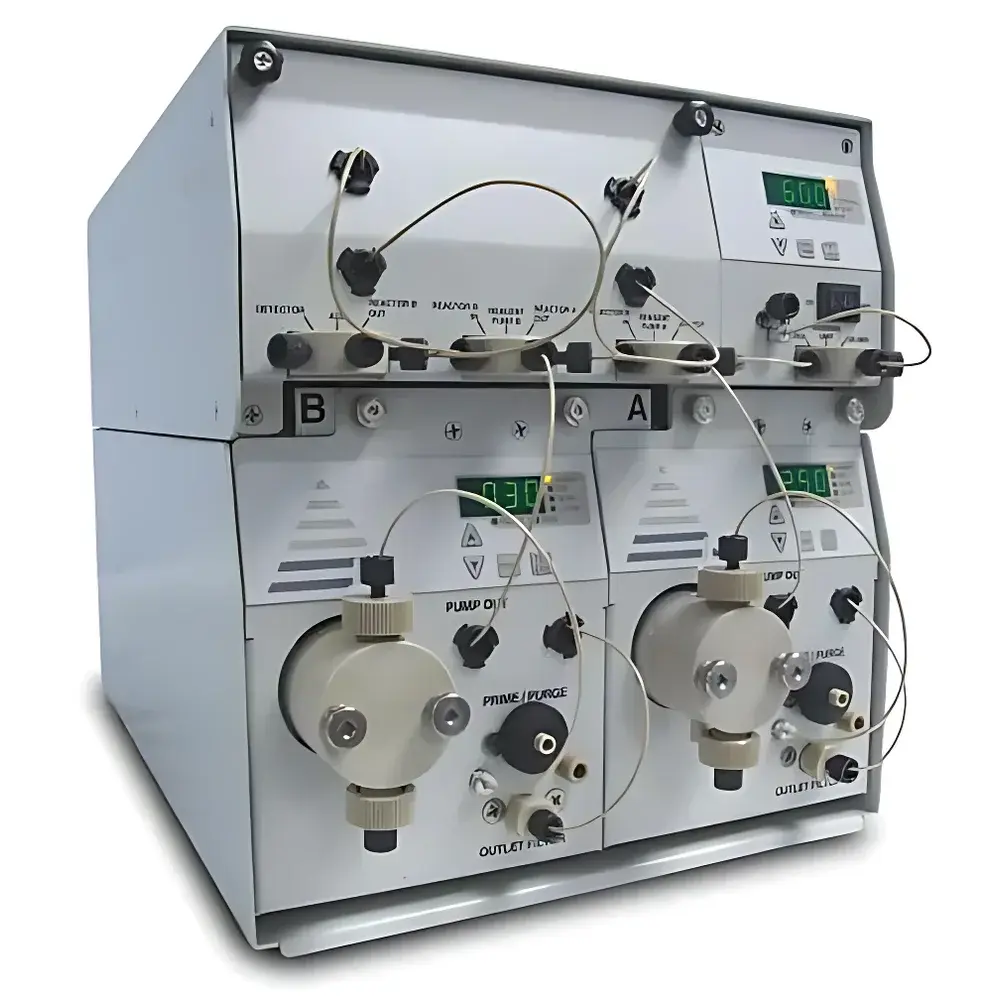
CoMetro SENSIVATE Post-Column Derivatization System
| Brand | CoMetro |
|---|---|
| Origin | Imported |
| Model | SENSIVATE |
| Temperature Range | 10–150 °C (heating), 0–80 °C (cooling) |
| Derivatization Reagent Flow Rate | 0.001–10 mL/min |
| Reaction Coil Material | PEEK |
| Reaction Volume Accuracy | ±5% |
| Temperature Reproducibility | ±0.5 °C |
| Temperature Accuracy | ±1 °C |
| Safety Cut-off Temperature | 160 °C (heating), 90 °C (cooling) |
| Thermal Stabilization Time | ≤30 min (to 150 °C or to 5 °C) |
Overview
The CoMetro SENSIVATE Post-Column Derivatization System is an engineered solution for enhancing detection sensitivity and selectivity in liquid chromatography (LC) and high-performance liquid chromatography (HPLC) workflows. Designed around the principle of on-line, controlled chemical derivatization immediately following column elution, the system enables real-time reaction between analytes and reagents under precisely regulated thermal conditions—either elevated (up to 150 °C) or sub-ambient (down to 0 °C). Unlike passive mixing devices, the SENSIVATE employs a continuous, fully sealed reaction loop with multi-directional flow dynamics to ensure uniform residence time distribution and minimize band broadening. This architecture supports both thermally activated reactions (e.g., o-phthalaldehyde (OPA), iodine-based derivatization) and cold-sensitive protocols (e.g., post-column cooling for labile derivatives), making it suitable for trace-level quantification where native UV/fluorescence response is insufficient.
Key Features
- Modular dual-core configuration: Independent heating and cooling reaction modules can operate simultaneously—enabling two-step derivatization (e.g., initial condensation followed by oxidative stabilization) without manual intervention.
- Front-panel digital interface: Real-time display of setpoint temperature, actual coil temperature, and system readiness status for each module; intuitive parameter entry via membrane keypad.
- PEEK reaction coil: Chemically inert, low-dead-volume tubing with optimized internal diameter and length to balance reaction kinetics and chromatographic integrity (peak dispersion < 5% increase vs. underivatized baseline).
- Integrated thermal management: Separate heating and cooling cores with PID-controlled solid-state elements; safety cut-off at 160 °C (heating) and 90 °C (cooling) prevents thermal degradation of reagents or column effluent.
- Plug-and-play connectivity: Single inlet (from LC column outlet) and single outlet (to detector) configuration; all fluidic connections located on front panel for rapid maintenance and leak mitigation.
- Quick-swap reactor design: Entire reaction core replaced using only two fittings—no tools required—reducing downtime during method development or routine cleaning.
Sample Compatibility & Compliance
The SENSIVATE system is compatible with reversed-phase, HILIC, and ion-exchange LC separations across pharmaceutical, food safety, and environmental testing laboratories. It supports derivatization chemistries including OPA (for primary amines and thiols), ninhydrin (for amino acids), iodine (for aflatoxins), and potassium permanganate (for hydrazides). All wetted parts comply with USP Class VI biocompatibility standards; PEEK coils meet ASTM D5094 for long-term solvent resistance in acetonitrile/water and methanol/water gradients. The system architecture aligns with GLP/GMP documentation requirements: temperature logs are timestamped and exportable, and firmware supports audit trail generation per FDA 21 CFR Part 11 when integrated with validated LIMS or CDS platforms.
Software & Data Management
While the SENSIVATE operates as a standalone hardware module, its thermal parameters are accessible via RS-232 or optional USB-to-serial interface for integration into third-party chromatography data systems (CDS). Temperature profiles—including ramp rates, hold times, and stabilization confirmation—are logged internally with 1-second resolution and stored for ≥30 days. Export formats include CSV and XML, enabling correlation with chromatographic peak data during method validation. Firmware updates are performed via secure signed binaries; configuration backups preserve user-defined profiles for regulatory traceability.
Applications
- Quantification of taurine and amino acids in infant formula and meat products using OPA post-column derivatization coupled with fluorescence detection (AOAC 2005.03, ISO 13903).
- Residue analysis of carbamate pesticides (e.g., carbaryl, methomyl) in fruits and vegetables via alkaline hydrolysis followed by OPA derivatization (EPA Method 531.1).
- Determination of aflatoxin B₁ and G₁ in cereals and nuts using iodine-mediated oxidation and fluorescence enhancement (EU Commission Regulation (EC) No 401/2006 Annex I).
- Stability-indicating assay of voglibose in pharmaceutical formulations, where acid-labile glycosidase inhibitors require low-temperature derivatization to prevent degradation prior to UV detection.
- Simultaneous analysis of glyphosate and AMPA in soil extracts using FMOC-Cl derivatization under controlled heating (ISO 14502-2).
FAQ
Can the SENSIVATE perform both heating and cooling in a single run?
Yes—the dual-core architecture allows independent temperature control of two reaction zones, enabling sequential or parallel heated and cooled derivatization steps within one chromatographic method.
What is the minimum derivatization reagent flow rate supported?
The system maintains stable delivery down to 0.001 mL/min, critical for low-flow UHPLC and capillary LC applications where reagent consumption and dilution must be minimized.
Is PEEK compatible with strong oxidants like iodine or potassium permanganate solutions?
Yes—PEEK exhibits excellent resistance to halogen-based oxidants at concentrations and temperatures used in standard derivatization protocols (e.g., 0.1–1% iodine in chloroform/methanol, up to 80 °C).
How is temperature accuracy verified during IQ/OQ qualification?
Each unit ships with NIST-traceable calibration certificates for both heating and cooling cores; users may validate performance using calibrated PT100 probes inserted into dedicated sensor ports adjacent to the reaction coil.
Does the system support gradient temperature programming during a run?
No—temperature is held constant per module during acquisition; however, discrete step changes between injections are programmable via external CDS triggers or manual front-panel adjustment.
Related Products





