
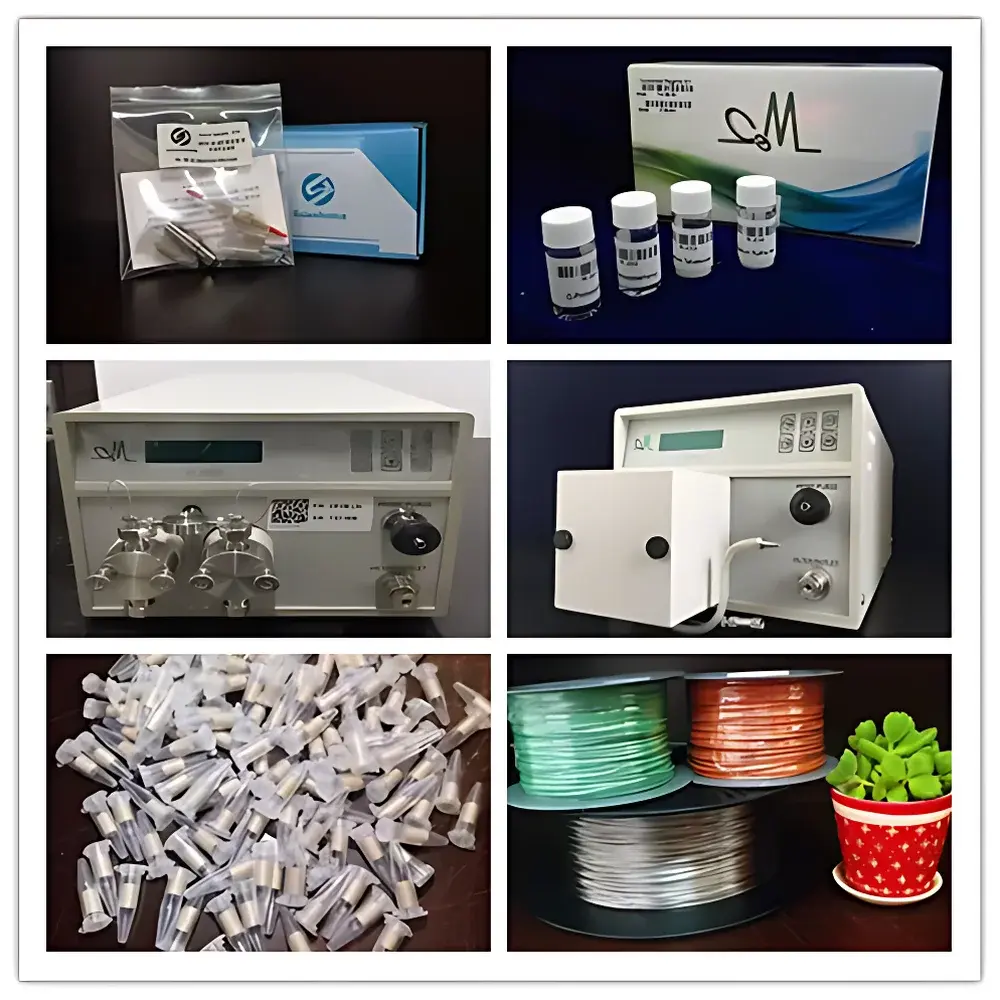
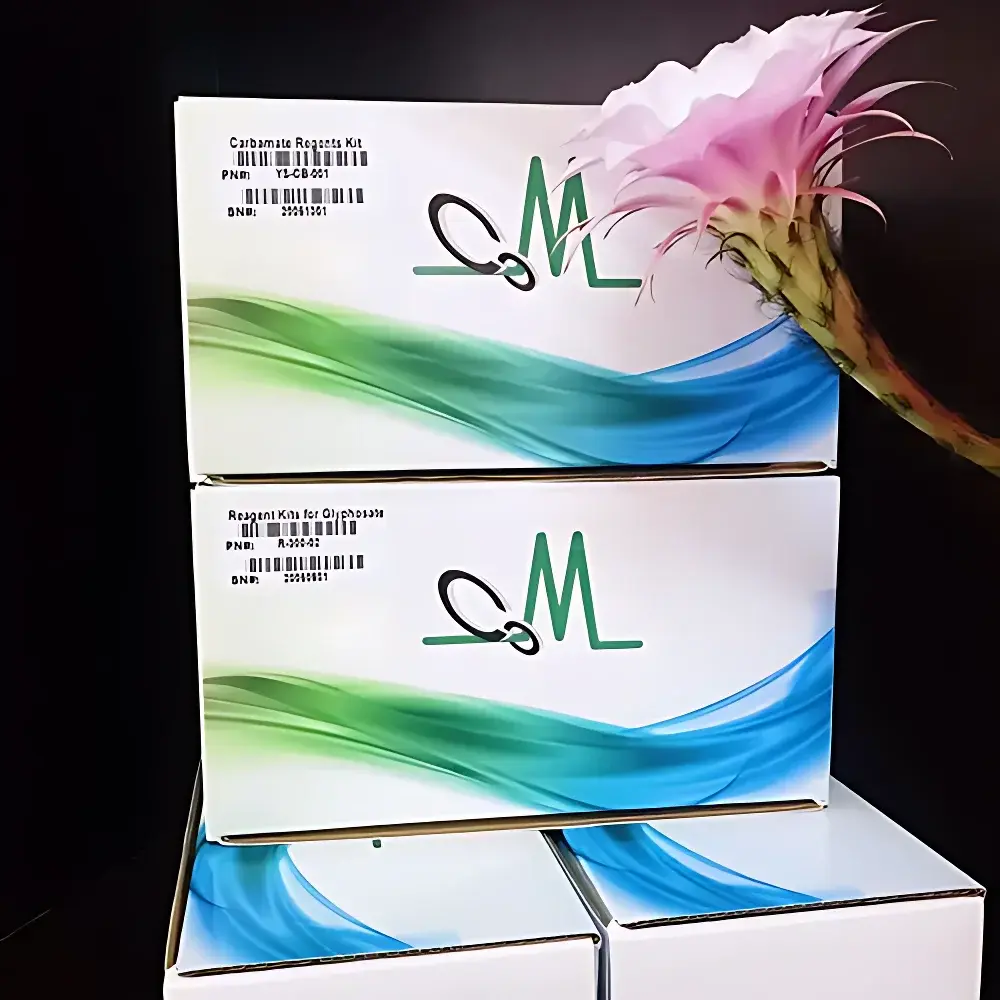
CoMetro YS-CB-001 Post-Column Derivatization Reagent Kit for Carbamate Pesticide Residue Analysis
| Brand | CoMetro |
|---|---|
| Origin | Imported |
| Manufacturer Type | Authorized Distributor |
| Instrument Type | HPLC-Compatible Post-Column Derivatization Kit |
| Application | Carbamate pesticide residue quantification in plant-based food matrices per GB 23200.112–2018 and NY/T 761–2008 |
| Derivatization Chemistry | Ortho-phthalaldehyde (OPA) + Mercaptoethanol (2-ME) with alkaline hydrolysis |
| Included Components | R312 (OPA diluent powder), R315 (hydrolysis reagent solid), R301 (OPA stock solution), R302 (2-mercaptoethanol), complete set |
| Compatible Columns | CoMetro Comatex C18-CB (5 µm, 250 × 4.6 mm |
| P/N | C42545) or C8-CB (5 µm, 250 × 4.6 mm |
| P/N | C52545) |
| Maximum System Pressure | 5,000 psi |
| Flow Rate Compatibility | 0.304 meq/column (optimized for 0.5–1.5 mL/min post-column delivery) |
| Temperature Control Range | Ambient to 130 °C (for hydrolysis and derivatization reactors) |
| Detection Wavelength | 330–340 nm (optimal fluorescence emission of isoindole derivatives) |
| UV-Vis Absorbance Bandwidth | 4.1 nm (spectral resolution at peak excitation) |
Overview
The CoMetro YS-CB-001 Post-Column Derivatization Reagent Kit is a rigorously validated chemical system engineered for the quantitative determination of carbamate pesticides—including carbofuran, carbaryl, methomyl, and aldicarb—in plant-derived food commodities. It operates within an HPLC-based analytical workflow where analytes are first separated on reversed-phase columns (e.g., C18-CB or C8-CB), then subjected to online alkaline hydrolysis followed by rapid OPA–thiol condensation to generate highly fluorescent isoindole derivatives. This two-step post-column chemistry enables trace-level detection (sub-ppb LODs) with high specificity and reproducibility—critical for compliance with regulatory methods such as China’s GB 23200.112–2018 and NY/T 761–2008. The kit is designed exclusively for integration with CoMetro 6000PCR post-column reaction systems and supports full method transferability across laboratories conducting routine food safety monitoring under GLP or ISO/IEC 17025 frameworks.
Key Features
- Pre-qualified reagent formulation aligned with mandatory hydrolysis time, temperature, and stoichiometric ratios specified in GB 23200.112–2018 Annex A and NY/T 761–2008 Section 5.3
- Stable lyophilized R312 OPA diluent powder and solid-phase R315 hydrolysis reagent—minimizing batch-to-batch variability and extending shelf life under refrigerated storage (2–8 °C)
- R301 OPA stock solution supplied in amber vials with inert gas headspace to prevent oxidation-induced fluorescence quenching
- R302 2-mercaptoethanol provided in low-volatility, stabilized formulation to ensure consistent thiol availability during derivatization
- Validated compatibility with CoMetro Comatex C18-CB and C8-CB columns (5 µm, 250 × 4.6 mm), offering retention selectivity tuning without method revalidation
- Engineered for robust performance under continuous flow conditions up to 5,000 psi and reactor temperatures up to 130 °C
Sample Compatibility & Compliance
The YS-CB-001 kit has been verified for use with homogenized extracts from fruits, vegetables, grains, and herbal matrices following QuEChERS or AOAC 2007.01 sample preparation protocols. All reagents meet ACS-grade purity specifications and are certified free of interfering fluorescent impurities (<0.05% background signal at 330 nm). Analytical procedures utilizing this kit satisfy data integrity requirements under CNAS-CL01:2018 and support audit readiness for FDA 21 CFR Part 11-compliant HPLC data systems when paired with CoMetro ChromaLink software. Method validation reports—including precision (RSD <4.2%), linearity (r² ≥0.9993 over 1–100 ng/mL), and recovery (85–105% across fortified levels)—are available upon request for laboratory accreditation submissions.
Software & Data Management
When deployed with the CoMetro 6000PCR system, the YS-CB-001 kit integrates seamlessly into ChromaLink v3.2 chromatography data system (CDS). The CDS provides automated sequence control for reagent delivery timing, reactor temperature ramping, and fluorescence detector parameter synchronization (excitation: 330 nm; emission: 455 nm; bandwidth: 4.1 nm). Audit trails record all reagent lot numbers, calibration events, and user-initiated derivatization protocol modifications—ensuring full traceability per ISO/IEC 17025:2017 Clause 7.7 and GLP Principle 5. Raw chromatographic data are stored in .cdf format compliant with LIMS import standards (ASTM E1925–06).
Applications
- Quantitative residue analysis of 9 target carbamates (carbofuran, carbaryl, methomyl, oxamyl, aldicarb, propoxur, bendiocarb, fenobucarb, isoprocarb) in apples, lettuce, rice, and green tea per GB 23200.112–2018
- Multi-residue screening of carbamates alongside organophosphorus and pyrethroid pesticides in composite fruit/vegetable extracts (NY/T 761–2008)
- Confirmatory testing in national food surveillance programs requiring orthogonal detection via fluorescence vs. tandem MS
- Method development support for laboratories transitioning from pre-column to post-column derivatization to improve sensitivity and reduce matrix interference
- Proficiency testing material analysis in inter-laboratory comparison studies coordinated by CNCA or FAPAS
FAQ
What is the shelf life of the YS-CB-001 kit components after reconstitution?
R301 (OPA stock) remains stable for 48 hours at 4 °C; R312/R315 reconstituted solutions must be used within 24 hours. Unopened kits retain full activity for 24 months from manufacture date when stored at 2–8 °C.
Can YS-CB-001 be used with non-CoMetro HPLC systems?
Yes—provided the system includes a programmable post-column reactor with precise temperature control (±0.5 °C), dual-pump capability for reagent delivery, and a fluorescence detector configured for 330/455 nm. Integration requires manual optimization of dwell volume and mixing coil dimensions.
Is method validation documentation included with the kit?
A comprehensive Certificate of Analysis (CoA) and application note (AN-YS-CB-001-Rev.D) detailing system suitability criteria, peak symmetry thresholds, and forced degradation study results are supplied digitally with each kit shipment.
Why is alkaline hydrolysis required prior to OPA derivatization?
Carbamate pesticides exist predominantly as non-fluorescent parent compounds; controlled alkaline cleavage releases primary aromatic amines (e.g., 1-naphthylamine from carbaryl), which then react rapidly with OPA/2-ME to form stable, highly fluorescent isoindoles—enabling selective detection without spectral overlap from co-eluting sugars or organic acids.




