
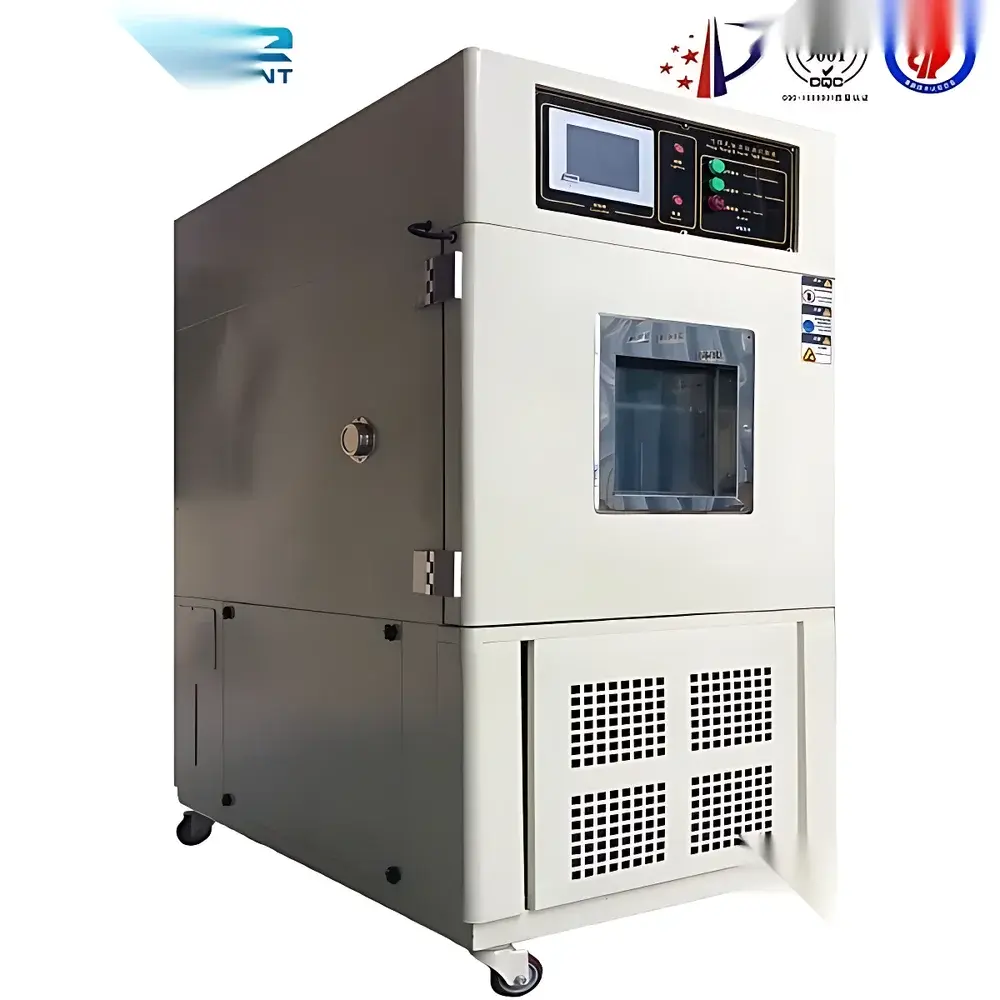
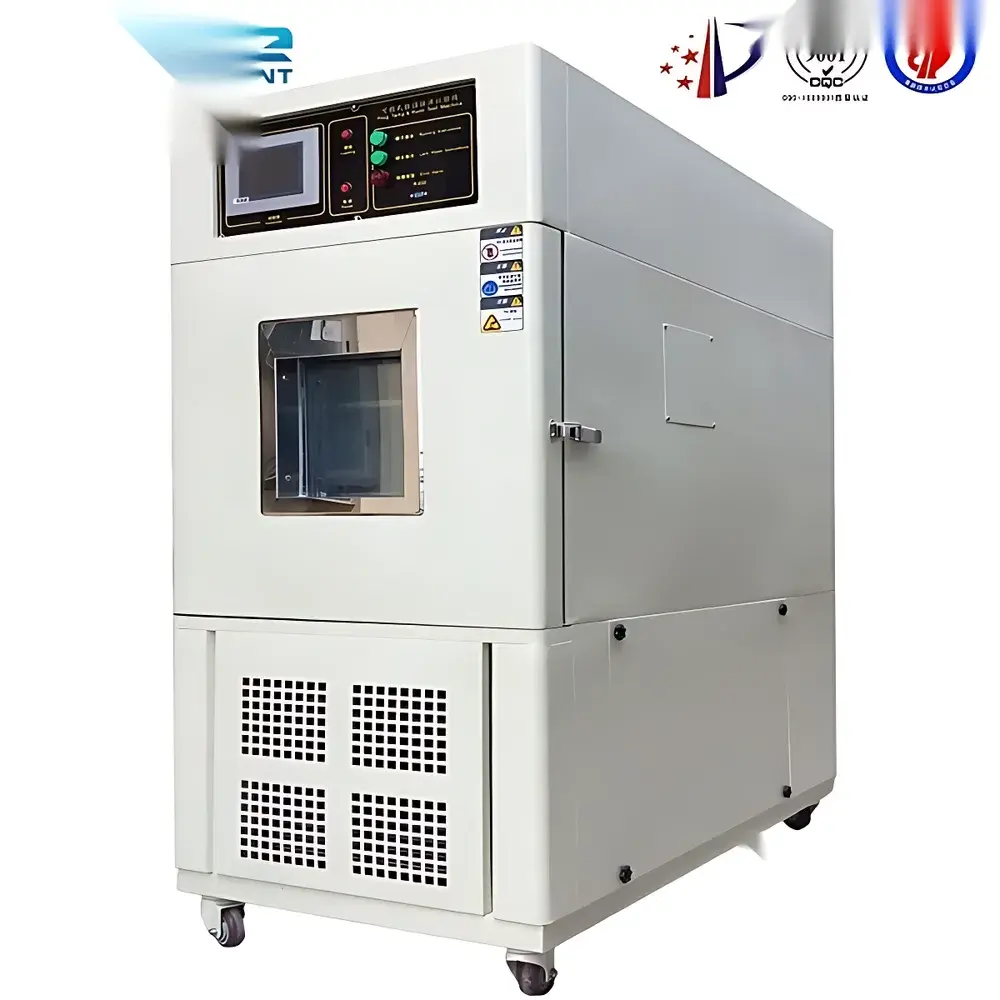
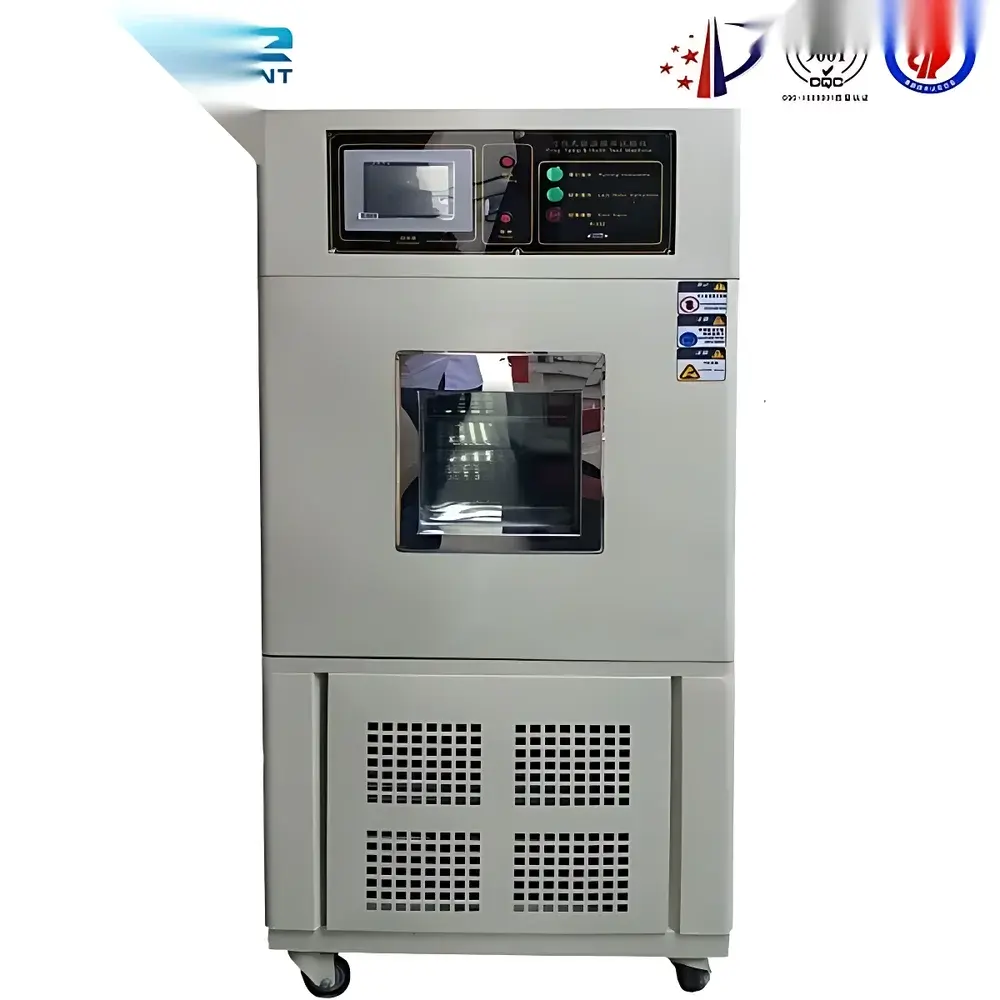
Compact Temperature and Humidity Controlled Chamber – TEMI880 Touchscreen Programmable Environmental Test Chamber
| Brand | OEM / Custom-Built |
|---|---|
| Origin | Imported |
| Manufacturer Type | Authorized Distributor |
| Price | USD 3,150 (FOB) |
| Temperature Range | −40 °C to +150 °C (standard) |
| Humidity Range | 30–98 % RH (standard) |
| Temp. Resolution | 0.01 °C |
| Humidity Resolution | 0.1 % RH |
| Temp. Uniformity | ±0.5 °C |
| Temp. Deviation | ≤ ±2 °C |
| Humidity Deviation | ≤ ±2.5 % RH |
| Heating Rate | 2.0–3.0 °C/min |
| Cooling Rate | 0.7–1.0 °C/min |
| Control System | TEMI880 Color LCD Touchscreen Controller |
| Power Supply | 380 V ±5 %, 50 Hz, 3P+N+G |
| Internal Chamber Material | SUS304 Stainless Steel |
| External Casing | SUS304 or Powder-Coated A3 Steel |
| Compliance | GB10589, GB10592, GB11158, GB/T5170.2, GB/T5170.5, GB2423.1, GB2423.2, GB2423.22, GB2424.1 |
Overview
The Compact Temperature and Humidity Controlled Chamber is an engineered environmental test system designed for precise, repeatable simulation of climatic conditions in constrained laboratory spaces. It operates on the principle of forced-air convection with dual independent refrigeration and steam-based humidification circuits, enabling simultaneous control of temperature and relative humidity across a wide operational envelope. The chamber is calibrated and validated per national metrological standards (GB/T5170.2 and GB/T5170.5) to ensure traceable accuracy under no-load, ambient-conditioned environments (25 °C ±6 °C). Its compact footprint—optimized for benchtop or low-clearance installation—makes it suitable for QC labs, R&D facilities, and academic institutions where floor space is limited but regulatory-grade environmental simulation is required.
Key Features
- Space-efficient architecture: Minimal external dimensions without compromising internal usable volume; accommodates placement in narrow corridors or modular lab setups.
- Large observation window with double-layer tempered glass and anti-fog heating film for real-time visual monitoring without thermal or humidity disturbance.
- High-capacity, drawer-style water reservoir with quick-release mechanism—enabling extended unattended operation and simplified maintenance.
- Dual-stage safety architecture: Includes over-temperature cut-off, compressor high-pressure protection, humidity sensor fault detection, door interlock, and ground-fault circuit interruption (GFCI).
- Intuitive TEMI880 color touchscreen controller with multi-segment programmable profiles, real-time trend graphs, and USB data export capability.
- Robust construction: Interior chamber fabricated from electropolished SUS304 stainless steel; exterior available in corrosion-resistant SUS304 or powder-coated A3 steel.
Sample Compatibility & Compliance
This chamber supports testing of electronic components, polymer materials, pharmaceutical packaging, automotive sensors, and precision optical assemblies. Its thermal and hygroscopic performance conforms to internationally referenced test standards including IEC 60068-2-1 (cold), IEC 60068-2-2 (dry heat), IEC 60068-2-30 (damp heat, cyclic), and ISO 16750-4 (road vehicles). All factory calibrations are performed in accordance with GB10589 (low-temperature chambers), GB10592 (climatic chambers), and GB2423 series for environmental stress screening. Optional validation packages—including IQ/OQ documentation and as-found/as-left calibration reports—are available to support GLP, GMP, and ISO/IEC 17025-compliant laboratories.
Software & Data Management
The TEMI880 controller provides full-cycle environmental profile programming with up to 100 segments and 999 cycles. It records timestamped temperature and humidity data at user-selectable intervals (1–600 seconds), stores ≥10,000 hours of historical logs internally, and supports export via USB 2.0 to CSV format for post-processing in Excel or statistical analysis platforms. Audit trail functionality meets basic requirements for FDA 21 CFR Part 11 compliance when paired with password-protected user roles (administrator, operator, viewer). Optional Ethernet interface enables remote monitoring via Modbus TCP or custom SCADA integration. Firmware updates are delivered via secure USB load—no internet dependency required.
Applications
- Accelerated aging studies of adhesives, coatings, and composite laminates under controlled thermal-hygric cycling.
- Stability testing of medical device packaging per ISO 11607 and ASTM F1980 protocols.
- Pre-conditioning of lithium-ion battery cells prior to electrical characterization.
- Qualification of printed circuit board assemblies (PCBAs) per IPC-J-STD-004 and J-STD-020.
- Environmental stress screening (ESS) of avionics modules in accordance with MIL-STD-810H Method 502.7.
- Material coefficient of thermal expansion (CTE) evaluation using dimensional metrology synchronized with chamber logging.
FAQ
What is the difference between “temperature uniformity” and “temperature deviation”?
Temperature uniformity (±0.5 °C) refers to spatial variation across the working volume at steady state; temperature deviation (≤±2 °C) indicates maximum offset between setpoint and actual chamber average under dynamic conditions.
Can this chamber operate continuously at 98% RH below 10 °C?
Yes—provided cooling water inlet temperature remains within 10–28 °C and pressure is maintained at 0.1–0.3 MPa. Condensation management is ensured via heated chamber walls and drain-heated sump.
Is the TEMI880 controller compliant with FDA 21 CFR Part 11?
The base controller supports role-based access and electronic signature capture; full Part 11 compliance requires documented configuration control, audit trail review procedures, and periodic revalidation—services available upon request.
Do you provide installation and commissioning support?
Yes—on-site mechanical/electrical commissioning, operational qualification (OQ), and user training are offered globally through certified field engineers.
Are custom chamber dimensions and extended temperature ranges available?
All structural and thermal specifications—including internal volume, door orientation, and ultra-low temperature options (down to −120 °C)—are configurable during engineering design phase.



