
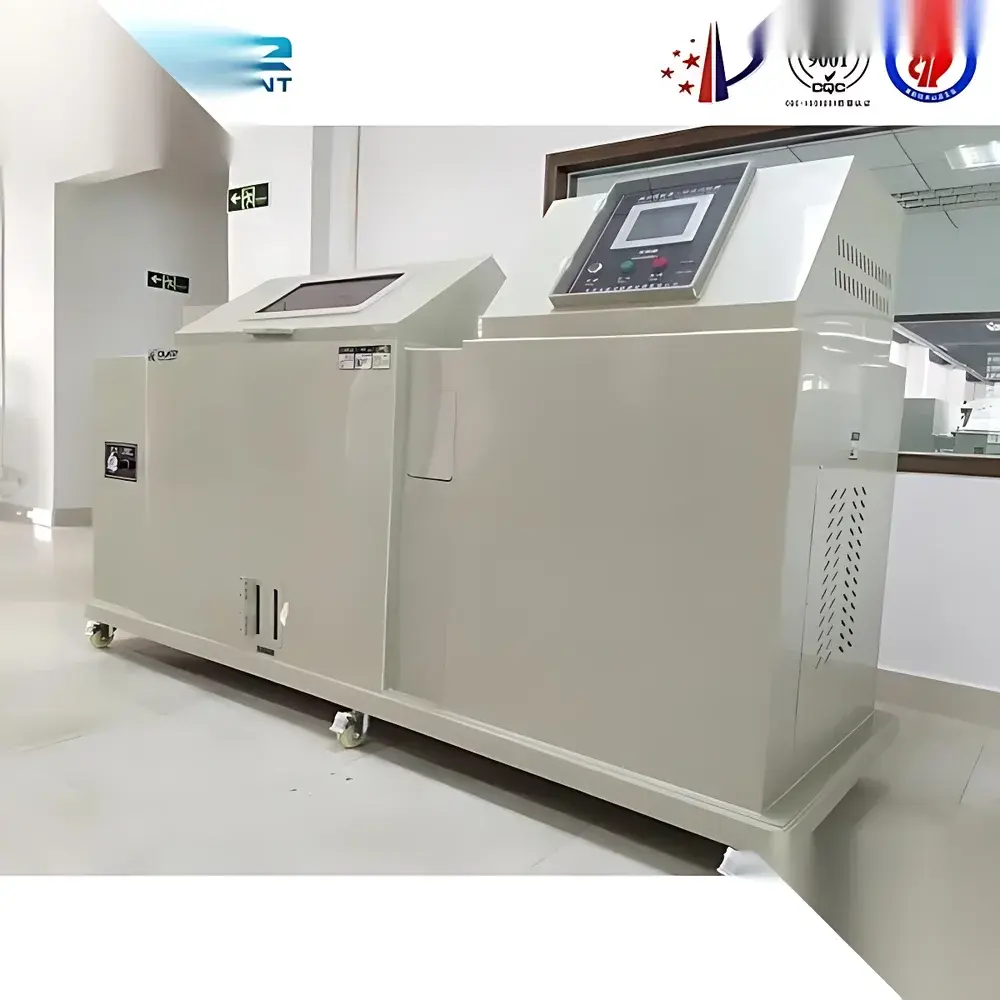
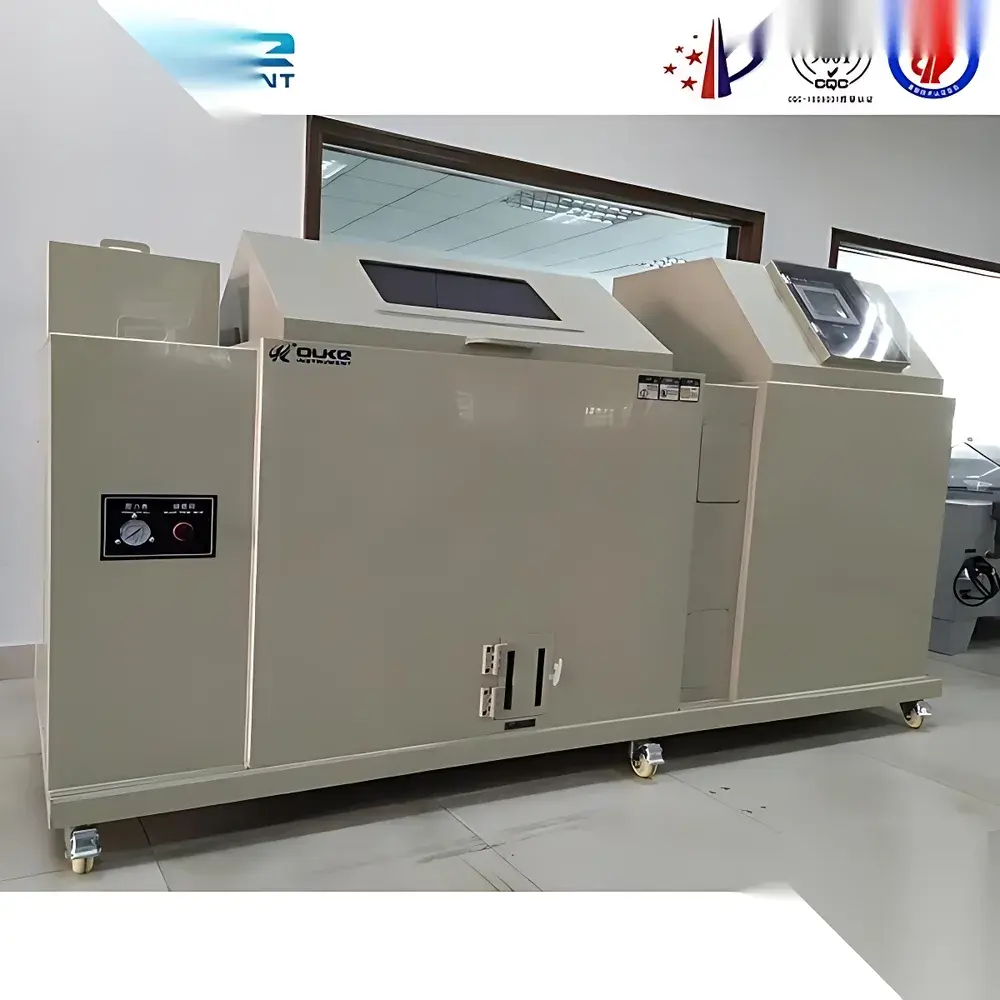
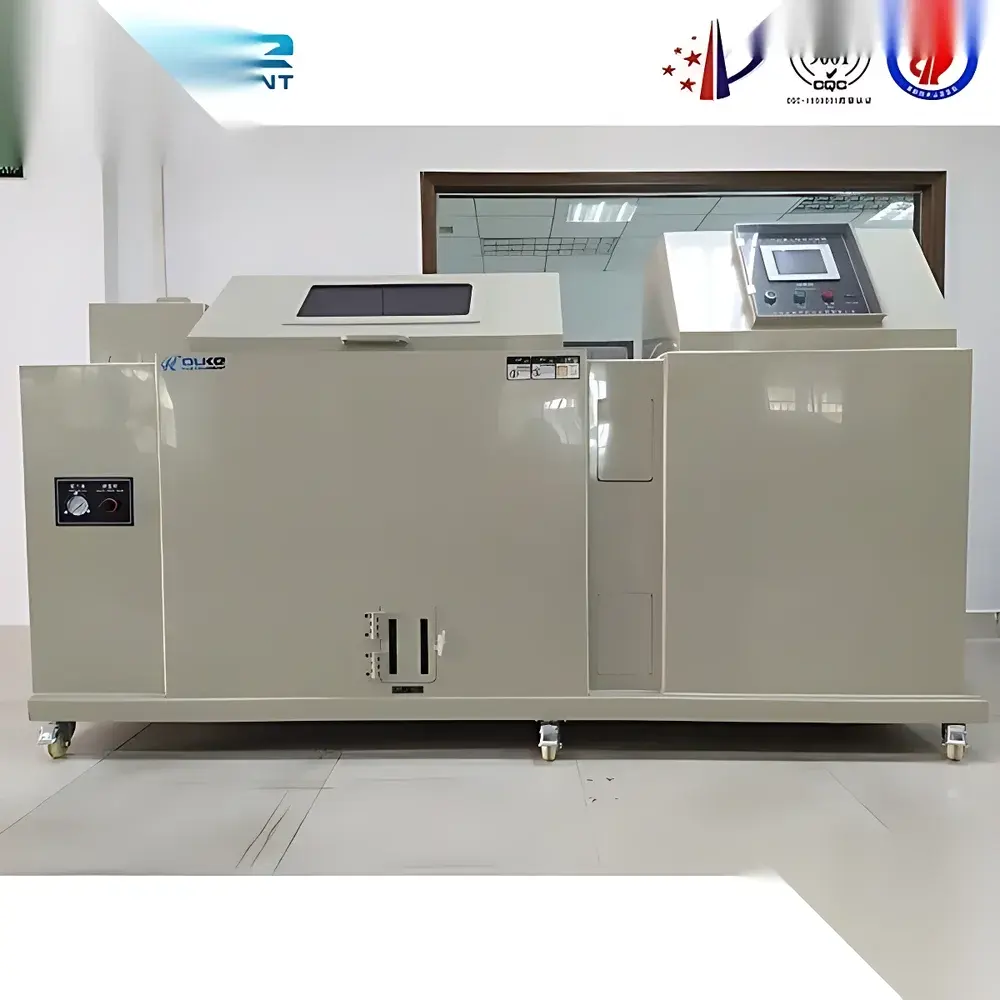
Composite Cyclic Salt Spray Test Chamber
| Brand | OEM / Custom-Built |
|---|---|
| Origin | Imported |
| Manufacturer Type | Authorized Distributor |
| Price | USD 12,500 (FOB) |
| Chamber Volume Range | 3–116 m³ |
| Temperature Range | RT+10°C to 55°C |
| Temperature Uniformity | ±2°C |
| Temperature Stability | ±0.5°C |
| Salt Spray Deposition Rate | 1–2 mL/80 cm²·h |
| Test Chamber & Lid Material | 8 mm High-Temperature-Resistant PVC |
| 雾化原理 | Bernoulli-Principle Air-Aspirated Atomization |
| 喷嘴材质 | Tempered Borosilicate Glass |
| 喷雾控制 | Programmable Cycle (1 s–9999 h), Adjustable Output (1–2 mL/h per 80 cm²) |
| 加热方� | �: Direct Steam Heating with Titanium Alloy Immersion Heater |
| 控制器 | Siemens S7-1200 PLC, 32-bit Automotive-Grade CPU, LCD Touch Interface, Power-Failure Memory, Dual Auto/Manual Operation Mode |
| Compliance | ASTM B117, ISO 9227, JIS Z2371, GB/T 2423.17, IEC 60068-2-11 |
Overview
The Composite Cyclic Salt Spray Test Chamber is an engineered environmental simulation system designed for accelerated corrosion testing of metallic and coated materials under dynamically controlled, multi-phase exposure conditions. Unlike conventional static salt fog chambers compliant solely with ASTM B117, this chamber integrates programmable temperature cycling, humidity modulation, drying phases, and precisely regulated salt mist generation—enabling full compliance with cyclic corrosion test (CCT) standards including ISO 14993, VDA 621-415, GMW 14872, and Ford CETP 00.00-L-467. Its core measurement principle relies on gravimetric deposition rate control and thermodynamic feedback stabilization to maintain reproducible corrosive environments across large-volume test spaces (3–116 m³). The system is constructed for industrial R&D labs, Tier-1 automotive suppliers, and aerospace component qualification facilities requiring GLP-aligned traceability, long-term operational stability, and audit-ready parameter logging.
Key Features
- Bernoulli-Driven Atomization System: Utilizes compressed air aspiration to draw and atomize NaCl solution without mechanical pumps or ultrasonic transducers—eliminating nozzle clogging, crystallization buildup, and flow-rate drift over extended cycles.
- Tempered Borosilicate Glass Nozzles: Chemically inert, thermal-shock resistant spray heads with adjustable orientation and calibrated orifice geometry; enable precise spatial distribution and repeatable deposition rates (1–2 mL/80 cm²·h, verified per ISO 9227 Annex A).
- Titanium Alloy Steam Heating Assembly: Direct-injection steam generator with corrosion-resistant titanium immersion elements ensures rapid thermal ramping (RT+10°C to 55°C in ≤25 min), minimal standby energy consumption, and immunity to chloride-induced pitting or scaling.
- Siemens S7-1200 PLC Control Architecture: 32-bit automotive-grade processor with deterministic real-time loop execution; supports dual-mode operation (fully automated sequence logic or manual override), power-failure memory retention, and configurable timing resolution from 0.1 seconds to 999,999 hours.
- Integrated Human-Machine Interface: Backlit LCD touchscreen panel consolidates all setpoints, real-time sensor readings (temperature, deposition rate, cycle phase), alarm status, and historical trend graphs into a single ergonomic vertical interface—reducing operator training time and misconfiguration risk.
Sample Compatibility & Compliance
This chamber accommodates specimens up to full-volume capacity (max. 116 m³ working space), supporting large assemblies such as brake calipers, chassis subframes, EV battery enclosures, and marine-grade fasteners. Internal construction uses 8 mm high-purity, UV-stabilized PVC panels rated for continuous service at 55°C and pH 3.2 saline aerosol exposure—ensuring structural integrity and zero metal ion leaching. All operational parameters adhere to internationally recognized corrosion test protocols: ASTM B117 (neutral salt spray), ISO 9227 (acetic acid/salt spray variants), JIS Z2371, and GB/T 2423.17. Full traceability is maintained via timestamped digital logs meeting FDA 21 CFR Part 11 requirements for electronic records and signatures when paired with optional audit trail software modules.
Software & Data Management
The embedded controller firmware supports CSV export of time-synchronized datasets—including chamber temperature, relative humidity (when equipped with optional RH sensor), spray activation duration, cumulative deposition volume, and fault event timestamps. Optional Ethernet/IP or Modbus TCP connectivity enables integration into centralized LIMS or MES platforms. Data integrity safeguards include cyclic redundancy checks (CRC), write-protected archival storage, and configurable auto-backup intervals. For regulated environments, optional validation packages (IQ/OQ/PQ documentation templates) and 21 CFR Part 11-compliant user access controls (role-based permissions, electronic signature capture, and immutable audit trails) are available upon request.
Applications
- Qualification of electrogalvanized, zinc-nickel, and aluminum conversion-coated automotive body panels per VDA 621-415
- Corrosion resistance validation of aerospace fasteners under ISO 14993 multi-stage cycles
- Accelerated aging of marine-grade stainless steel housings per ASTM G85 Annex A5
- Coating adhesion and blistering assessment on powder-coated aluminum extrusions (ISO 12944-9)
- Electrochemical interface stability testing of EV battery module casings exposed to coastal atmospheric conditions
FAQ
What standards does this chamber support beyond ASTM B117?
It natively executes ISO 9227 (NSS, AASS, CASS), ISO 14993 (cyclic corrosion), VDA 621-415, GMW 14872, and JASO M609—configurable via preloaded test profiles.
Can the chamber operate unattended for multi-day cycles?
Yes. With Siemens PLC-based automation, power-failure memory, and self-diagnostic alarms (e.g., low solution level, heater fault), it supports fully autonomous operation for up to 9999 hours.
Is the 8 mm PVC chamber material compliant with RoHS and REACH?
Yes. Certificate of Conformance (CoC) and SVHC screening reports are provided with each unit shipment.
How is salt spray deposition rate verified and calibrated?
Calibration follows ISO 9227 Annex A using standardized funnels and volumetric cylinders; annual third-party verification services are available through authorized metrology partners.
Does the system include remote monitoring capability?
Standard Ethernet port enables local network access; optional cloud-based telemetry (with TLS 1.2 encryption) and SMS alert modules are available for off-site supervision.



