
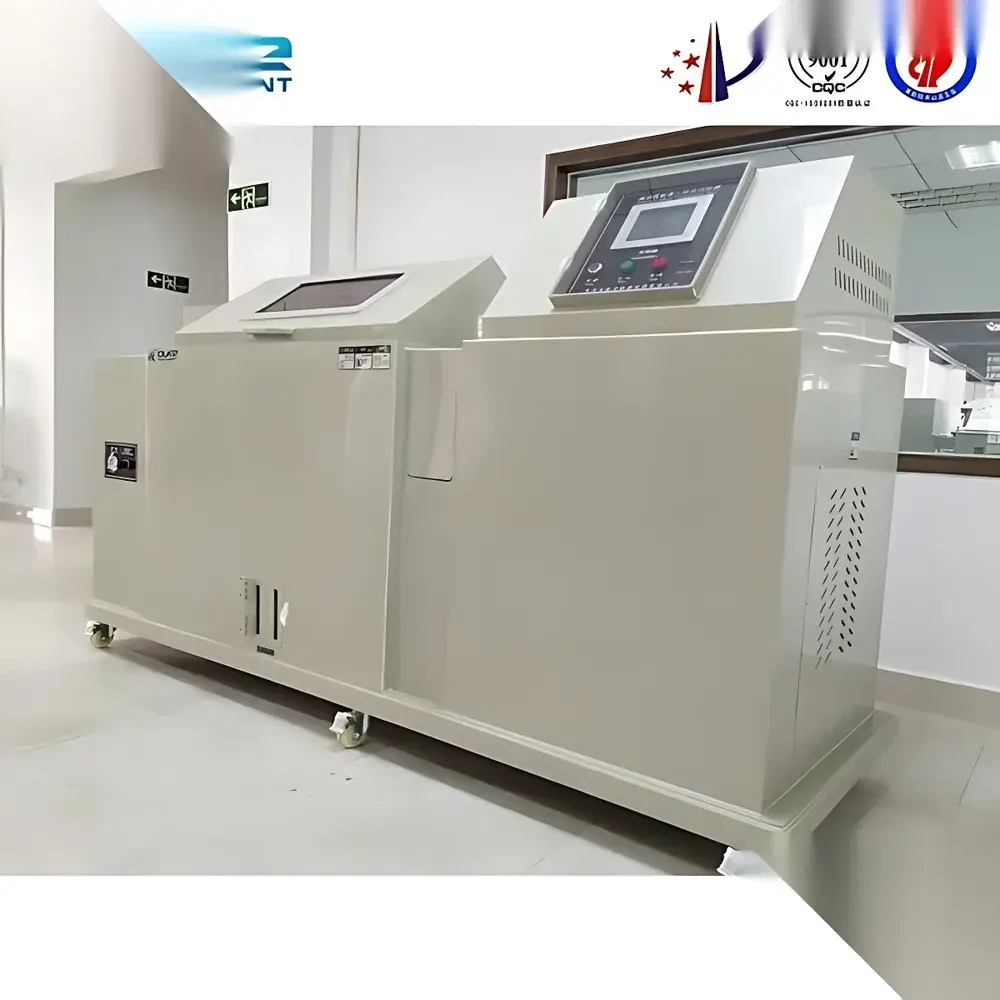
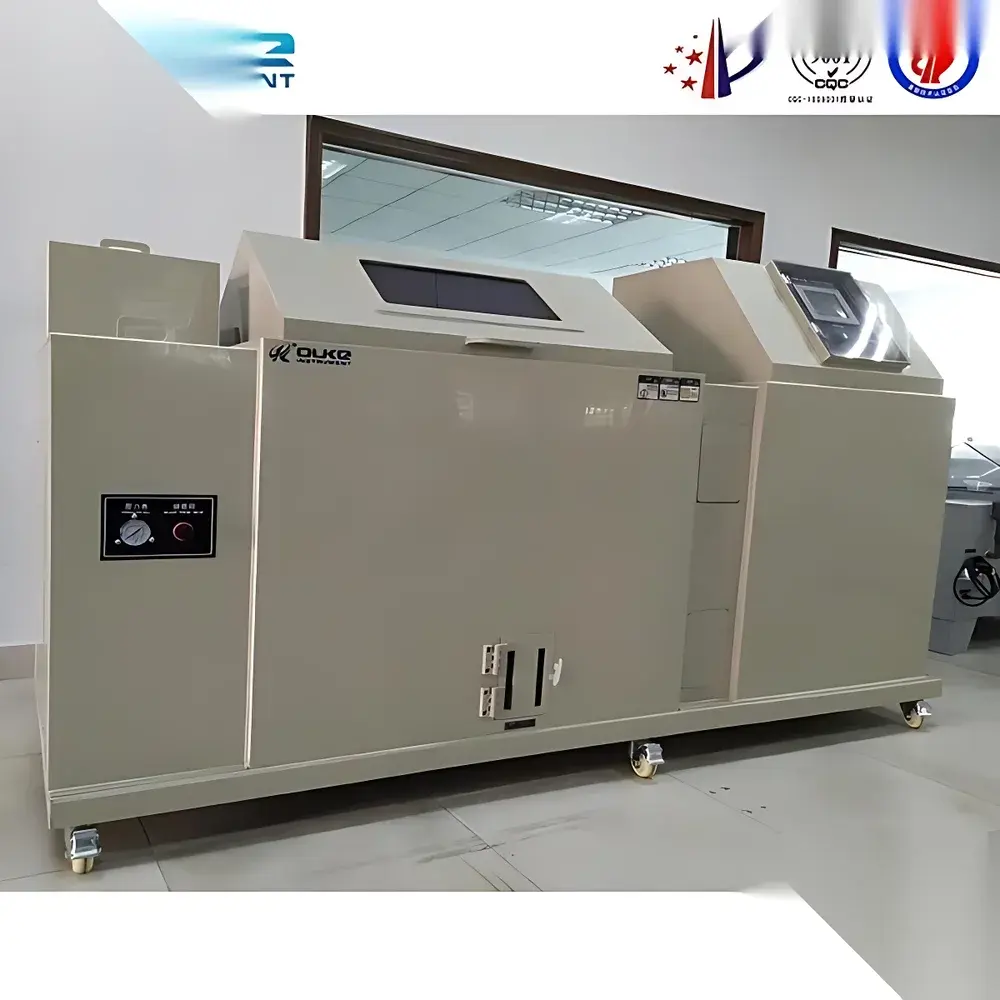
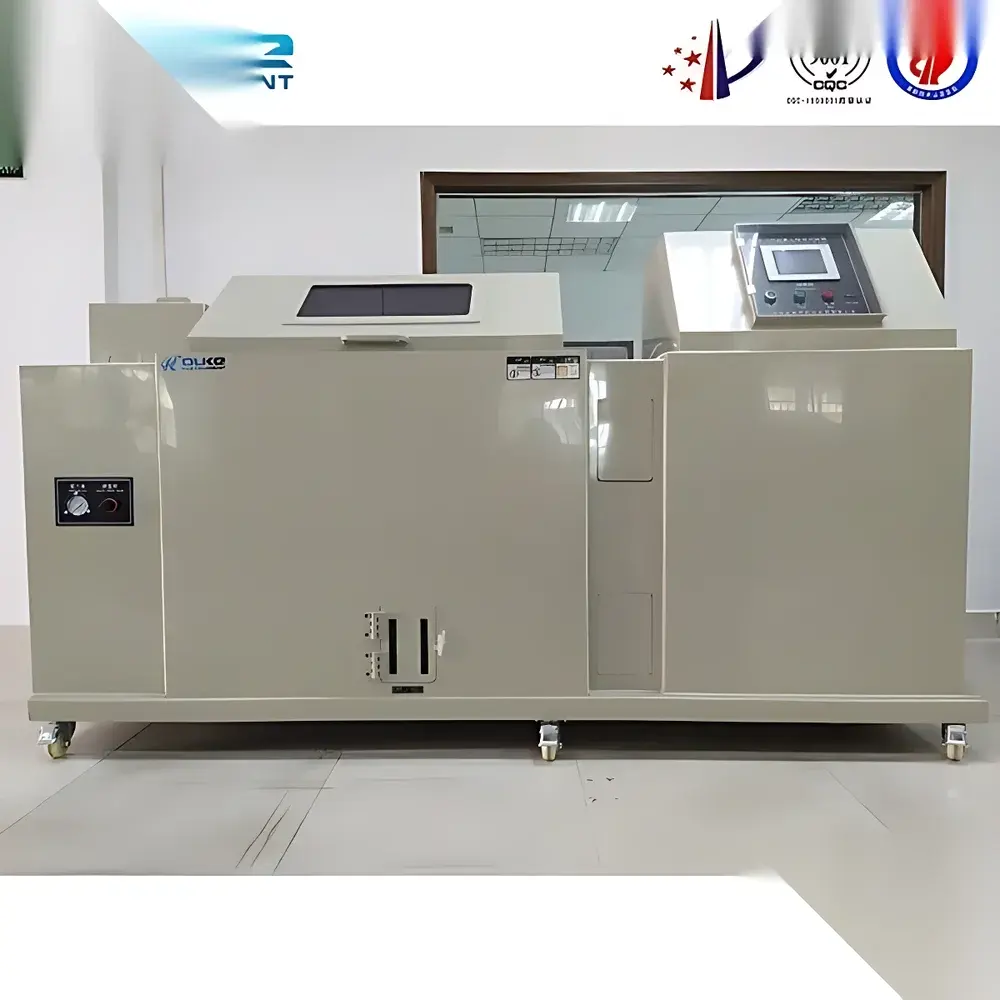
Composite Salt Spray & Corrosion Test Chamber OK-FH Series
| Brand | Other Brands |
|---|---|
| Origin | Imported |
| Manufacturer Type | Authorized Distributor |
| Temperature Range | RT+10°C to 50°C |
| Humidity Range | 85–98% RH |
| Temp. Uniformity | ≤2°C |
| Temp. Stability | ±0.5°C |
| Salt Solution Concentration | 0.1–1% v/v |
| 雾 Generation Method | Compressed Gas (N₂ or Air) via Precision PYREX Nozzle |
| Test Modes | Continuous (ASTM B117), Cyclic (GB/T 2423.17, GB/T 2423.18, ISO 9227), NSS/ASS/CASS Protocols |
| Chamber Dimensions (OK-FH-60 / -80 / -120) | 850×1300×600 mm / 850×1600×600 mm / 900×2000×600 mm (D×W×H) |
| Saturated Air Tank Temp. | 47°C (NSS), 63°C (CASS) |
| Control System | PID-Based Digital Controller with Programmable Cycle Sequencing |
| Safety Features | Dual Over-Temperature Protection, Low-Water Level Alarm, Crystallization-Resistant Nozzle Design |
Overview
The OK-FH Series Composite Salt Spray & Corrosion Test Chamber is an engineered environmental test system designed for accelerated corrosion evaluation of metallic and coated materials under controlled electrochemical stress conditions. It operates on the principle of simulating aggressive atmospheric environments—primarily chloride-laden marine or industrial atmospheres—by generating a continuous or cyclic mist of atomized sodium chloride (NaCl) or acidified salt solutions. Unlike basic salt spray cabinets, the OK-FH series integrates dual-condition control: precise regulation of chamber temperature (RT+10°C to 50°C) and high-humidity saturation (85–98% RH) via a thermally coupled saturated air tank operating at elevated temperatures (47°C for NSS, 63°C for CASS). This architecture enables strict compliance with internationally recognized corrosion testing standards—including ASTM B117 (neutral salt spray), ASTM G85 Annex A2 (acidified salt spray, ASS), and Annex A3 (copper-accelerated acetic acid salt spray, CASS)—as well as Chinese national standards GB/T 2423.17 and GB/T 2423.18.
Key Features
- Precision PYREX glass nozzles ensure uniform aerosol dispersion without crystallization-induced clogging, delivering reproducible droplet size distribution and consistent impingement across test specimens.
- Programmable digital PID controller with ±0.1°C temperature accuracy supports both continuous and multi-stage cyclic test profiles, enabling automated transitions between salt fog, drying, and humidification phases per ISO 9227 and GMW 14872 protocols.
- Saturated air tank utilizes Henry’s Law-based thermal humidification, maintaining stable vapor pressure and eliminating condensation variability during prolonged exposure cycles.
- Direct steam heating of the test chamber ensures rapid thermal equilibration (<15 min from ambient to 35°C), minimizing standby time and improving throughput in high-volume QA/QC laboratories.
- Dual independent over-temperature protection circuits and real-time water-level monitoring provide fail-safe operation, meeting IEC 61000-6-2 EMC and UL 61010-1 functional safety requirements.
- Modular chamber configurations (OK-FH-60, -80, -120) accommodate specimen footprints up to 2000 mm wide, supporting full-size automotive panels, aerospace fasteners, and electronic enclosures.
Sample Compatibility & Compliance
The OK-FH chamber accommodates flat, curved, or three-dimensional samples up to 60 kg per load, including electroplated steel, aluminum alloys, zinc-coated hardware, polymer-coated substrates, and printed circuit board assemblies. Its design conforms to mechanical and operational requirements of ASTM B117, ISO 9227, JIS Z2371, and GB/T 2423.17–2423.18. All internal wetted surfaces are constructed from non-reactive PVC or PP, preventing secondary contamination. The saturated air tank and chamber walls undergo hydrophobic surface treatment to suppress residual salt adhesion and facilitate cleaning between test runs—critical for GLP-compliant labs conducting sequential qualification batches.
Software & Data Management
While the base model features a standalone digital controller, optional RS-485/Modbus RTU interface enables integration with centralized lab data acquisition systems (e.g., LabVIEW, Siemens Desigo, or custom SCADA platforms). Logged parameters—including chamber temperature, saturated tank temperature, cumulative spray duration, and alarm events—are timestamped and exportable as CSV files. For regulated environments, optional validation packages support IQ/OQ documentation aligned with FDA 21 CFR Part 11 requirements, including electronic signature capability, audit trail generation, and user access level management (Operator, Technician, Administrator).
Applications
This chamber serves quality assurance departments in automotive OEMs (corrosion resistance validation of brake calipers, chassis components), electronics manufacturers (conformal coating integrity on PCBs), defense contractors (marine-grade fastener qualification), and coating suppliers (salt tolerance benchmarking of powder-coated aluminum extrusions). It is routinely deployed for pre-compliance screening prior to third-party certification, comparative lifetime modeling of protective coatings, and failure analysis root-cause investigations following field corrosion incidents.
FAQ
What salt solution concentrations can be accurately maintained?
The system supports programmable concentration ranges from 0.1% to 1.0% NaCl (v/v) using calibrated volumetric dosing; acidified variants (e.g., 0.2% NaCl + 0.1% CH₃COOH for ASS) are achievable with auxiliary chemical delivery modules.
Does the chamber support fully automated cyclic testing per ISO 9227?
Yes—via the programmable controller, users define sequence steps (e.g., 2h salt fog → 2h dry → 4h humidity), dwell times, and transition ramp rates, satisfying ISO 9227’s “Prohesion” and “Cyclic Corrosion Testing” modes.
How is nozzle clogging prevented during extended CASS testing?
The PYREX nozzle geometry, combined with heated saturated air delivery and periodic automatic purge cycles, inhibits CuCl₂ crystallization; maintenance intervals exceed 200 hours under standard CASS conditions.
Is calibration traceability provided with the unit?
Each chamber ships with a NIST-traceable temperature calibration certificate for both chamber and saturated tank sensors, valid for 12 months from commissioning.
Can the system be integrated into an existing LIMS or MES environment?
Yes—through optional Ethernet-to-Modbus gateways and OPC UA server add-ons, enabling real-time parameter streaming and test status synchronization with enterprise systems.



