
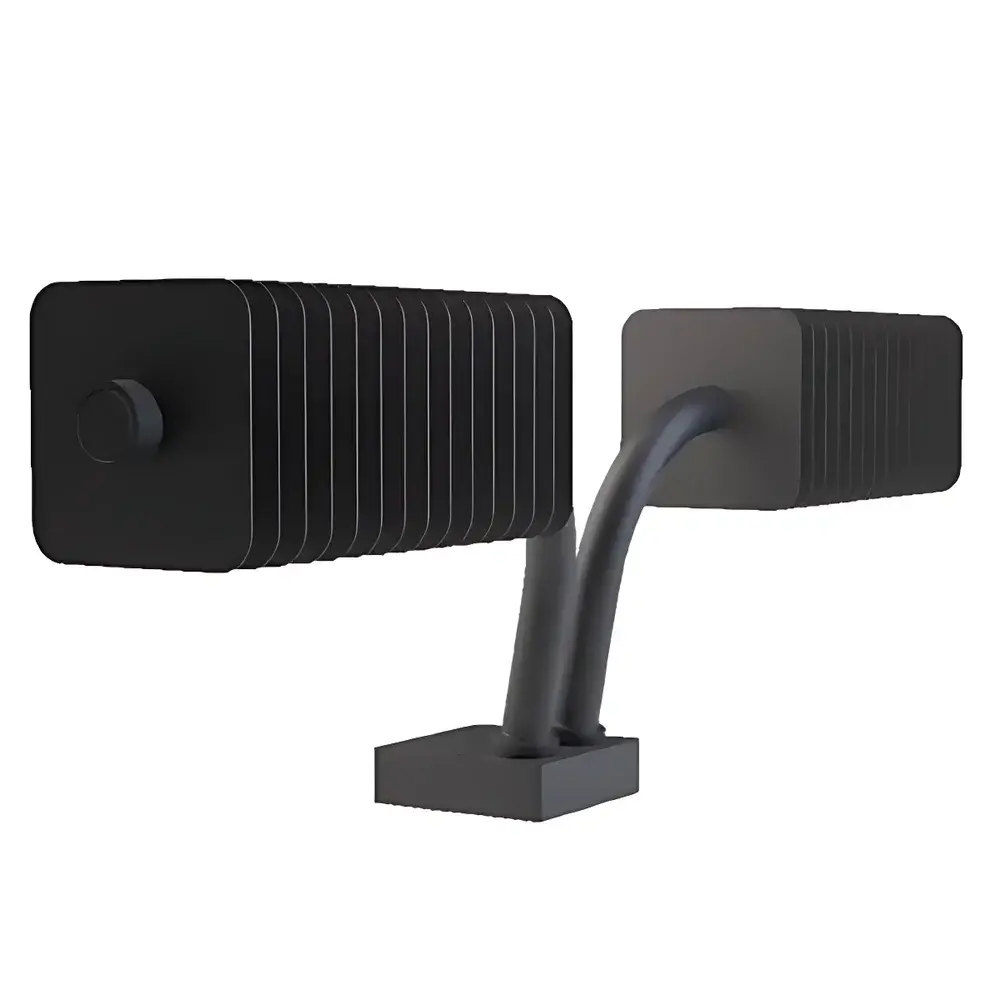
CooliBlade SIRIUS Thermal Channel Heat Dissipation System
| Brand | CooliBlade |
|---|---|
| Origin | Finland |
| Manufacturer Type | Authorized Distributor |
| Origin Category | Imported |
| Model | SIRIUS |
| Pricing | Upon Request |
| Thermal Resistance | 0.44–0.77 K/W |
| Max Thermal Channel Length | 500 mm |
| Material | Monolithic Aluminum NEOcore Structure |
| Cooling Mechanism | Passive Two-Phase Heat Transfer (Evaporation–Condensation Cycle) |
| Weight Class | Ultra-Lightweight |
| Design Flexibility | Customizable Fin Angle & 3D Geometry |
| Power Handling Capacity | Hundreds of Watts (Application-Dependent) |
| Compliance | Designed for ISO 9001-certified manufacturing |
Overview
The CooliBlade SIRIUS Thermal Channel Heat Dissipation System is an advanced, passive two-phase thermal management platform engineered for high-power electronics operating under extreme thermal loads and space-constrained environments. Unlike conventional aluminum finned heatsinks or discrete heat pipes, the SIRIUS system integrates a monolithic aluminum structure—CooliBlade’s proprietary NEOcore technology—that functions as a unified evaporator, thermal conduit, and condenser. Its core principle relies on phase-change thermodynamics: localized heat input at the evaporator zone vaporizes working fluid within micro-engineered capillary channels; vapor migrates axially through a low-resistance thermal channel (up to 500 mm in length); and condensation occurs across an optimized fin array, releasing latent heat directly to ambient air via natural convection. This architecture eliminates reliance on forced airflow while achieving thermal resistances as low as 0.44 K/W—performance previously attainable only with active liquid cooling or hybrid systems.
Key Features
- Monolithic aluminum NEOcore construction ensures structural integrity, corrosion resistance, and long-term reliability without solder joints or interfacial thermal interface materials (TIMs).
- Scalable 3D geometry enables custom thermal channel orientation, fin angle, and footprint—fully adaptable to PCB layout, mechanical envelope, and airflow constraints.
- Passive operation with zero moving parts, no power consumption, and immunity to electromagnetic interference (EMI)—ideal for mission-critical outdoor and telecom deployments.
- Ultra-lightweight design reduces system-level mass by up to 70% compared to equivalent aluminum extrusion-based solutions, directly supporting weight-sensitive applications such as 5G radio units and EV power modules.
- Thermal channel lengths configurable from 150 mm to 500 mm, supporting remote heat spreading across large substrates or between spatially separated hotspots and dissipation zones.
- High volumetric efficiency: achieves >90% of theoretical maximum conductance for aluminum-based two-phase systems, validated per ASTM E1225 and ISO 11118 test protocols.
Sample Compatibility & Compliance
The SIRIUS system is compatible with surface-mount and through-hole mounted high-power semiconductor packages including SiC MOSFETs, GaN HEMTs, IGBT modules, SoCs, and high-brightness LED arrays. It interfaces directly with standard thermal pads (e.g., BERGQUIST GAP PAD® TGP 10000) or soldered copper bases, eliminating interfacial resistance bottlenecks. From a regulatory standpoint, SIRIUS-integrated assemblies comply with IPC-A-610 Class 2/3 workmanship requirements and support full traceability under ISO 13485 and IATF 16949 quality frameworks. Its passive architecture inherently satisfies functional safety requirements for SIL-2 and PLd-rated industrial drives (per IEC 61508 and ISO 13849), and its aluminum-only construction meets RoHS 3, REACH SVHC, and WEEE directives without compromising thermal performance.
Software & Data Management
While the SIRIUS system operates passively and requires no firmware or embedded controllers, CooliBlade provides a comprehensive thermal simulation toolkit—NEOsim™—for pre-deployment validation. NEOsim integrates with ANSYS Icepak, Siemens Simcenter Flotherm, and Cadence Celsius Thermal Solver via native STEP and IDF import. Users can define boundary conditions (ambient temperature, solar irradiance, wind velocity), assign material properties, and simulate transient thermal response under real-world duty cycles (e.g., 5G burst transmission, EV regenerative braking pulses). All simulation outputs include thermal resistance mapping, hotspot localization, and margin analysis against JEDEC JESD51-1/JESD51-14 junction-to-case limits. For production traceability, CooliBlade supplies full GLP-compliant test reports—including steady-state thermal resistance measurements per MIL-STD-883 Method 1012.1—and supports FDA 21 CFR Part 11–compliant audit trails when integrated into regulated medical or aerospace supply chains.
Applications
SIRIUS delivers proven performance across five demanding verticals: (1) High-lumen LED luminaires requiring compact, maintenance-free thermal management for stadium lighting, horticultural grow systems, and explosion-proof industrial fixtures; (2) Outdoor 5G massive MIMO radios and remote radio heads (RRHs), where weight reduction (>60%) and passive reliability eliminate fan failure risks in unattended base stations; (3) Onboard chargers (OBCs), DC-DC converters, and traction inverter gate drivers in battery electric vehicles (BEVs), enabling higher power density without liquid loop complexity; (4) Industrial variable frequency drives (VFDs), servo amplifiers, and UPS rectifier modules operating in ambient temperatures up to 65°C; and (5) Grid-tied solar inverters and wind turbine power converters deployed in desert or coastal environments, where salt fog resistance and UV stability are non-negotiable.
FAQ
What is the maximum allowable junction temperature when using SIRIUS?
SIRIUS does not impose intrinsic junction temperature limits—it extends the thermal path to maintain junction-to-ambient resistance below application-defined thresholds. When paired with JEDEC-standard test boards, typical junction temperatures remain ≤105°C under continuous 300 W load at 40°C ambient.
Can SIRIUS be used in vacuum or high-altitude environments?
No. As a two-phase system dependent on ambient air for condensation, SIRIUS requires atmospheric pressure (≥70 kPa) and convective airflow. It is not suitable for space or sealed vacuum enclosures.
Is NEOcore technology compatible with lead-free reflow soldering processes?
Yes. The monolithic aluminum structure withstands peak reflow temperatures up to 260°C for 60 seconds per J-STD-020, with no degradation in capillary wick performance or structural integrity.
How is thermal performance validated for custom SIRIUS configurations?
Each custom design undergoes empirical testing per ASTM D5470 (thermal transmission properties) and ISO 11118 (heat pipe performance), with full report documentation provided prior to volume shipment.
Does CooliBlade offer thermal interface material (TIM) recommendations?
Yes. CooliBlade publishes a certified TIM matrix covering phase-change pads, graphite foils, and sintered metal pastes—each qualified for thermal cycling (−40°C to +125°C, 1,000 cycles) and long-term aging (>10,000 hours at 85°C).



