
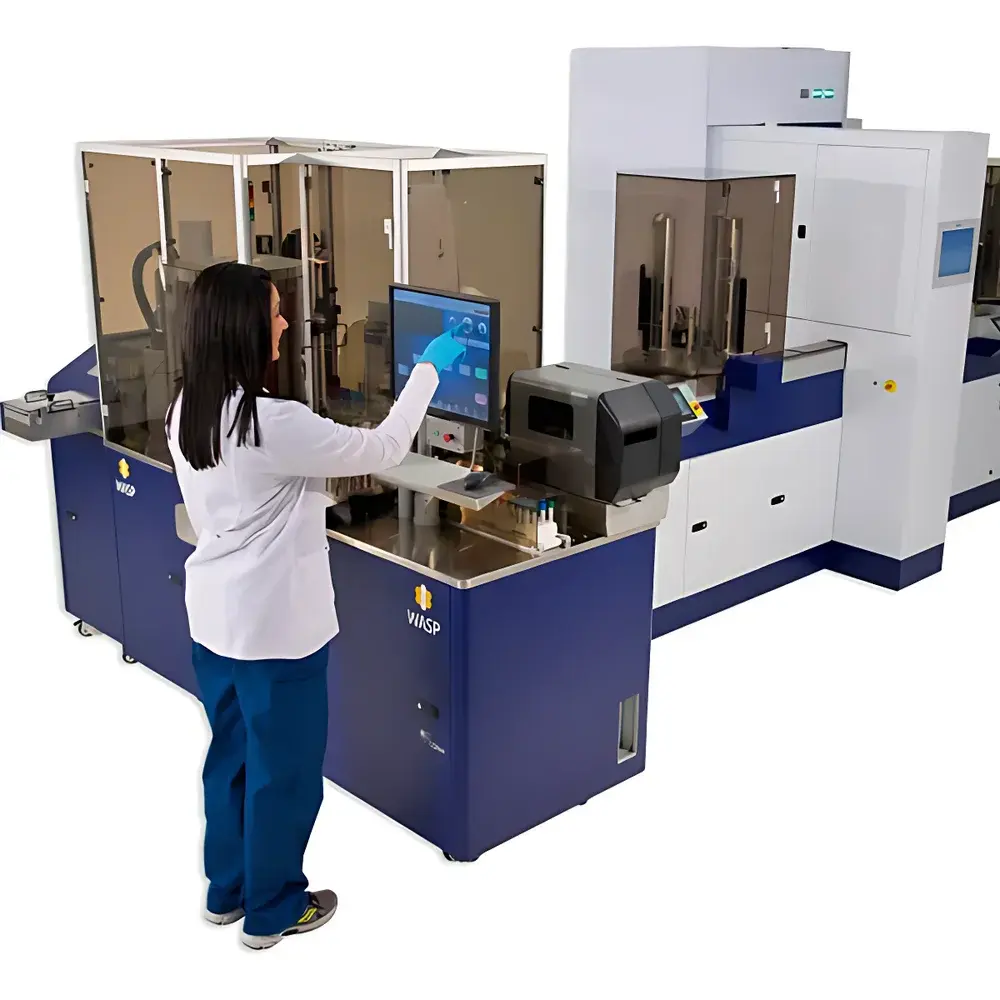
Copan WASPLab® Automated Microbiology Workflow System
| Brand | COPAN |
|---|---|
| Origin | Italy |
| Model | WASPLab® |
| Type | Integrated Automated Bacteriology Platform |
| Compliance | CE-IVD, ISO 15189-ready architecture |
| Software | WASPLab® WebApp (browser-based), LIS/HIS integration via ASTM/HL7 |
| Optional Module | Colibrí™ Automated Colony Picker |
Overview
The Copan WASPLab® Automated Microbiology Workflow System is a fully integrated, modular platform engineered for digital transformation in clinical and reference microbiology laboratories. Built upon the foundational principles of industrial automation and digital pathology, WASPLab® combines robotic sample handling, standardized streaking, intelligent incubation, high-resolution digital imaging, and centralized data management into a single cohesive architecture. It operates on a closed-loop, traceable workflow—from primary specimen receipt through plate inoculation, incubation, digital acquisition, AI-assisted interpretation, and downstream processing (e.g., colony picking or MALDI-TOF target spotting). Unlike standalone automation tools, WASPLab® implements a holistic, ISO 15189-aligned process control framework where every plate is assigned a unique digital identity linked to upstream specimen metadata, operator actions, environmental conditions (temperature/humidity logging), and time-stamped image series. This enables full auditability, reproducible streaking geometry, and objective growth assessment—critical for regulatory compliance under CLIA, CAP, and EU IVDR.
Key Features
- Modular robotic architecture: Scalable from single-module deployment (e.g., WASP® inoculator + digital imager) to full end-to-end workflow including incubators, storage carousels, and optional Colibrí™ colony picker.
- 48 MP tri-linear sensor with telecentric optics and 9 mm depth of field: Captures high-fidelity, distortion-free images of agar surfaces under standardized illumination—enabling quantitative colony morphology analysis and growth density mapping.
- Digital plate ID system: Each Petri dish receives a machine-readable barcode; all associated data—including patient ID, specimen type, media lot, incubation duration/temperature, and sequential image sets—are stored in a unified relational database.
- Non-contact workflow: Eliminates manual plate handling post-loading; automated streaking, transport, incubation, imaging, and triage (negative plates auto-discarded; positives flagged for review or downstream processing).
- Web-native WASPLab® WebApp: Browser-accessible interface supporting real-time plate review, zoom/pan annotation, colony marking, batch assignment to identification/susceptibility systems, and export of structured reports compliant with HL7 v2.x and ASTM E1384.
Sample Compatibility & Compliance
WASPLab® supports standard 90 mm and 100 mm Petri dishes across all major microbiological media types—including blood agar, chocolate agar, MacConkey, chromogenic UTI/Candida, MRSA/ESBL/VRE selective agars, and anaerobic plates (when paired with compatible incubators). The system accommodates diverse specimen inputs (urine, sputum, wound swabs, CSF, stool) via integrated primary tube decapping and loop calibration modules. All hardware and software components are CE-marked as IVD devices (Class B per IVDR 2017/746) and designed to support laboratory accreditation under ISO 15189:2022. Audit trail functionality meets FDA 21 CFR Part 11 requirements for electronic records and signatures, with configurable retention policies, user-level permissions, and immutable action logging.
Software & Data Management
The WASPLab® WebApp serves as the central command interface, requiring no local client installation and compatible with Windows, macOS, and ChromeOS endpoints. It features role-based access control (RBAC), customizable dashboards, and integrated quality control dashboards tracking key performance indicators (KPIs): TAT reduction per specimen category, plate rejection rate, inter-operator consistency metrics, and incubator temperature variance. All image and metadata are stored in an encrypted, DICOM-compliant repository with optional PACS integration. Data export supports CSV, PDF, and structured JSON formats for LIMS interoperability. Firmware and application updates are delivered over secure HTTPS channels with version-controlled rollback capability.
Applications
- Clinical diagnostic microbiology: High-volume urine culture screening, respiratory panel triage, bloodstream infection workflows.
- Antimicrobial stewardship programs: Rapid identification of critical isolates (e.g., carbapenemase producers) with direct linkage to AST platforms.
- Reference and public health labs: Standardized outbreak strain comparison using digital morphology baselines and longitudinal plate tracking.
- Research microbiology: Reproducible inoculation geometry for antibiotic gradient studies, biofilm formation assays, and phenotypic resistance profiling.
- Education and training: Digital archive of annotated plates used for competency assessment and remote learning modules.
FAQ
Does WASPLab® require dedicated IT infrastructure or on-premise servers?
No. The system operates via browser-based WebApp hosted either on-site (virtualized environment) or via validated cloud infrastructure meeting HIPAA/GDPR requirements. Local network bandwidth ≥100 Mbps is recommended for concurrent multi-user imaging review.
Can WASPLab® integrate with existing MALDI-TOF or automated identification systems?
Yes. Through bidirectional HL7/ASTM messaging, WASPLab® can dispatch plate IDs and selected colony coordinates to Bruker MBT, bioMérieux VITEK MS, or Thermo Fisher SmartSpec systems—triggering automatic target spotting and result reconciliation.
How is calibration and maintenance managed?
Automated daily self-calibration routines verify streaking accuracy, optical focus, and barcode scanner performance. Preventive maintenance schedules are tracked within the WebApp dashboard, with service alerts triggered by usage thresholds or environmental deviations.
Is Colibrí™ required for downstream processing?
No. Colibrí™ is an optional module. Users may manually pick colonies from digitally flagged plates using standard loops or opt for semi-automated picking via WASPLab®-guided coordinate overlays on physical plates.
What training and documentation support is provided?
Copan delivers site-specific validation protocols (IQ/OQ/PQ), SOP templates aligned with ISO 15189 Annex A.3, and certified operator training—including digital image interpretation certification—delivered by CE-certified clinical microbiologists.





