
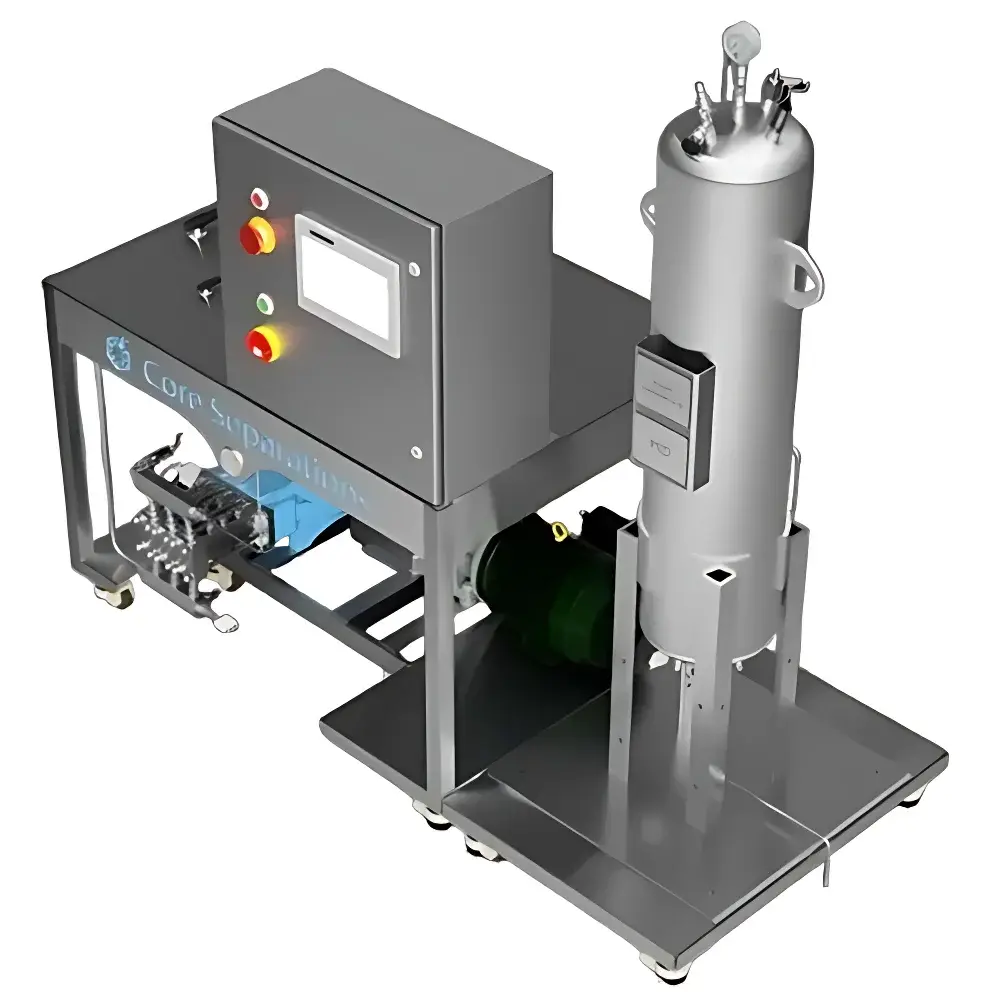
Core Separations BDS Bulk Delivery System for Low-Temperature Carbon Dioxide
| Brand | Core Separations |
|---|---|
| Origin | USA |
| Manufacturer Type | Authorized Distributor |
| Origin Category | Imported |
| Model | BDS |
| Extraction Volume | 50–100 L |
| Maximum Operating Pressure | 80 bar |
| Maximum Mass Flow Rate | 500 g/min (non-condensing) / 2 kg/min (with −20 °C condensation) |
Overview
The Core Separations BDS (Bulk Delivery System) is an engineered solution for laboratories operating multiple supercritical fluid chromatography (SFC) or supercritical fluid extraction (SFE) instruments requiring a continuous, stable supply of low-temperature liquid carbon dioxide. Unlike conventional high-pressure gas cylinders or third-party bulk tank services, the BDS functions as an on-site CO₂ conditioning and pressurization system—accepting commercially supplied liquid CO₂ at ~22 bar and −20 °C, then compressing, buffering, and delivering it at precisely regulated pressures up to 74 bar. This architecture eliminates phase instability (e.g., flashing to gas) during long-line distribution and ensures consistent density, solvating power, and flow stability across analytical or preparative SFC/SFE platforms. The system operates without active refrigeration; thermal management relies on adiabatic compression control and insulated buffer storage, maintaining CO₂ in a dense liquid state suitable for direct integration with back-pressure regulators and extraction cells.
Key Features
- Stable delivery of liquid CO₂ at adjustable output pressures from 30 to 74 bar—optimized to prevent vaporization in distribution lines while meeting instrument inlet requirements.
- Integrated high-efficiency compression train rated for continuous operation at up to 80 bar maximum system pressure, with pressure relief valves compliant with ASME BPVC Section VIII.
- Two-stage mass flow capability: 500 g/min in ambient non-condensing mode; scalable to 2 kg/min when paired with a dedicated −20 °C condensation module for enhanced density retention and flow repeatability.
- Modular configuration supports single-instrument analytical SFC setups or multi-port distribution networks serving up to four preparative-scale SFE systems simultaneously.
- Buffer tank maintains constant pressure and residence time for phase homogenization; includes level monitoring, temperature-compensated pressure transducers, and redundant overpressure protection.
- Front-end pressure regulation with stainless-steel diaphragm regulators ensures minimal hysteresis and long-term calibration stability under cyclic load conditions.
Sample Compatibility & Compliance
The BDS is compatible with all commercial SFC and SFE instrumentation requiring liquid or dense-phase CO₂ feed—including but not limited to Waters, Thar, Jasco, and SFT Instruments platforms. It delivers CO₂ meeting ASTM D6866-compliant purity specifications (≥99.995% grade, moisture < 5 ppmv, hydrocarbons < 1 ppmv), verified via in-line GC-TCD analysis ports. The system conforms to ISO 13849-1 for functional safety architecture and integrates seamlessly into GLP- and GMP-regulated environments: all pressure events, flow setpoints, and alarm states are timestamped and exportable for audit trails. Optional 21 CFR Part 11-compliant software modules support electronic signatures, user access tiers, and data integrity validation per ALCOA+ principles.
Software & Data Management
Supplied with CoreControl™ v3.2 supervisory software (Windows-based), the BDS enables remote monitoring of real-time parameters including inlet pressure, buffer temperature, mass flow rate, compressor duty cycle, and fault log history. All operational data are logged at 1 Hz resolution and stored in encrypted SQLite databases with automatic daily backup to network drives. Customizable alarm thresholds trigger email/SNMP notifications for deviations exceeding ±2% of setpoint for >10 seconds. Export formats include CSV, PDF reports, and XML schemas compatible with LIMS integration (e.g., LabWare, STARLIMS). Audit trail functionality records operator ID, parameter changes, and system resets with immutable timestamps.
Applications
- Continuous CO₂ supply for multi-column SFC purification in pharmaceutical chiral separations (e.g., API enantiomer isolation per USP <621>).
- High-throughput botanical extraction workflows—caffeine removal from green coffee, curcumin isolation from turmeric, or cannabinoid fractionation—where batch-to-batch solvent consistency directly impacts yield reproducibility.
- Green chemistry R&D labs replacing hexane or chlorinated solvents in lipid extraction from microalgae or fish oil processing.
- Academic core facilities supporting shared-use SFE/SFC infrastructure across departments, minimizing cylinder logistics and reducing lab safety incidents associated with manual cylinder handling.
- Method development labs validating robustness of SFC methods under variable CO₂ density conditions, enabled by precise pressure-controlled delivery across the 30–74 bar range.
FAQ
What is the minimum required inlet CO₂ specification for the BDS?
Liquid CO₂ must be supplied at ≥22 bar and ≤−15 °C, with purity ≥99.995% (ISO 8573-1 Class 2:2:2 for particulates, water, and oil). Inlet filtration (0.1 µm sintered stainless steel) is included.
Can the BDS be integrated with existing SFE vessels rated for 100 bar?
Yes—the BDS delivers up to 74 bar to the instrument inlet; final system pressure is governed by the downstream back-pressure regulator and vessel rating. A pressure-matched BPR is recommended for optimal control.
Is routine maintenance required beyond filter replacement?
Compressor oil analysis is advised every 2,000 operating hours; buffer tank internal inspection is recommended every 5 years per ASME RTP-1 guidelines. No scheduled calibration is needed for pressure transducers (NIST-traceable factory calibration valid for 24 months).
Does the system support automated start/stop synchronized with instrument run schedules?
Yes—dry-contact I/O interface (24 VDC) allows TTL-triggered activation/deactivation and status feedback to external sequencers or LIMS schedulers.
How does the −20 °C condensation module improve extraction efficiency?
By maintaining CO₂ density above 0.7 g/mL across the full flow range, the module reduces compressibility effects and improves solute solubility predictability—particularly critical for temperature-sensitive compounds like terpenes or labile glycosides.



