
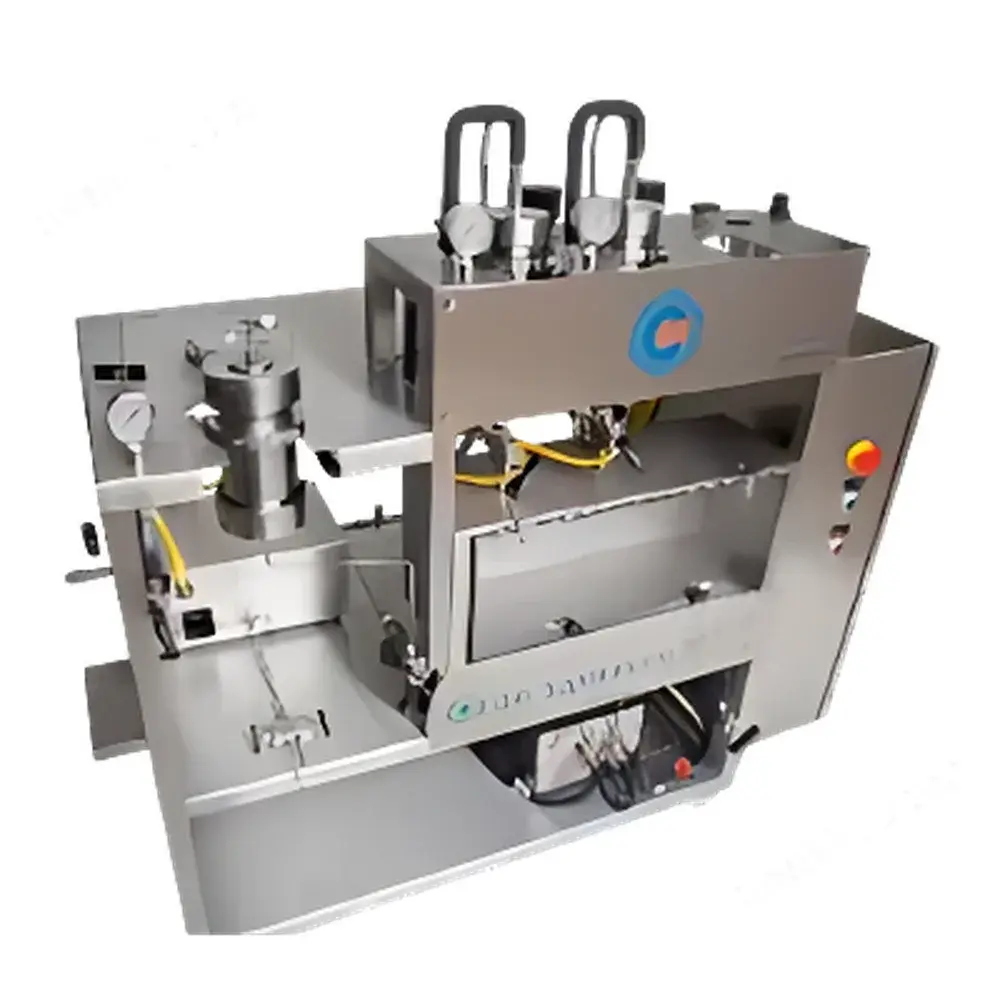
Core Separations Extraction Series Supercritical Fluid Extraction System
| Brand | Core Separations |
|---|---|
| Origin | USA |
| Manufacturer Type | Authorized Distributor |
| Product Origin | Imported |
| Model | Extraction Series |
| Price Range | USD 210,000 – 280,000 (FOB) |
| Max Temperature | 150 °C |
| Extraction Vessel Volume | 10 L |
| Max Operating Pressure | 1000 bar |
| CO₂ Mass Flow Rate | up to 1000 g/min |
| Co-solvent Pump Pressure | 689 bar |
| Flow Rate Range | 5–1000 g/min |
| Heating Method | Electric (supercritical mode) or Thermal Fluid (subcritical mode) |
| Collection Configurations | Direct solvent collection, liquid cryo-trap, cold trap (−80 °C), solid-phase extraction cartridge |
| Separation Stages | Standard single-stage cyclonic separation |
Overview
The Core Separations Extraction Series Supercritical Fluid Extraction (SFE) System is an engineered platform for precision separation and purification using supercritical and subcritical carbon dioxide as the primary solvent. Based on the thermodynamic principle that CO₂ above its critical point (31.1 °C, 73.8 bar) exhibits tunable solvation power—controllable via pressure and temperature—the system enables selective extraction of target analytes from complex matrices such as botanicals, polymers, foodstuffs, and pharmaceutical intermediates. Designed for both laboratory-scale method development and pilot-scale process validation, the system operates across a validated range of 5–1000 g/min mass flow, supporting continuous or batch-mode operation under fully programmable thermal and pressure profiles. Its modular architecture allows seamless transition from R&D to scalable process optimization without revalidation of core fluid dynamics.
Key Features
- High-pressure stainless-steel extraction vessel (up to 10 L volume) rated for continuous operation at 1000 bar and 150 °C, with real-time internal temperature monitoring via immersed Pt100 sensors
- Dual-mode thermal management: electric-resistive heating for supercritical applications; external thermal-fluid circulation for subcritical or low-temperature extractions requiring precise cooling control
- CO₂ delivery system featuring a high-efficiency, oil-free reciprocating pump with integrated active cooling cavity to maintain consistent density and prevent pump cavitation
- Co-solvent injection module capable of delivering polar modifiers (e.g., ethanol, methanol) at pressures up to 689 bar, enabling polarity tuning of the supercritical phase for enhanced solubility of polar compounds
- Cyclonic separation technology with configurable pressure gradients across up to three sequential collection stages, facilitating fractionated recovery based on volatility and polarity differences
- Flexible product recovery options including ambient solvent collection, liquid nitrogen-cooled traps (−196 °C), mechanical cold traps (−80 °C), and inline solid-phase extraction cartridges for direct capture of thermally labile fractions
Sample Compatibility & Compliance
The system accommodates diverse sample forms—including dried plant material, ground seeds, polymer pellets, spent catalysts, and lyophilized biologics—within standardized extraction baskets or custom-fitted liners. All wetted components comply with ASTM A276 Type 316 stainless steel specifications and are electropolished to Ra ≤ 0.4 µm for cleanability and corrosion resistance. The control architecture supports 21 CFR Part 11-compliant electronic records and signatures when paired with validated software configurations. Process parameters—including pressure, temperature, flow rate, and time—are logged with timestamped audit trails meeting GLP and GMP documentation requirements. System design aligns with ISO 14001 environmental guidelines through closed-loop CO₂ recovery integration (optional).
Software & Data Management
Control and monitoring are executed via a dedicated Windows-based HMI with deterministic real-time OS kernel, offering synchronized logging of all analog and digital I/O channels at 10 Hz resolution. The interface supports user-defined extraction protocols with up to 99 step sequences, each specifying ramp rates, dwell times, and interlock conditions. Data export formats include CSV, XML, and PDF reports compliant with LIMS integration standards. Optional add-ons include remote diagnostics via TLS-encrypted MQTT protocol, automated calibration verification logs, and third-party SCADA compatibility (OPC UA 1.04). All firmware updates undergo FMEA-reviewed release validation prior to deployment.
Applications
- Phytochemical isolation: selective extraction of cannabinoids, terpenes, and flavonoids from Cannabis sativa biomass with minimal thermal degradation
- Food-grade decaffeination and lipid removal from coffee, tea, and cocoa while preserving volatile aroma compounds
- Pharmaceutical impurity profiling: removal of residual solvents or catalysts from API crystallization batches
- Polymer processing: extraction of unreacted monomers or plasticizers from synthetic elastomers and thermoplastics
- Environmental remediation research: recovery of PAHs and PCBs from contaminated soils and sediments under non-oxidizing conditions
- Microencapsulation precursor preparation: generation of solvent-free, micronized actives for subsequent spray-drying or supercritical antisolvent (SAS) processing
FAQ
What is the maximum allowable operating pressure for long-term continuous use?
The system is certified for continuous operation at 1000 bar per ASME BPVC Section VIII Div. 3, with pressure transducers calibrated annually to NIST-traceable standards.
Can the system be integrated with existing CO₂ recycling infrastructure?
Yes—standardized flange interfaces (ANSI B16.5 Class 2500) and optional CO₂ condensation/recompression modules enable direct coupling with third-party recovery skids.
Is validation documentation provided for GMP environments?
Factory acceptance test (FAT) reports, IQ/OQ templates, and DQ support packages are included; PQ execution requires site-specific risk assessment per ICH Q5A and USP <1058>.
How is temperature uniformity maintained inside the 10 L extraction vessel?
A dual-zone electric heating jacket with independent PID loops and internal thermocouple feedback ensures ±0.5 °C spatial uniformity across the vessel cross-section during steady-state operation.
Does the co-solvent pump support gradient elution protocols?
Yes—the syringe-type co-solvent pump accepts programmable flow profiles synchronized with main CO₂ flow, enabling dynamic polarity modulation during extraction runs.



