
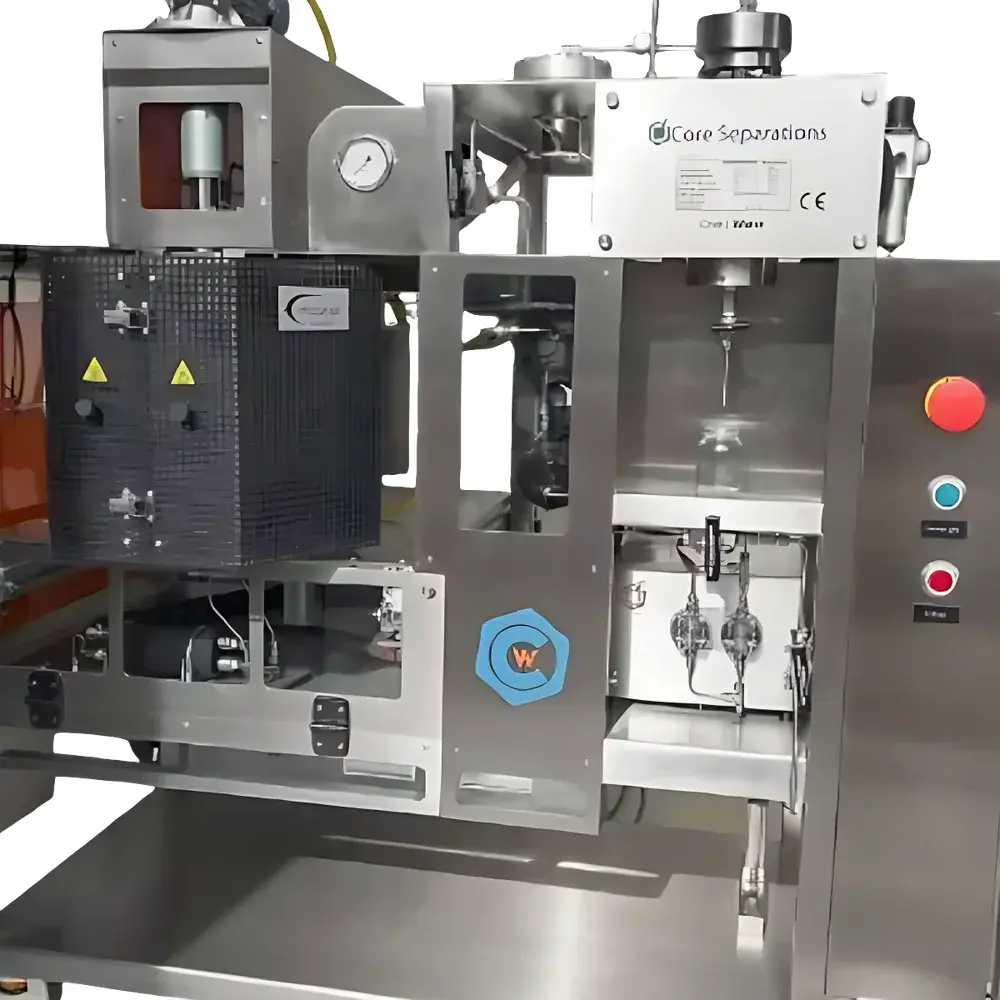
Core Separations Subcritical Water Extraction System
| Brand | Core Separations |
|---|---|
| Origin | USA |
| Manufacturer Type | Authorized Distributor |
| Product Origin | Imported |
| Model | Subcritical Water Extraction System |
| Price Range | USD 70,000 – 140,000 |
| Max Temperature | 400 °C |
| Max Pressure | 550 bar |
| Flow Rate Range | 5–200 g/min |
Overview
The Core Separations Subcritical Water Extraction System is a precision-engineered bench-scale platform designed for controlled extraction, hydrolysis, and reaction chemistry under subcritical aqueous conditions (100–374 °C, 10–550 bar). Unlike conventional solvent-based or supercritical CO₂ systems, this instrument leverages the tunable physicochemical properties of water near its critical point—where dielectric constant, density, and solvation power decrease significantly—to selectively extract polar and semi-polar analytes (e.g., polyphenols, alkaloids, flavonoids, organic acids) from complex matrices such as plant biomass, food waste, pharmaceutical residues, and environmental solids. The system operates on a continuous-flow principle with optional batch-mode capability, enabling both kinetic studies and scalable process development. Its core architecture integrates a high-integrity Inconel 625 reactor vessel, furnace-type resistive heating with dual-zone thermal zoning, and integrated pressure regulation via back-pressure control valves compliant with ASME B31.3 piping standards.
Key Features
- Inconel 625 construction throughout wetted components—including reactor, tubing, fittings, and heat exchangers—for exceptional resistance to chloride-induced stress corrosion cracking and oxidation at elevated temperature/pressure.
- Furnace-enclosed reactor design with independent upper/lower zone temperature control (±0.5 °C stability), eliminating direct heater contact and enhancing thermal uniformity and operator safety.
- Continuous-flow operation at 5–200 g/min mass flow rate, supported by high-accuracy gravimetric feed control and real-time density compensation.
- Integrated cryogenic cold trap (−40 °C) with liquid nitrogen or mechanical cooling, enabling efficient condensation of vapor-phase water and selective recovery of non-volatile extracts.
- Top-mounted magnetic or mechanical stirrer (optional) for enhanced solid–liquid mass transfer during heterogeneous extractions.
- Intermittent (batch) mode with zero-flow pressure hold capability—maintaining setpoint pressure for up to 120 min without flow—ideal for static soaking or time-resolved reaction profiling.
- Automated fraction collector with programmable trigger logic (time-, pressure-, or temperature-based), supporting unattended operation and GLP-compliant sample archiving.
Sample Compatibility & Compliance
The system accommodates solid, semi-solid, and slurry samples up to 1 L reactor volume, including ground botanicals, algae pellets, spent coffee grounds, municipal compost, and polymer composites. It complies with ASTM D8193–21 (Standard Guide for Subcritical Water Extraction of Organic Compounds from Solid Matrices) and supports method development aligned with ISO 17025-accredited laboratories. All pressure-containing components are certified to PED 2014/68/EU and ASME Section VIII Div. 1. Data integrity meets FDA 21 CFR Part 11 requirements when used with validated software configurations, including electronic signatures, audit trails, and user access controls.
Software & Data Management
The embedded control interface (Windows-based HMI) provides real-time monitoring of temperature, pressure, flow rate, and valve positions via calibrated transducers (0.1% FS accuracy). Process parameters are logged at user-defined intervals (100 ms–10 s) and exported in CSV or HDF5 format for downstream analysis in MATLAB, Python (Pandas), or ChemStation. Optional LabVIEW-compatible drivers enable integration into larger automation frameworks. All raw data files include embedded metadata (operator ID, timestamp, method name, calibration certificate IDs) to support traceability in GMP/GLP environments.
Applications
- Green extraction of thermolabile phytochemicals from herbs and spices without organic solvents.
- Depolymerization of lignocellulosic biomass for platform chemical recovery (e.g., levulinic acid, furfural).
- Decontamination and recovery of metals or organics from contaminated soils and sediments.
- Accelerated solvent-free hydrolysis of glycosidic bonds in natural product isolation.
- Method development for regulatory submission (e.g., EPA Method 3545A adaptation, USP ).
- Reaction engineering studies of Maillard products, caramelization intermediates, or peptide cleavage kinetics.
FAQ
What distinguishes subcritical water extraction from supercritical CO₂ extraction?
Subcritical water offers higher polarity and hydrogen-bonding capacity than scCO₂, making it superior for extracting polar compounds (e.g., polyphenols, amino acids) without co-solvents. It also avoids post-processing solvent removal steps.
Can the system operate below 100 °C?
Yes—the system supports ambient-to-400 °C operation, enabling low-temperature leaching protocols and comparative studies across aqueous phase regimes.
Is validation documentation available for GMP environments?
Yes—IQ/OQ/PQ protocols, material certifications (EN 10204 3.1), and transducer calibration certificates are provided upon request.
What maintenance is required for long-term reliability?
Routine inspection of O-rings (Inconel-clad graphite), periodic verification of pressure transducer drift, and annual furnace thermocouple recalibration per ISO/IEC 17025 guidelines.



