
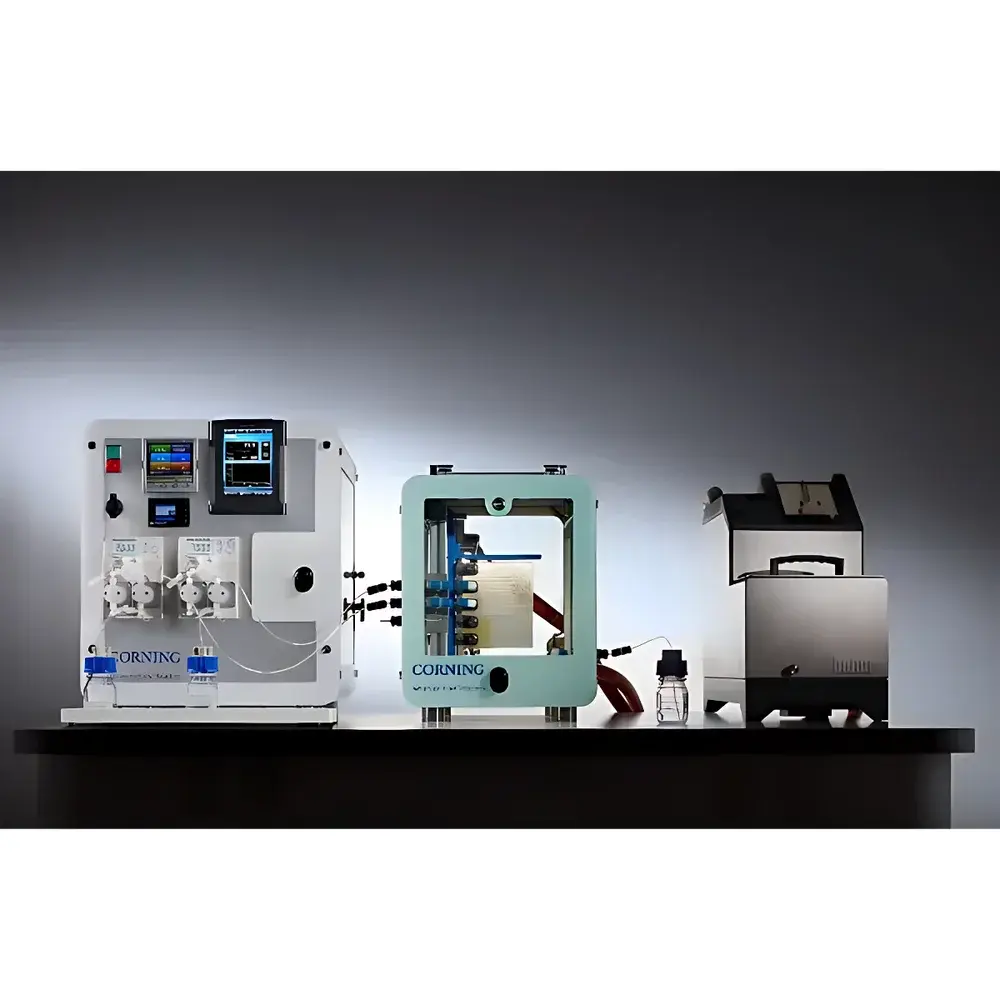
Corning AFR Lab Microchannel Continuous Flow Reactor
| Brand | Corning |
|---|---|
| Origin | USA |
| Model | Corning AFR Lab Microchannel Continuous Flow Reactor |
| Operating Flow Rate | 0–10 mL/min |
| Temperature Range | –40 °C to 200 °C |
| Maximum Operating Pressure | 0–18 bar (gauge) |
| Construction Materials | Specialty glass, PFA, PETE, perfluoroelastomer |
| Reaction Module Volume | 2.7 mL per module |
| Light Source Options | 6 selectable LED wavelengths, irradiance ≥100 mW/cm², dual-side uniform illumination, liquid-cooled, wireless intensity/wavelength control |
| Thermal Management | Integrated portable temperature controller, rapid thermal equilibration |
| Fluid Inlets | 1 gas + 2 or 3 liquid inlets with back-pressure regulation |
| Compliance | Metal-free fluid path, plug-and-play architecture, seamless interoperability with Corning AFR Series reactors |
Overview
The Corning AFR Lab Microchannel Continuous Flow Reactor is an engineered platform for safe, scalable, and highly reproducible flow chemistry research. Based on Corning’s proprietary “heart-shaped” microchannel geometry, the system leverages laminar flow dynamics and enhanced interfacial contact to achieve superior heat transfer coefficients and multiphase mixing efficiency—critical for exothermic, photochemical, or gas–liquid reactions. Unlike batch systems, this reactor operates under precisely controlled residence time, temperature, pressure, and irradiation conditions, enabling quantitative kinetic profiling and robust process parameter mapping. Its fully transparent specialty glass construction allows real-time visual monitoring of phase behavior, precipitation, or bubble formation without compromising chemical resistance. Designed for laboratory-scale reaction screening and mechanistic studies, the AFR Lab integrates seamlessly into established continuous processing workflows while eliminating scale-up artifacts commonly observed between lab and pilot-scale equipment.
Key Features
- Patented heart-shaped microchannel architecture ensures uniform shear distribution, minimized channel clogging, and high surface-area-to-volume ratio for rapid thermal equilibration.
- Metal-free fluidic path constructed from chemically inert specialty glass, PFA, PETE, and perfluoroelastomer seals—compatible with strong acids, bases, halogens, and organometallic reagents.
- Integrated portable temperature controller enables precise setpoint stability (±0.5 °C) across the full operating range (–40 °C to 200 °C), with sub-minute thermal response time.
- Modular design supports interchangeable reaction modules (2.7 mL internal volume each), facilitating rapid method development and parallel experimentation.
- Configurable inlet manifold accommodates one gas stream and two or three independent liquid streams, each with mass-flow or syringe-pump compatibility and individual back-pressure regulation (0–18 bar gauge).
- Optimized optical interface for photoreactions: six independently addressable LED light sources (wavelengths spanning UV-A to visible red), delivering ≥100 mW/cm² irradiance with uniform bilateral illumination and active liquid cooling for extended diode lifetime.
Sample Compatibility & Compliance
The AFR Lab is validated for use with organic solvents (e.g., THF, DMF, acetonitrile), aqueous media, corrosive reagents (e.g., HCl, HF, Cl₂ solutions), and reactive intermediates (e.g., diazo compounds, nitrenes). Its all-glass/PFA wetted path complies with USP Class VI and ISO 10993-5 biocompatibility requirements for extractables testing. The system supports GLP-compliant operation through timestamped, tamper-evident data logging (including temperature, pressure, flow rate, and LED output parameters), meeting audit-trail requirements per FDA 21 CFR Part 11 when paired with validated software. No metallic components contact process fluids—ensuring trace-metal-free synthesis essential for pharmaceutical API development and catalyst studies.
Software & Data Management
The reactor operates via a vendor-provided control interface supporting real-time monitoring and automated sequence execution. All operational parameters—including flow rates, temperature profiles, pressure feedback, and LED settings—are logged at user-defined intervals (100 ms resolution minimum) and exported in CSV or HDF5 format for downstream analysis in MATLAB, Python, or commercial kinetic modeling tools. Data files include embedded metadata (operator ID, timestamp, module serial number, calibration certificate references) to support regulatory submissions. Optional integration with LIMS platforms is available via OPC UA or RESTful API endpoints. Firmware updates are delivered through secure, signed packages compliant with IEC 62443-3-3 cybersecurity guidelines.
Applications
- Kinetic optimization of cross-coupling reactions (Suzuki, Heck, Buchwald–Hartwig) under controlled stoichiometry and residence time.
- Photochemical C–H functionalization using tunable narrow-band LED irradiation and millisecond-level photon exposure control.
- Nanoparticle synthesis (e.g., quantum dots, metal oxides) with narrow size distribution via precise supersaturation management.
- High-pressure hydrogenation and ozonolysis with integrated gas–liquid mass transfer enhancement.
- Process safety evaluation of energetic transformations (e.g., nitrations, diazotizations) using sub-milliliter holdup volume and rapid quench capability.
- Method transfer validation between AFR Lab and Corning’s larger-scale AFR Pilot or AFR Production systems—demonstrating consistent conversion, selectivity, and impurity profiles per ICH Q5C principles.
FAQ
Is the AFR Lab compatible with standard HPLC tubing and fittings?
Yes—it accepts 1/16″ OD PTFE, PFA, or stainless-steel tubing with standard VCR or Swagelok®-compatible compression fittings. Adapters for 1/8″ and microbore configurations are available as optional accessories.
Can multiple AFR Lab modules be operated in series or parallel?
Yes—the modular manifold design supports both configurations via external T-junctions or custom manifolds; residence time distribution is preserved in series mode due to matched channel geometry and low dispersion characteristics.
Does the system support automated reagent switching during a single run?
Yes—when integrated with third-party multi-channel syringe pumps or valve-based selector modules, programmable reagent sequencing is fully supported through the digital control interface.
What maintenance is required for long-term LED performance?
LED modules undergo factory-calibrated aging compensation; routine verification involves annual irradiance mapping using a NIST-traceable photodiode sensor—no user-serviceable parts require replacement under normal operation.
How is temperature uniformity verified across the microchannel network?
Each reactor module is qualified via IR thermography and embedded Pt100 sensor mapping during manufacturing; temperature gradients remain ≤0.3 °C across the active reaction zone under steady-state conditions at 150 °C.
Related Products



