
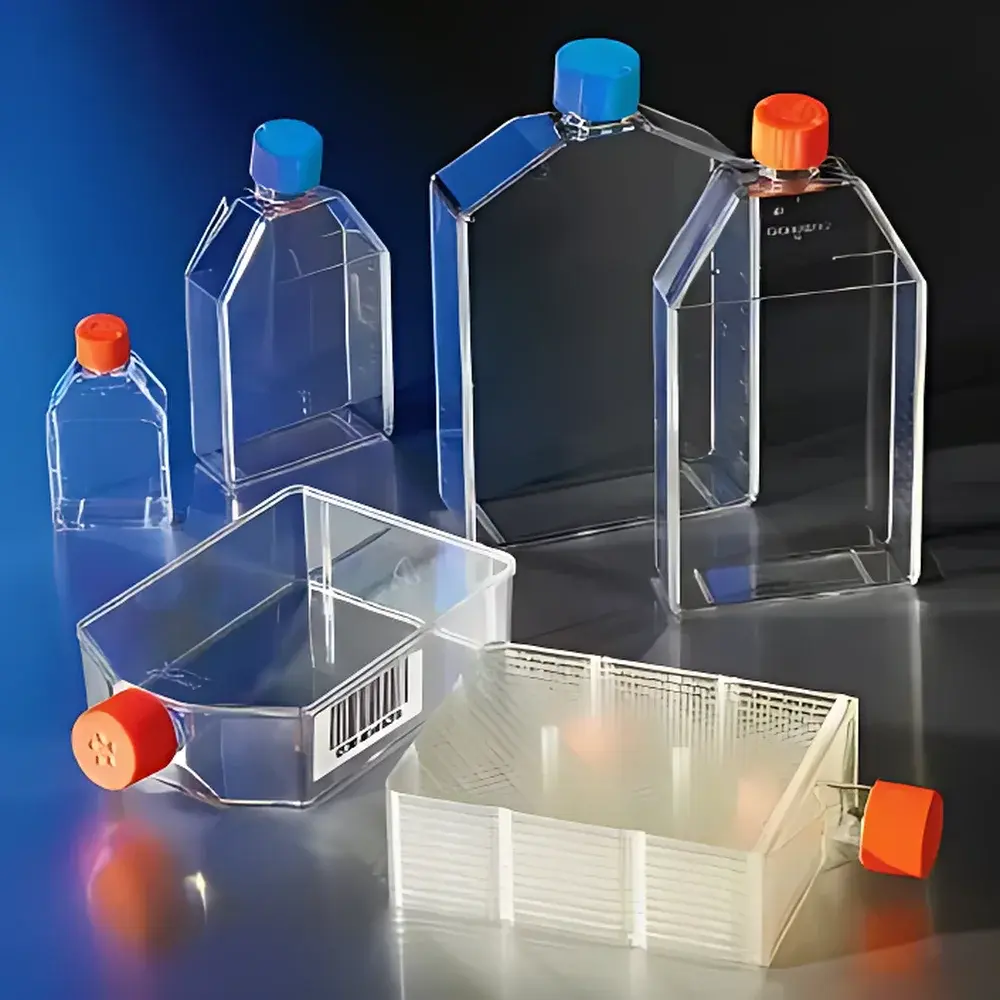
Corning Cell Culture Roller Bottles
| Brand | Corning |
|---|---|
| Origin | USA |
| Manufacturer Type | Authorized Distributor |
| Product Origin | Imported |
| Model | Cell Culture Roller Bottles |
| Pricing | Available Upon Request |
Overview
Corning Cell Culture Roller Bottles are precision-engineered cylindrical vessels designed for scalable, serum-dependent or serum-free adherent cell culture under controlled rotation. Unlike static flasks, these bottles operate on the principle of continuous, low-shear rotational motion—typically mounted on a roller drum platform—to maximize surface-area-to-volume ratio and ensure uniform nutrient/gas exchange across the entire inner surface. This hydrodynamic environment promotes consistent cell monolayer formation, enhances metabolic homogeneity, and supports high-density expansion of sensitive primary cells, hybridomas, and stem cell lines. The bottles are manufactured to meet stringent bioprocessing requirements for reproducible, scalable suspension-adapted or surface-adherent culture workflows in both R&D and cGMP-aligned production environments.
Key Features
- CellBIND® Surface Technology: Proprietary covalently bound hydrophilic polymer layer increases surface wettability and significantly improves initial cell attachment kinetics and spatial uniformity—critical for clonal selection and assay reproducibility.
- Ultra-Low Attachment (ULA) Option: Select variants feature a covalently grafted hydrogel coating that minimizes non-specific protein adsorption, cell adhesion, and immune activation—ideal for 3D spheroid formation, exosome harvesting, and suspension-adapted line maintenance.
- Optically Clear, Medical-Grade Polystyrene: Molded from USP Class VI-certified virgin polystyrene with exceptional clarity (≥92% transmittance at 550 nm), enabling real-time microscopic monitoring without vessel removal.
- Validated Sterility & Endotoxin Control: Each bottle undergoes terminal gamma irradiation (25–35 kGy) and is certified sterile (ISO 11137) and non-pyrogenic (<0.03 EU/mL, LAL test per USP <85>).
- Full Traceability & Quality Assurance: Indelible batch-number laser etching on the bottle base enables full lot-level traceability; 100% integrity testing performed via pressure decay method (ASTM F2096) prior to release.
- Consistent Surface Treatment: Plasma discharge modification ensures batch-to-batch reproducibility in surface energy (42–45 mN/m), eliminating variability in cell seeding efficiency across production runs.
Sample Compatibility & Compliance
These roller bottles support a broad spectrum of mammalian cell types—including CHO, HEK293, Vero, MRC-5, and human mesenchymal stem cells—with validated performance in both DMEM/F12 and chemically defined media formulations. They comply with ISO 5725 (accuracy and precision of measurement methods), ISO 13485 (medical device quality management), and are compatible with FDA 21 CFR Part 11–enabled electronic batch records when integrated into automated bioreactor control systems. All materials are REACH-compliant and free of phthalates, BPA, and heavy metals (tested per ICH Q3D).
Software & Data Management
While the bottles themselves are passive consumables, they are fully interoperable with industry-standard bioprocess software platforms—including Sartorius Biostat®控制系统, Thermo Fisher Unity™, and Emerson DeltaV—when used in conjunction with programmable roller drums equipped with torque feedback, RPM logging, and temperature ramp profiling. Batch records generated during roller culture include timestamped rotation speed, duration, ambient CO2, and incubator humidity metadata—supporting GLP/GMP audit readiness and full ALCOA+ data integrity principles (Attributable, Legible, Contemporaneous, Original, Accurate, Complete, Consistent, Enduring, Available).
Applications
- Large-scale production of monoclonal antibodies and viral vectors (AAV, lentivirus)
- Primary neuron and cardiomyocyte differentiation under shear-reduced conditions
- High-yield harvest of extracellular vesicles and exosomes
- Pre-clinical toxicology studies requiring metabolically stable cell layers
- Biobanking of cryopreserved adherent cell stocks with minimal phenotypic drift
- Development of 3D tumor spheroids for drug penetration assays
FAQ
Are Corning roller bottles suitable for use in CO2 incubators?
Yes—bottles are rated for continuous operation at 37°C and 5% CO2; vented caps with 0.2 µm PTFE membranes ensure gas exchange while preventing contamination.
Can these bottles be reused after sterilization?
No—they are single-use, disposable devices validated only for one culture cycle; re-sterilization compromises surface chemistry and structural integrity.
What cap options are available?
Standard configurations include vented (0.2 µm filter) and non-vented closures; custom cap threading (e.g., GL45) is available upon request for integration with liquid handling systems.
Do you provide certificates of analysis (CoA) and conformance (CoC)?
Yes—each shipment includes lot-specific CoA (sterility, endotoxin, extractables, surface energy) and ISO 13485 CoC compliant with EU MDR Annex II requirements.
How should bottles be stored prior to use?
Store unopened at 15–25°C in original packaging; avoid direct sunlight and high-humidity environments to preserve surface functionality.
Related Products






