
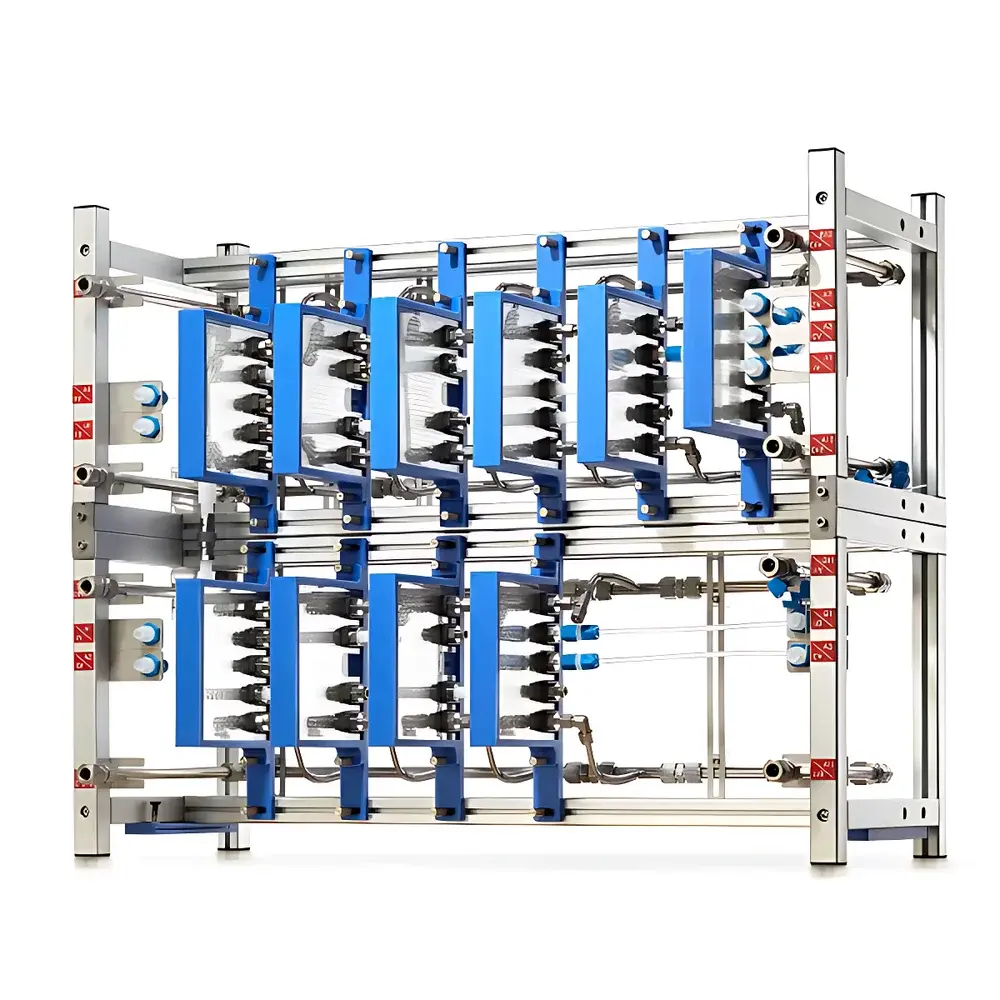
Corning G1 Glass Reactor
| Brand | Corning |
|---|---|
| Origin | USA |
| Model | G1 Glass Reactor |
| Flow Rate Range | 15–250 mL/min |
| Operating Temperature | −60 °C to 200 °C |
| Maximum Inlet Pressure (gauge) | 18 bar |
| Material Compatibility | All-glass fluidic path (HF, F₂, and molten alkali above 150 °C excluded) |
| Thermal Management | Dual-zone integrated heat exchange plates (top & bottom) |
| Residence Time | 5.0 s at 100 mL/min |
| Configurability | Standalone or series-connected dual-G1 operation |
| Compliance | Designed for GLP-compliant process development and scalable continuous manufacturing |
Overview
The Corning G1 Glass Reactor is a chemically inert, all-glass continuous flow reactor engineered for precision-controlled synthesis under demanding thermal, pressure, and corrosive conditions. Based on Corning’s proprietary microstructured glass architecture, the G1 employs laminar-flow-enhanced mixing and highly efficient conductive heat transfer across integrated borosilicate glass heat exchange plates. Its core design principle leverages controlled residence time distribution (RTD) and uniform thermal boundary conditions—critical for reproducible kinetic studies, exothermic reaction management, and phase-sensitive transformations such as heterogeneous catalysis, photochemical activation, and gas–liquid–solid multiphase reactions. Unlike metal or polymer-based flow reactors, the G1 eliminates leachable metals and surface adsorption artifacts, making it especially suitable for organometallic chemistry, pharmaceutical intermediate synthesis, and high-purity fine chemical production where trace contamination must be avoided.
Key Features
- All-borosilicate-glass fluidic pathway ensures exceptional chemical resistance—compatible with strong acids (except hydrofluoric acid), oxidizers (e.g., HNO₃, H₂O₂), and bases up to 150 °C (excluding molten alkali and elemental fluorine).
- Dual independent thermal zones enabled by top- and bottom-mounted heat exchange plates support precise axial temperature gradients—enabling staged reaction control (e.g., initiation at elevated T, quenching at lower T).
- Modular configuration: A single G1 unit operates standalone; two units may be connected in series without additional manifolding to extend residence time or cascade multi-step transformations.
- Rated for continuous operation from −60 °C to +200 °C and inlet pressures up to 18 bar (gauge), validated per ASME B31.3 process piping guidelines for laboratory-scale deployment.
- Optimized channel geometry delivers narrow residence time distribution (RTD) with coefficient of variation <12% at nominal flow rates—essential for kinetic modeling and scale-up fidelity.
- Compatible with standard Swagelok® 1/4″ and 3/8″ compression fittings; no wetted elastomers or metallic seals required in base configuration.
Sample Compatibility & Compliance
The G1 reactor accommodates homogeneous solutions, slurries, emulsions, and gas–liquid mixtures—including O₂-, Cl₂-, and H₂-saturated streams—without clogging or performance drift. Its absence of metal contact surfaces eliminates catalytic side reactions and metal ion leaching, satisfying ICH Q5C and USP / elemental impurity requirements for API synthesis. The system supports ASTM E2500-13 (risk-based approach to verification) and aligns with FDA’s Process Validation Guidance (Stage 2: Process Qualification). When integrated into a validated continuous manufacturing train, the G1 contributes to 21 CFR Part 11–compliant data integrity when paired with compliant SCADA or DCS platforms recording flow, temperature, and pressure timestamps.
Software & Data Management
While the G1 itself is a passive hardware module, it is routinely deployed with third-party pump controllers (e.g., Watson-Marlow 323Du, ISMATEC IPC) and digital temperature controllers (Eurotherm 2408, Watlow F4T) featuring Modbus RTU/TCP or EtherNet/IP interfaces. Process parameters—including real-time flow rate, zone-specific temperatures, and inlet pressure—are logged via OPC UA–enabled historians (e.g., Ignition SCADA, Siemens Desigo CC). Audit trails, electronic signatures, and alarm management follow ALCOA+ principles when implemented within a validated infrastructure meeting GMP Annex 11 and EU GMP Annex 15 expectations.
Applications
- Rapid screening of reaction parameters (temperature, stoichiometry, residence time) for Grignard, lithiation, nitration, halogenation, and diazotization sequences.
- Safe handling of highly exothermic nitrations and hydrogenations using distributed thermal control—avoiding hot-spot formation observed in batch vessels.
- Photochemical synthesis under UV–Vis irradiation (with optional quartz window integration) due to optical clarity and UV-transmission stability of borosilicate glass.
- Multi-step telescoped synthesis—e.g., imine formation followed by asymmetric reduction—using two G1 units in series with intermediate workup or quench modules.
- Production of kilogram quantities of reference standards and clinical trial materials under documented, repeatable conditions aligned with ICH M7 and Q7.
FAQ
Can the G1 reactor handle solid-containing slurries?
Yes—its trapezoidal microchannel geometry and minimum hydraulic diameter of 1.2 mm prevent particle bridging for solids loading ≤15 wt% and d₅₀ < 50 µm.
Is the G1 compatible with supercritical CO₂ or ozone?
It has been successfully operated with scCO₂ up to 120 °C / 150 bar and ozone concentrations ≤12 wt% in aqueous systems; full compatibility requires material compatibility review per NIST SRD-106.
What validation documentation is provided?
Corning supplies Factory Acceptance Test (FAT) reports including dimensional inspection, pressure test records (1.5× MAWP, hydrostatic), and thermal mapping data. Installation Qualification (IQ) templates are available upon request.
How does the G1 compare to stainless-steel or PFA coil reactors?
Unlike metallic reactors, the G1 avoids catalytic decomposition and metal leaching; unlike polymer reactors, it maintains dimensional stability and solvent resistance across wide T/P ranges—particularly critical for chlorinated solvents and strong oxidizers.
Can residence time be extended beyond 5 seconds without hardware modification?
Yes—by reducing flow rate within the 15–250 mL/min operating envelope or connecting multiple G1 units in series; residence time scales linearly with total active volume and inversely with volumetric flow rate.



