
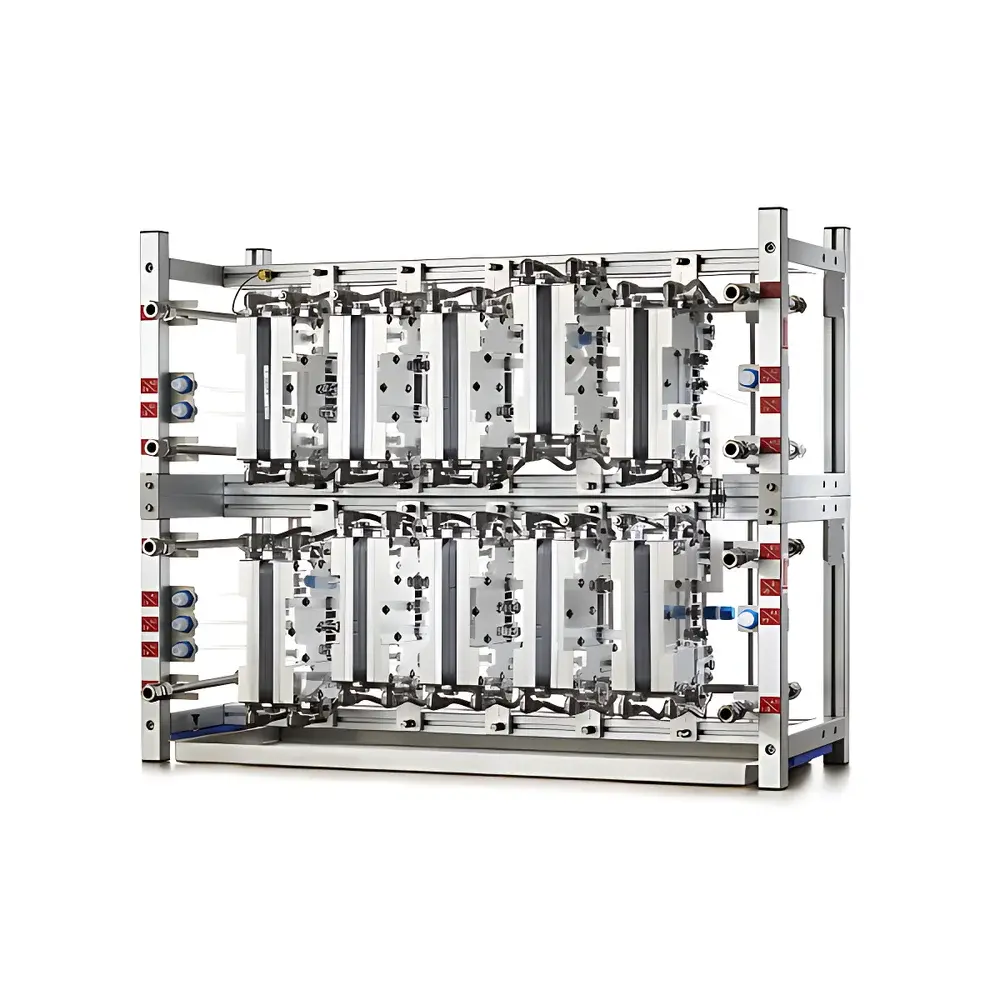
Corning G1 Silicon Carbide Microchannel Reactor
| Brand | Corning |
|---|---|
| Origin | France |
| Model | G1 SiC |
| Reactor Type | Microchannel Reactor |
| Internal Volume per Module | 8.2 mL |
| Operating Pressure | Up to 18 bar (gauge) |
| Temperature Range | –60 °C to 200 °C |
| Material | Silicon Carbide (SiC) Reaction Channels, Aluminum Heat Exchange Blocks, PFA Tubing, Perfluoroelastomer (FFKM) Gaskets |
| Chemical Resistance | Full compatibility with hydrofluoric acid (HF) and concentrated alkalis at elevated temperatures |
| Flow Rate Range | 15–250 mL/min |
| Vacuum Capability | Up to 1.8 MPa (absolute) |
Overview
The Corning G1 Silicon Carbide (SiC) Microchannel Reactor is an engineered continuous-flow platform designed for high-precision, scalable chemical synthesis under demanding thermal, pressure, and corrosive conditions. Built upon Corning’s proprietary microstructured silicon carbide ceramic architecture, the G1 SiC reactor operates on the principle of intensified mass and heat transfer within precisely defined microchannels—enabling exceptional temperature control (< ±0.5 °C), rapid mixing (millisecond residence time distribution), and near-isothermal reaction profiles. Unlike conventional batch reactors or glass-based microreactors, the SiC construction delivers intrinsic mechanical robustness and chemical inertness across extreme pH ranges (pH 0–14), including full compatibility with anhydrous HF and molten alkali hydroxides at temperatures up to 200 °C. Its modular design supports seamless integration into existing laboratory flow chemistry infrastructure and serves as a direct technological bridge from lab-scale process development (G1) to pilot- and production-scale systems (G4), eliminating traditional scale-up risks such as thermal runaway, concentration gradients, or residence time dispersion.
Key Features
- Silicon carbide (SiC) microchannel plates providing unparalleled corrosion resistance—validated for long-term exposure to HF, hot concentrated NaOH/KOH, chlorosulfonic acid, and other aggressive reagents.
- Modular architecture: Interchangeable G1 SiC modules can be physically and hydraulically coupled with Corning’s G1 borosilicate glass modules—retaining optical transparency for in-line UV/Vis monitoring and photochemical activation while enabling sequential reaction-quenching steps in a single integrated flow path.
- Integrated aluminum heat exchange blocks with precision-machined thermal interfaces ensure uniform heat flux distribution across the entire active channel length, supporting exothermic reactions up to 200 °C with cooling capacity down to –60 °C.
- True metal-free fluidic path: All wetted surfaces consist exclusively of SiC, PFA, and FFKM—eliminating catalytic leaching, ion contamination, or surface passivation issues common in stainless-steel or Hastelloy systems.
- Rated for continuous operation at up to 18 bar (gauge) and vacuum conditions down to 1.8 MPa (absolute), enabling high-pressure hydrogenations, supercritical CO₂ reactions, and low-pressure distillative separations within the same platform.
Sample Compatibility & Compliance
The G1 SiC reactor accommodates a broad spectrum of organic, inorganic, and organometallic chemistries—including lithiations, nitrations, diazotizations, fluorinations, and Grignard additions—without degradation of channel integrity or performance drift over extended runs (>500 h cumulative operation). Its material certification aligns with ASTM C651 (SiC ceramics), ISO 10993-5 (biocompatibility screening), and USP Class VI requirements for extractables profiling. The system meets GLP-compliant documentation standards when paired with validated flow controllers and data acquisition hardware; full traceability—including pressure, temperature, flow rate, and time-stamped event logs—is achievable under FDA 21 CFR Part 11–compliant software environments.
Software & Data Management
While the G1 SiC reactor itself is a hardware platform without embedded firmware, it is fully compatible with third-party industrial-grade flow control ecosystems—including Bronkhorst EL-FLOW Select mass flow controllers, Syrris Asia automated pumps, and NI LabVIEW or MATLAB-based custom DAQ architectures. Real-time synchronization of pressure transducers (0.1% FS accuracy), PT100 sensors (±0.15 °C), and inline IR/UV spectrometers enables closed-loop process control and dynamic parameter adjustment. Audit trails, electronic signatures, and raw data export (CSV, HDF5) are supported through compliant SCADA extensions, satisfying ICH Q7 and ASTM E2500 validation frameworks for pharmaceutical process development.
Applications
- High-yield, low-impurity synthesis of APIs requiring strict stoichiometric control and thermal management (e.g., nitro-to-amine reductions, asymmetric epoxidations).
- Safe handling of energetic intermediates—diazonium salts, acyl nitrates, and peroxides—via precise residence time confinement and immediate quenching in downstream SiC segments.
- Continuous photochemistry using upstream G1 glass modules (for irradiation) followed by rapid thermal deactivation in SiC zones—minimizing photodegradation side products.
- Catalyst screening under reproducible laminar flow conditions, with parallel module configurations enabling 4–8 simultaneous reaction conditions per unit footprint.
- Process intensification of multi-step sequences (e.g., protection–reaction–deprotection) without intermediate isolation—reducing solvent use by >60% versus batch equivalents.
FAQ
Can the G1 SiC reactor be used with hydrofluoric acid (HF)?
Yes—the silicon carbide channels exhibit no measurable etching or structural degradation after continuous exposure to 48% aqueous HF at 80 °C for >100 hours.
Is there a pathway to scale from G1 to production volumes?
Yes—Corning’s G-series architecture maintains identical channel geometry and thermal boundary conditions from G1 (lab) through G4 (multi-kg/h); process parameters translate directly without re-optimization.
How is temperature controlled across the SiC module?
Via integrated aluminum heat exchange blocks with dual-zone PID control; coolant channels are thermally decoupled from reaction channels to prevent cross-contamination and ensure ±0.3 °C stability.
Does the system support automation and regulatory compliance?
Yes—when interfaced with validated flow instrumentation and compliant software, the platform supports 21 CFR Part 11 audit trails, electronic signatures, and IQ/OQ/PQ documentation packages.
What is the maximum allowable pressure differential across a single G1 SiC module?
The rated pressure limit is 18 bar (gauge) at 200 °C; pressure drop across a single module at 250 mL/min (water, 25 °C) is typically <0.8 bar.
Related Products



